As an Amazon Associate, Akermin earns from qualifying purchases. Product links on this page are affiliate links.
A gas detector, in the sense a homeowner means it, is a fixed alarm mounted in one room that sounds when natural gas or propane reaches its sensor. A multi-gas detector is a battery-powered personal monitor that a worker clips to a collar or belt before entering a tank, manhole, vault, silo or tight crawlspace, and it typically reads four things at once: combustible gas as percent LEL, oxygen, carbon monoxide and hydrogen sulfide. If you want to know whether a leak has started in the kitchen while you sleep, you want the first. If you are about to climb into a space where the air itself may be unsafe, you want the second. Owning one does not cover you for the other.
What Each Device Is Built to Answer
A home gas alarm answers one question, continuously, in one place: has enough combustible gas collected here to be worth an alarm? It is mounted high for natural gas or low for propane, powered from an outlet or a battery, and set to trip at a fraction of the lower explosive limit so that the warning comes well before the air can ignite. It never moves and it never needs a person to read it.
A multi-gas monitor answers a different question, on demand, wherever the wearer goes: is this atmosphere safe to enter and stay in? That means combustible gas, but it also means whether there is enough oxygen, whether carbon monoxide has built up from an engine or a fire, and whether hydrogen sulfide from sewage or decay is present. Each of those can be lethal on its own with no flammable gas anywhere. The monitor is worn, checked before each use, and expected to be calibrated on a schedule. The multi-gas detector overview covers the category in detail.
Side by Side
| Item | Home gas detector | Multi-gas detector |
|---|---|---|
| Where it lives | Fixed to a wall in the room with the gas appliance | Clipped to a person; goes where they go |
| Power | Outlet, hardwired or long-life battery; runs around the clock | Rechargeable pack rated in hours of use |
| What it reads | Natural gas or propane, sometimes both, sometimes plus CO | Combustible gas as percent LEL, oxygen, CO, hydrogen sulfide |
| Readout | Alarm tone; some models show a ppm figure or the word GAS | Live numbers for every channel, with alarm records on some units |
| Alarm logic | Fixed setpoint, commonly 10 to 25 percent LEL | Setpoints per channel, adjustable within manufacturer limits |
| Upkeep | Test button; replace at end of sensor life | Bump test before use, periodic calibration with certified gas |
| Listing | UL 1484 for residential gas detectors; UL 2034 for the CO half of a combination unit | Hazardous-location and performance certifications stated by the manufacturer |
Different Sensors for Different Jobs
Most plug-in home alarms and pocket sniffers rely on a heated semiconductor element that responds to low concentrations of many gases. Industrial combustible channels more often use a catalytic bead sensor that reads percent LEL in a fairly linear way, or an infrared sensor where oxygen may be absent. The toxic channels and the oxygen channel are electrochemical cells, the same family of sensor that a household CO alarm uses. That is why a home combustible gas alarm ignores carbon monoxide and a CO alarm ignores methane; the gas detector versus CO detector comparison goes into that split, and what gases a combustible gas detector detects lists what the combustible sensor alone will and will not respond to.
A Consumer-Priced Four-Gas Unit as an Example
The TopTes Guard-101 shows what a multi-gas monitor looks like at the entry level. The manufacturer specifies detection of hydrogen sulfide, carbon monoxide, combustible gas as LEL and oxygen; a battery life of up to 14 hours; LED, vibration and sound alarms that respond within 0.5 seconds and continue until the reading returns to normal; alarm record storage; a password to prevent accidental changes to settings; and an ABS housing the listing describes as waterproof, dustproof and explosion-proof. It ships with a gas hood, which is the fitting you place over the sensors when flowing calibration gas. Compare that to a Kidde plug-in combination alarm, which the manufacturer describes as detecting explosive gas and CO, showing a CO level or the word GAS on its display, and sounding at 85 decibels. One is an instrument you maintain; the other is an appliance you install and test.
When a Homeowner Actually Needs a Multi-Gas Monitor
Rarely, and the cases are specific: entering a septic tank, a manure pit, a well pit, a boat bilge that has been closed for months, a sealed crawlspace with a history of sewer gas, or any space where an engine or generator has been running. In every one of those, oxygen and toxic gas matter more than flammability, and a combustible-only sniffer would say nothing useful. For that kind of entry, a four-gas unit that has been bump-tested that day is the minimum, and for anything beyond a brief look, professional confined-space procedures apply. How to choose a multi-gas detector walks through the specifications.
For the ordinary house, the answer is the other way around: a fixed alarm in each room with a gas appliance, and a handheld sniffer for tracing fittings. The gas leak detector guide covers both, and the combustible gas detector roundup focuses on the fixed alarms.
What Neither Device Replaces
A monitor on a belt or an alarm on a wall gives you earlier warning; neither changes the response. If you smell gas or an alarm sounds in the house, leave, keep your hands off switches and appliances on the way out, and call the gas utility or 911 once you are outside. In a confined space the equivalent is simpler still: an alarm means get out, and nobody goes back in until the air has been re-tested.
Recommended Tools
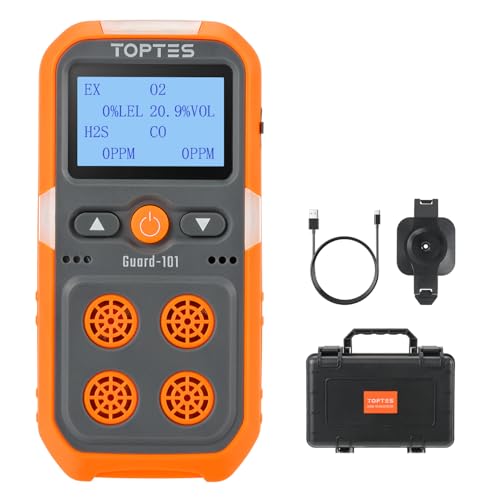
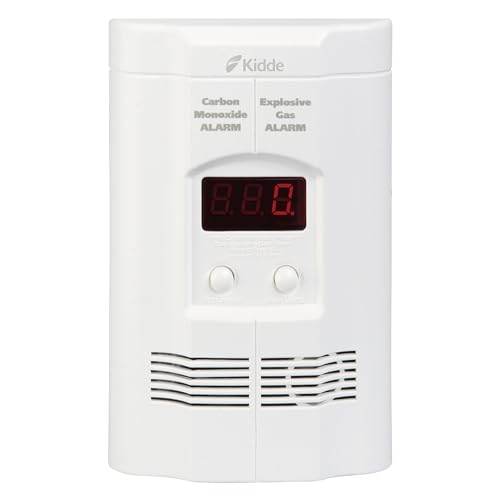

Products shown because their documented specifications fit this guide. Price and availability are on Amazon and can change.
Frequently Asked Questions
Can I use a four-gas monitor as a home gas alarm?
You can switch one on in a kitchen, but it is a poor fit. It runs on a battery rated in hours, so it is off most of the time; it is built to be worn, not mounted; it expects regular bump tests and calibration; and its combustible channel is scaled against a reference gas rather than tuned for one household fuel. A fixed alarm plugs in and runs continuously with none of that upkeep.
Does a multi-gas detector detect natural gas?
Its combustible channel responds to methane and to other flammable gases, reporting the result as percent of the lower explosive limit. It is normally calibrated to one reference gas, and the manufacturer publishes how it responds to others. It tells you how close the air is to ignitable, not which gas is present.
What does the O2 channel on a multi-gas monitor do?
It reads the oxygen content of the air and alarms when oxygen is too low to breathe safely or high enough to make fire more likely. That is a confined-space hazard that no home gas alarm addresses, and it is the main reason confined-space entry uses a four-gas unit rather than a combustible-only sniffer.
Is a combination gas and CO alarm a multi-gas detector?
Not in the sense the industry uses the term. A combination alarm holds two sensors for two household hazards and mounts on a wall. A multi-gas detector is a portable monitor carrying three or four sensors, worn by a person, and it is the standard tool for confined-space entry.
Affiliate disclosure: Akermin earns a commission from qualifying Amazon purchases made through links on this page. Our editorial picks are based on documented specifications and owner feedback, not commissions.
Related Guides

WiFi Natural Gas Alarm Review: One Unit Reveals the Whole Design
A WiFi natural gas alarm with an LCD showing gas concentration status and temperature, a stated response within 30 seconds, an alarm of at least 85 decibels and notifications to a phone app.
Read More→
Forensics Detectors Cl2 Review: 5 Percent of Full Scale Is 2.5 ppm
A rechargeable chlorine detector with an electrochemical sensor reading 0 to 50 ppm at 0.1 ppm resolution, a response time under 30 seconds, adjustable audible, visual and vibrating alarms and a supplied calibration certificate.
Read More→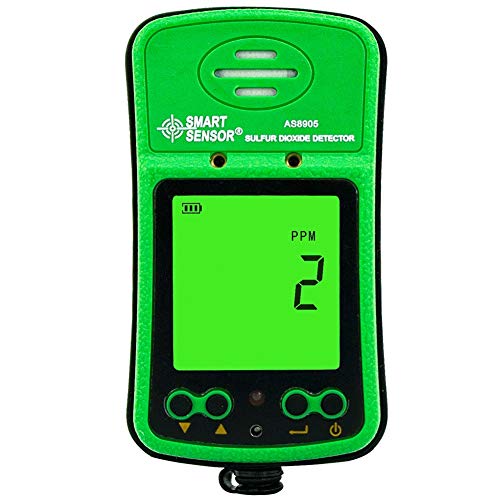
Smart Sensor SO2 Detector Review: 0.1 ppm Steps, No Accuracy Figure
A clip on sulfur dioxide monitor built on an electrochemical sensor, reading 0 to 20 ppm in 0.1 ppm steps, with adjustable high and low alarms signalled by sound, flash and vibration and a rechargeable cell quoted at 8 to 9 hours.
Read More→