The Short Answer
A gas leak detector and a carbon monoxide detector watch for two unrelated hazards, and neither can do the other one’s job. A gas leak detector senses unburned fuel, meaning methane in natural gas or propane and butane in LPG, before it reaches a concentration that could ignite. A carbon monoxide detector senses the poisonous byproduct of fuel that has already burned incompletely. If your home has any gas appliance, you need CO coverage without question, and a gas leak detector is a sensible addition. If the two seem interchangeable, that confusion is the reason combination alarms exist, and it is worth ten minutes to understand what each sensor actually responds to.
Two Hazards, Two Chemistries
Natural gas and propane are fuels. The danger is fire and explosion rather than poisoning: methane and propane are not toxic at the concentrations found in a leaking room, although a very large leak can displace oxygen. The risk becomes real when the concentration climbs toward the lower explosive limit, about 5 percent by volume for methane and about 2.1 percent for propane, and a spark or flame is present. Utilities add mercaptan odorant so that a leak announces itself with a rotten-egg smell long before it approaches that level.
Carbon monoxide is what a furnace, water heater, range or generator produces when combustion is incomplete. It has no odor, no color and no taste, and it mixes with room air roughly evenly rather than layering at the ceiling or the floor. Exposure causes headache, nausea and confusion, and at high concentrations it kills. There is no smell to warn you, which is why CO alarms are required in most US homes with fuel-burning appliances while gas leak detectors usually are not.
Side by Side
| Item | Gas leak detector | Carbon monoxide detector |
|---|---|---|
| What it senses | Unburned fuel gas (methane, propane, butane) | Carbon monoxide from incomplete combustion |
| Nature of the hazard | Fire and explosion | Poisoning |
| Where the gas collects | Ceiling (natural gas) or floor (propane) | Mixes evenly through the room |
| Sensor | Heated semiconductor or catalytic element | Electrochemical cell |
| US standard | UL 1484 | UL 2034 |
| Alarm basis | Fixed fraction of the lower explosive limit | Concentration weighted by exposure time |
| Warning from your senses | Rotten-egg odorant | None |
| Typically required by code | Rarely | Widely, in homes with fuel-burning appliances |
Why One Sensor Cannot Cover Both
The electrochemical cell in a CO alarm is built to react with carbon monoxide and produce a current proportional to its concentration. Methane and propane do not react in that cell, so a CO alarm sits silent in a room filling with natural gas. The reverse is also true: the heated element in a combustible gas detector responds to flammable vapor, and CO at the levels that harm people is far below anything a combustible sensor is designed to flag. A combination alarm solves this by putting two separate sensors in one housing, each with its own alarm logic. Our page on whether a CO detector detects natural gas goes through the common misreadings of alarm labels, and gas detector sensor types explains the hardware itself.
How Each One Decides to Alarm
A CO alarm certified to UL 2034 uses a time-weighted approach: a low concentration must persist for a long period before the horn sounds, while a high concentration triggers quickly. This is deliberate. It avoids nuisance alarms from brief events such as a car starting in an attached garage, and it mirrors how CO harms the body, by accumulating. Some models add an earlier low-level warning pattern for vulnerable occupants; the listing for the Kidde COPDLG states that this alerts in the 30 to 70 ppm range, with a separate pattern at 70 ppm.
A combustible gas alarm has no reason to wait. Fuel concentration is an immediate ignition risk, so the alarm is set to a fixed fraction of the LEL, commonly somewhere between 10 and 25 percent LEL depending on the standard and the product. The Safe T Alert propane alarms sold for RVs, for example, list activation below 25 percent LEL. A fixed gas alarm therefore reacts as soon as gas reaches the sensor at that level, and the way that threshold is expressed is covered in what LEL means on a gas detector.
Placement Differs Too
Because CO mixes evenly, a CO alarm can go at outlet height, on a shelf or on a wall, ideally where it can be heard from bedrooms. A natural gas detector belongs high on the wall near the ceiling in the room with the appliance; a propane detector belongs low, near the floor. A combination plug-in alarm is a compromise: it sits at outlet height, which suits the CO sensor and is a middle position for the gas sensor. The manufacturer’s instructions for the specific model decide whether that compromise is acceptable for your fuel, and that trade-off is weighed model by model in the best gas leak detectors guide.
What to Buy
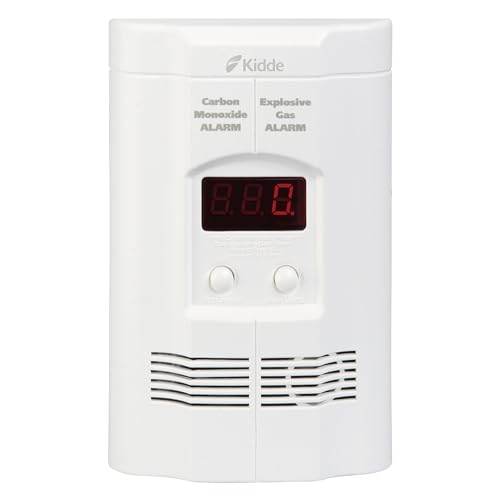
- Home with gas appliances and no gas alarm yet: a combination CO and explosive gas alarm near the kitchen or utility room is the simplest single purchase. The Kidde plug-in with 9V backup shows a CO number on its display and the word GAS when combustible gas is present.
- Home that already has CO alarms: add a dedicated combustible gas alarm mounted for your fuel. The best combustible gas detectors roundup covers the dedicated units, including plug-in models such as the Orabal that show a live ppm reading.
- Someone who wants a CO number rather than an alarm: that is a CO meter, a different instrument, explained in CO meter vs CO alarm.
Whatever you install, treat the detectors as an early-warning layer rather than the plan. The plan for a gas smell is unchanged by any device: get everyone outside, leave light switches, appliances and phones alone until you are out, and call the gas utility or 911 from a safe distance. The background on the gas side of this comparison is in what a combustible gas detector is.
Recommended Tools


Products shown because their documented specifications fit this guide. Price and availability are on Amazon and can change.
Frequently Asked Questions
Can one device cover both a gas leak and carbon monoxide?
Yes, a combination explosive gas and CO alarm contains two separate sensors in one housing, each with its own alarm logic. Check the label for both UL 1484 and UL 2034, and check that its mounting position suits your fuel.
Does a gas leak produce carbon monoxide?
No. A leak releases unburned fuel, which contains no carbon monoxide. CO is produced when fuel burns with too little air, for example in a dirty furnace or a blocked flue. The two problems can occur independently.
If my home is all-electric, do I need either one?
A CO alarm is still worth having if you have an attached garage, a fireplace or ever run a generator. A combustible gas detector has nothing to detect in a home with no gas supply and no propane appliances.
Will a gas detector sound for carbon monoxide?
No. Combustible gas sensors are built to respond to flammable vapor at a fraction of the explosive limit, which is far above the concentrations at which CO poisons people. Only an electrochemical CO sensor covers that hazard.
Affiliate disclosure: Akermin earns a commission from qualifying Amazon purchases made through links on this page. Our editorial picks are based on documented specifications and owner feedback, not commissions.
Related Guides
Does a Carbon Monoxide Detector Detect Natural Gas?
No. A CO detector cannot sense natural gas, propane or methane, and a smoke detector cannot either. Only a combustible gas sensor responds to a fuel leak.
Read More→
Best Gas Leak Detectors for the Kitchen
Where to put a gas alarm in a kitchen so it catches a range leak without false alarms, and which plug-in and sniffer models fit.
Read More→
Best Gas Leak Detectors for RVs and Campers
12V propane and dual LP/CO alarms rated for RV temperatures, compared on trip point, current draw, mounting and replacement dates.
Read More→