As an Amazon Associate, Akermin earns from qualifying purchases. Product links on this page are affiliate links.
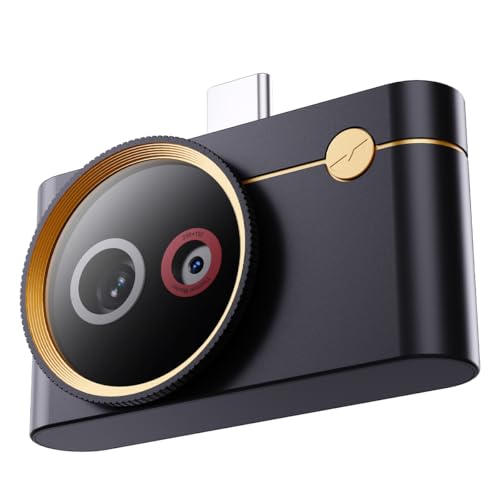
Thermal Master · Thermal Master P4 Thermal Camera for Android w/Dual Lens & 35mK Sensitivity
View on AmazonPrice and availability are shown on Amazon and can change at any time.
The P4 is an Android phone attachment with a 256 x 192 detector, upscaled in software to 512 x 384, a stated NETD below 35 mK, 25 Hz refresh, a 56.0 by 42.2 degree field of view, plus or minus 3.6 F accuracy across minus 4 F to 1112 F, and no battery of its own. The listing deserves credit for stating the native and upscaled figures side by side. Once you read it that way, the sensitivity figure rather than the resolution is the reason to consider it.
The listing tells you the truth about its own headline
Super resolution is the most misleading phrase in consumer thermal imaging. A detector of 256 by 192 elements is fed through an interpolation step and the result is presented as 512 by 384, a figure four times larger, with no hint that three quarters of those pixels were calculated rather than measured.
This listing does not play that game. It states 256 x 192 IR resolution upscaled to 512 x 384 Super Resolution, in one phrase, with the relationship explicit. That is worth saying out loud because it is rare, and because it lets a buyer make an informed comparison instead of an accidental one.
The practical consequence is that this camera should be compared against other 256 by 192 units, not against cameras with genuinely larger detectors. Against a native 320 by 240 standalone it has fewer real pixels. Where it competes is elsewhere.
Sensitivity is where it actually wins
The listing states NETD below 35 mK and claims this detects subtle temperature differences better than many entry level thermal cameras. That claim is supportable on the number alone, because plenty of cameras in this bracket publish 50 mK or more and plenty publish nothing at all.
Thirty five thousandths of a degree is a fine discrimination, and it is the specification that decides whether the problems people actually hire a thermal camera for show up. Consider what is being looked for. A damp patch behind plaster is perhaps half a degree cooler than the wall around it because evaporation is cooling it. A missing batt of insulation might read one degree different. A cold bridge at a floor junction may be less. None of these are hot spots. They are faint, broad, low contrast features.
Against a large faint feature, resolution barely matters, because the feature covers hundreds of pixels either way. Sensitivity is everything, because the difference between the feature and its surroundings is small enough to sink into detector noise. At 35 mK it does not sink. That is a coherent argument for this camera, and it is stronger than anything the resolution figure could support.
The wide field of view is a choice, not a bonus
The listing states a 56.0 by 42.2 degree field of view and pairs it with hotspot tracking for quickly scanning large areas and locating the hottest point.
Wide is genuinely faster for survey work. Fewer frames to cover a wall, less walking backwards, less stitching together in your head. But a field of view is a division problem. The same 49,152 detector elements spread across a wider angle means each element covers more of the target, so at a given distance a wide lens resolves less detail than a narrow one.
That makes this a building and panel sweeping instrument rather than a fine detail instrument. The listing also mentions PCB inspection, and it is fair to be sceptical about that pairing: a 56 degree lens is the opposite of what circuit board work wants. For close small targets the relevant capability is a macro or narrow lens, which the listing mentions only as dual lens without specifying a second field of view. The Android attachment comparison shows which units publish a macro figure.
IR Eraser and the interpretation problem
The first bullet describes a feature called IR Eraser, where swiping the screen reveals heat areas, so you pinpoint where the issue is rather than only that it exists.
Behind the branding this is a visible and thermal blend you control by dragging. It matters more than it sounds. A pure thermal image of a wall is an abstract cloud with no landmarks, and the single most common mistake with a thermal camera is misidentifying what you are looking at. Being able to slide the visible image in and out tells you that the warm stripe is the pipe run and not a damp trace.
It changes no temperature. Like MSX on other cameras it is an interpretation aid, and interpretation errors are a bigger practical risk than measurement errors for most users.
The specification set
| Specification | Published in the listing |
|---|---|
| Native detector | 256 x 192 |
| Upscaled output | 512 x 384 Super Resolution |
| Thermal sensitivity | NETD below 35 mK |
| Accuracy | Plus or minus 3.6 F |
| Temperature range | Minus 4 F to 1112 F |
| Refresh rate | 25 Hz |
| Field of view | 56.0 by 42.2 degrees |
| Digital zoom | 15 times |
| Power | From the phone, up to five hours, no battery |
| Emissivity adjustment | Not stated in the listing bullets |
| Radiometric file format | Not stated in the listing bullets |
| Second lens field of view | Not stated in the listing bullets |
Two notes on what is absent. Emissivity adjustment is not mentioned, and without it bare metal reads far colder than it is, which limits electrical work on unpainted busbars. And 15 times digital zoom is a number that should be read with the resolution above it: zooming a 256 by 192 detector fifteen times magnifies pixels, not detail.
The right and wrong buyer
This suits someone doing building fabric work on Android: damp, insulation, cold bridges, underfloor heating runs, HVAC. The sensitivity figure is the strongest thing in the listing and it is aimed exactly at those faint, broad temperature differences. No battery to manage is a real convenience on a long day.
It is the wrong tool for fine electronics despite the listing mentioning PCB work, because a 56 degree lens and a 256 by 192 detector are not a close detail combination. It is also the wrong tool if you need emissivity control for bare metal, or radiometric files in a named format for someone else’s software. For those, the honest answer is that this listing does not make the claim.
Recommended Tools


Products shown because their documented specifications fit this guide. Price and availability are on Amazon and can change.
Frequently Asked Questions
Is it 256 by 192 or 512 by 384?
Both figures are in the listing and it is clear about the relationship: 256 x 192 IR resolution upscaled to 512 x 384 Super Resolution. The detector has 49,152 elements. The larger figure is what the software produces from them. Credit where it is due, the listing states this plainly rather than printing only the big number.
Does upscaling help at all?
It helps the picture and not the measurement. Interpolation smooths the blocky edges between detector elements, which genuinely makes an image easier to interpret and nicer to put in a report. It cannot reveal a hot component smaller than one detector element, because no information about it was ever captured. Judge spatial capability on 256 by 192.
Why does NETD below 35 mK matter more here?
Because it is the specification where this unit is strong rather than average. NETD is the smallest temperature difference the detector can separate from its own noise, and below 35 mK is a good figure at this level. For finding damp, insulation gaps and cold bridges, where the difference is fractions of a degree over a large area, sensitivity does more work than resolution.
What does the field of view figure tell me?
The listing states 56.0 by 42.2 degrees, which is wide. A wide field covers a whole wall or panel in one frame, so you sweep faster. The trade is that the same 256 by 192 elements are spread over more area, so each pixel covers a larger patch of the target and small objects get smaller. Wide is right for building sweeps, narrow is right for circuit boards.
Does having no battery matter?
It changes the failure mode. The listing states it is powered directly by the phone with no battery required and up to five hours of continuous use. Nothing to charge separately and nothing to find flat. Against that, it drains the phone you also need for photographs and calls, and it cannot be used at all if the phone is dead or the port is occupied.
Affiliate disclosure: Akermin earns a commission from qualifying Amazon purchases made through links on this page. Our editorial picks are based on documented specifications and owner feedback, not commissions.