Skip to content
AkerminMeasure. Monitor. Improve. Compare Products

Best Multimeters for Marine Electrical Systems: 6 Picks

A boat's electrical system is a 12 volt DC system that lives in salt air, so the instrument you choose has to answer a different question than a household meter does. You are usually chasing voltage drop, a corroded terminal, or a slow drain, not checking a wall outlet. This page separates the handheld meters you carry to a fault from the sealed panel gauges you leave installed.

  • Independent Research
  • Verified Specifications
  • Honest Recommendations

Measure It
Compare It
Buy Once

As an Amazon Associate, Akermin earns from qualifying purchases. Product links on this page are affiliate links.

Our Top Picks

This comparison was assembled from the manufacturer listings supplied for each product. No laboratory testing was performed and no measurements of our own are published. Where a listing does not state a figure, the table and the review say so rather than estimating.

Best overall handheld
Klein Tools MM420

Klein Tools MM420

Auto-ranging TRMS meter with lead-alert LEDs, the most complete diagnostic tool in this group.

  • Measures AC/DC voltage to 600V, 10A AC/DC current, 50 megohm resistance
  • Adds continuity, temperature, capacitance, frequency/duty cycle and diode test
  • Lead-alert LEDs illuminate to show correct test lead placement
  • Backlit LCD for low-light work in a bilge or engine bay
View on Amazon Read Full Review→
Best value handheld
AstroAI DM200M

AstroAI DM200M

True RMS handheld with ceramic fuses and a published CAT III 600V rating.

  • Measures AC/DC voltage, AC/DC current, resistance, continuity and diodes
  • Data hold, max value recording, 15-minute auto power off, low battery indicator
  • Two ceramic fuses: F250mA/250V and F10A/250V
  • Listing states it exceeds CAT III 600V safety standards
View on Amazon Read Full Review→
Best installed monitor
Blue Sea Systems 8248

Blue Sea Systems 8248

Panel-mount DC meter with high and low voltage alarms and a splashproof front.

  • Displays amperage from -500 to +500 Amps and voltage from 0 to 60 Volts in 0.01 Volt increments
  • High and low voltage audio and visual alarms
  • Three levels of display brightness
  • Splashproof front; standard meter operates in negative side of circuit only
View on Amazon Read Full Review→
Best for current without breaking the circuit
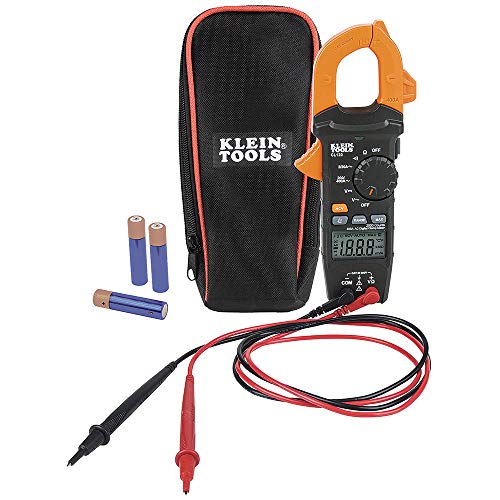
Klein Tools CL120

Klein Tools CL120

Clamp meter for AC current and non-contact voltage, with test-lead functions for DC voltage.

  • Measures AC current and non-contact voltage via the clamp
  • Measures AC/DC voltage, resistance and continuity via test leads
  • Non-contact voltage testing integrated into the clamp jaw
  • Backlit LCD for low-light conditions
View on Amazon Read Full Review→
Budget panel voltage monitor
Nilight LED Panel Voltmeter

Nilight LED Panel Voltmeter

Round panel-mount voltmeter with a twist-and-lock fitting and a green LED display.

  • Twist and lock design for simple installation
  • 3-digit green LED display for checking voltage and battery status
  • Fits cars, boats, ATVs, UTVs, motorcycles and trucks
  • 12VDC nominal
View on Amazon Read Full Review→
Sealed panel voltage monitor
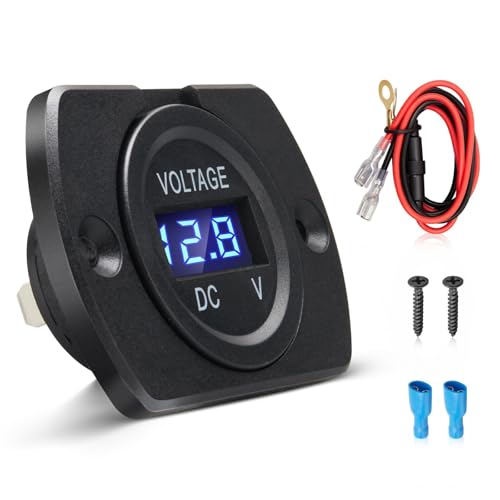
Anina Round Panel Voltmeter

Anina Round Panel Voltmeter

Waterproof round panel voltmeter with a blue LED display and a stated 0.1V accuracy.

  • Real-time LED voltmeter with a 6V to 30V readout range
  • Blue LED digits for day and night reading
  • Stated 0.1V accuracy
  • Waterproof and sealed design for boats, RVs and off-road use
View on Amazon Read Full Review→

Comparison Table

View Full Comparison→
PickTypeDC voltageDC currentAC currentResistanceContinuitySafety ratingWater resistance
Handheld DMMUp to 600VUp to 10AUp to 10AUp to 50 MOhmYesNot statedNot statedView
Handheld DMMNot statedUp to 10AUp to 10AYesYesCAT III 600V statedNot statedView
Panel meter0 to 60V, 0.01V resolution-500 to +500A via shuntNoNoNoNot statedSplashproof frontView
Clamp meterYes via leadsNoYes via clampYes via leadsYesNot statedNot statedView
Panel gauge12VDC nominalNoNoNoNoNot statedNot statedView
Panel gauge6V to 30V, 0.1V accuracyNoNoNoNoNot statedWaterproof statedView

Cells marked Not stated are absent from the manufacturer listing. The P6 clamp measures AC current only; it does not read DC current. The P1 standard unit operates in the negative side of the circuit only.

How to choose

Match the instrument to the job, not to the price.

Decide diagnostic or monitoring

A handheld meter finds faults; a panel gauge watches a battery. They are not interchangeable, and buying the wrong one wastes money.

Check the current path

Handheld meters measure current in series, which means breaking the circuit. A clamp meter avoids that but must be rated for DC if you want to read 12V loads.

Know your resolution needs

0.1V is fine for watching a battery bank. Voltage drop across a connection needs millivolt resolution, which only a handheld DMM provides.

Look for a safety rating

A published CAT rating tells you the meter is designed to survive transient overvoltages. If the listing does not state one, ask before you buy.

Plan for the environment

A splashproof front is not waterproof. If the gauge is in an exposed cockpit, choose a sealed unit or move the location.

Read the installation notes

Some panel meters require an external supply or a shunt shifter. Confirm what else you need before you start drilling holes.

Frequently Asked Questions

View All FAQs→
Can I use a household multimeter on a boat?

Electrically, yes, for basic 12V DC checks. The problem is the environment. A meter with no IP rating and no published CAT rating may survive a dry engine bay but will not tolerate spray or a drop into a bilge. If you keep it in a sealed case and only use it in dry conditions, a general-purpose handheld meter will do the job. If it lives on the boat, choose one with at least a splashproof front or a stated water resistance.

Why does my meter read 12.6V at the battery but 11.8V at the pump?

That is voltage drop, and it is the single most common marine electrical fault. The difference is lost across the wiring and connections between the battery and the load. A handheld DMM with millivolt resolution is the right tool to find it: measure from the battery positive to the pump positive, then from the pump negative to the battery negative, and the sum of those two readings is the drop. Panel gauges with 0.1V resolution are not fine enough for this.

Will a clamp meter read my 12V DC current?

Only if it is a DC clamp meter. The P6 clamp in this group measures AC current only, so it will not read your 12V loads. Many clamp meters look similar but differ in this one respect, so check the listing carefully before buying. If you need DC current without breaking the circuit, you need a clamp meter specifically rated for DC.

Do I need true RMS on a boat?

For pure DC work, no. True RMS matters when you are measuring AC with a non-sinusoidal waveform, which on a boat means shore power through an inverter or a charger. If you only ever check 12V DC, a averaging meter is adequate. If you also work on the AC side, true RMS is worth having.

Reviews

Klein Tools MM420

Klein Tools MM420 Best overall handheld

The MM420 is the pick that covers the widest range of marine fault-finding jobs with one instrument. Auto-ranging means you do not have to guess the correct range before probing a circuit, which matters when you are working in a cramped locker and cannot easily see the display while holding two probes. True RMS matters less on pure DC than on AC, but it becomes relevant when you are checking a shore power connection or an inverter output, where the waveform is not a clean sine wave. The lead-alert LEDs are a genuine safety feature: they tell you if the leads are in the wrong sockets for the function you have selected, which prevents the classic mistake of trying to measure voltage with the leads still in the current jacks. That mistake blows the internal fuse and, on a boat, often happens at the worst possible moment. The temperature function is useful for checking whether a connection or a charger is running hot, and capacitance is occasionally handy for testing a suspect motor start capacitor. The listing does not publish a CAT safety rating, an IP rating, or a DC accuracy figure, so if those matter to you, ask the manufacturer before buying.

Strengths

  • Auto-ranging and true RMS across a wide function set
  • Lead-alert LEDs reduce the risk of a blown fuse from wrong lead placement
  • Temperature and capacitance functions add diagnostic reach
  • Backlit display for dim engine compartments

Limitations

  • No CAT safety rating or IP rating published in the listing
  • No DC accuracy figure stated, so the precision on 12V readings is unknown
  • 10A current limit means it cannot measure heavy starter or windlass draw directly
  • Not a clamp meter, so current measurement requires breaking the circuit
View on Amazon
AstroAI DM200M

AstroAI DM200M Best value handheld

The DM200M is the meter to look at if you want true RMS and a stated safety category without moving up to a premium handheld. The CAT III 600V claim is the important one for marine work, because it tells you the meter is designed to survive transient overvoltages that can appear on a boat's AC shore circuit or on a DC system with a large inductive load switching. The ceramic fuses are a step up from glass fuses, which can shatter under a high-energy fault; ceramic bodies contain the arc. The data hold function is genuinely useful on a boat because you can take a reading in an awkward position and then read the display once you are upright. Max value recording helps you catch a voltage spike or a brief current surge that you would miss watching a live display. The 15-minute auto power off will save the battery, though it can be mildly annoying if you are mid-diagnosis. The listing does not publish a DC accuracy figure, an IP rating, or the exact voltage and current ranges beyond the fuse ratings, so treat the CAT III claim as the headline safety data point and ask for the rest.

Strengths

  • True RMS measurement at a value price point
  • Published CAT III 600V safety rating
  • Ceramic fuses rather than glass for better fault containment
  • Data hold and max value recording are useful in awkward positions

Limitations

  • No DC accuracy figure published
  • No IP or water resistance rating stated, so keep it dry
  • No temperature or capacitance function listed
  • 10A current limit, same as most handhelds in this class
View on Amazon
Blue Sea Systems 8248

Blue Sea Systems 8248 Best installed monitor

This is the only product in this group that is genuinely designed as a permanent marine instrument rather than a generic panel gauge. The 0.01 Volt resolution on a 0 to 60 Volt range is fine enough to watch a battery come up on charge and to spot the slow drift that tells you an alternator regulator is failing. The alarm function is the real differentiator: a high voltage alarm can warn you that a charger is overcharging and boiling your batteries, and a low voltage alarm can tell you that a fridge or a bilge pump has been running the bank down while you are ashore. Both are audio and visual, so you do not have to be staring at the display. The splashproof front is appropriate for a helm or a battery switch panel, though it is not described as fully waterproof. The critical limitation is in the listing itself: the standard meter operates in the negative side of the circuit only, and a Shunt Shifter is required for positive side installation such as alternators. That means if you want to measure alternator output, you need an additional part, and you need to understand your boat's grounding arrangement before you wire it in. The listing does not publish an accuracy figure for either the voltage or the current reading.

Strengths

  • Fine 0.01V resolution across a 0 to 60V range
  • High and low voltage alarms with both audio and visual indication
  • Splashproof front suits a helm or panel location
  • Wide current range of -500 to +500 Amps via shunt

Limitations

  • Standard unit works only in the negative side of the circuit
  • Shunt Shifter required for positive side installation such as alternators
  • No accuracy figure published for voltage or current
  • Splashproof, not waterproof, so not for an exposed cockpit location
View on Amazon
Klein Tools CL120

Klein Tools CL120 Best for current without breaking the circuit

The CL120 is included here because clamping around a conductor is the fastest way to check current without disconnecting anything, which on a boat is often the difference between a five-minute check and an hour of wrestling with a battery terminal. But read the listing carefully: the clamp measures AC current only. It will not read the DC current in your 12V circuits, which is most of what a marine electrical system does. What it will do is measure AC current on a shore power circuit, check AC and DC voltage through the test leads, and test continuity and resistance. The non-contact voltage function in the jaw is useful for quickly confirming whether an AC circuit is live before you touch it. For DC current on a boat, you would need a DC clamp meter, which this is not, or you would need to break the circuit and use a handheld meter in series. The listing does not publish a DC current range for the clamp, because there is not one. It also does not publish a CAT rating or an IP rating. Treat this as a complement to a handheld DMM, not a replacement for one.

Strengths

  • Clamp allows AC current measurement without breaking the circuit
  • Non-contact voltage detection in the jaw for quick live-circuit checks
  • AC/DC voltage, resistance and continuity via test leads
  • Backlit display

Limitations

  • Clamp measures AC current only, not DC, so it cannot read 12V loads
  • No CAT safety rating published
  • No IP rating published
  • Does not replace a handheld DMM for DC current work
View on Amazon
Nilight LED Panel Voltmeter

Nilight LED Panel Voltmeter Budget panel voltage monitor

This is a battery voltage monitor, not a diagnostic multimeter, and it should be judged on that basis. It gives you a constant, at-a-glance voltage reading at the panel, which is genuinely useful on a boat because it lets you see the bank state without digging out a handheld meter. The twist-and-lock mounting is a simple mechanical fitting that avoids a separate bezel or screws, which is a small but real convenience on a crowded panel. The green LED display is readable in most conditions, though the listing does not state a digit height or a brightness level. What it does not do is measure current, resistance, continuity, or anything else. It also does not publish an accuracy figure, so you cannot know whether a reading of 12.4V is actually 12.4V or 12.2V. The listing describes it as a voltmeter for checking voltage and battery status, and that is the honest scope. If you want to know whether your alternator is charging, this will show you the voltage rise, but it will not tell you the current going into the bank.

Strengths

  • Simple twist-and-lock panel mounting
  • Constant voltage readout at a glance
  • Green LED display readable in most light
  • Low cost relative to a full instrument

Limitations

  • Voltage only, no current, resistance or continuity
  • No accuracy figure published
  • No IP or waterproof rating stated
  • Not a substitute for a diagnostic meter
View on Amazon
Anina Round Panel Voltmeter

Anina Round Panel Voltmeter Sealed panel voltage monitor

The Anina is the panel gauge to choose if the location is exposed to spray or rain, because the listing states it is waterproof and sealed, which the other round gauges here do not. The 6V to 30V range covers both 12V and 24V systems, and the 0.1V accuracy figure is published, which is more than most of the budget panel gauges offer. On a boat, 0.1V resolution is enough to see a battery come up on charge and to spot a slow drain over a day or two, though it is not fine enough to measure voltage drop across a single connection with confidence. The blue LED is bright and readable at night, though some owners find blue harder on the eyes than red or green in a dark cabin. The listing does not state whether the display dims, so at night it may be brighter than you want. It is a voltage monitor only: no current, no alarms, no data logging. Treat it as a permanent battery state indicator, not a diagnostic tool.

Strengths

  • Waterproof and sealed, suitable for exposed locations
  • Stated 0.1V accuracy
  • 6V to 30V range covers 12V and 24V systems
  • Blue LED readable day and night

Limitations

  • Voltage only, no current or alarm function
  • No display dimming stated, may be bright at night
  • 0.1V resolution is not fine enough for voltage drop diagnosis
  • No data logging or history
View on Amazon

Buying Guide

Short answer: For fault finding on a boat, a handheld meter is what you need, and P3 (Klein Tools MM420) is the strongest all-round pick here because it is auto-ranging, true RMS, and covers voltage, current, resistance, continuity, temperature and capacitance in one instrument. P5 (AstroAI DM200M) is the value alternative if you want true RMS and a CAT III 600V rating for less, though it publishes fewer ranges. For current without breaking a circuit, P6 (Klein Tools CL120) clamps around a conductor, but note it measures AC current only, so it will not read your 12V DC loads. If you want a permanent readout at the helm or battery switch, P1 (Blue Sea Systems 8248) is the only true marine instrument in the panel group, with alarms and a splashproof front. The small round gauges (P7, P8) are battery voltage monitors, not diagnostic meters, and should be treated as such.

What a marine multimeter actually has to do

A boat’s DC system is not complicated in principle: a battery bank, a charging source, and a set of loads connected by wiring that is exposed to vibration, heat, and salt. What makes it different from a car or a house is the environment. Terminals corrode, connections loosen, and a fault that reads fine on a dry day can disappear or reappear with the motion of the hull. The instrument you choose has to be able to find a fault that is intermittent and to survive being carried into a damp locker. That is why the handheld meters on this page are the primary tools, and the panel gauges are secondary. A handheld meter lets you probe a connection while a load is running, which is the only way to measure voltage drop. A panel gauge lets you watch a battery over days, which is the only way to catch a slow drain. If you are new to the category, the general guide to multimeters covers the function set in more detail.

Voltage drop is the measurement that matters most

Most marine electrical problems are not failed components. They are resistance where there should be none: a corroded terminal, a loose crimp, a wire that is too thin for the run. The symptom is a load that runs slowly or a battery that seems to discharge faster than it should. The measurement that finds it is voltage drop. With the load running, you measure the voltage between the battery positive and the load positive, then between the load negative and the battery negative. The two readings added together are the voltage lost in the wiring. A good connection loses millivolts. A bad one loses volts. This is why resolution matters: a meter that reads to 0.1V, like the panel gauges here, cannot see a 50 millivolt drop that is enough to make a bilge pump sluggish. A handheld DMM with a millivolt range can. The same logic applies to galvanic issues, where a small stray current through a bonding system can eat an anode or a propeller in weeks. Finding that requires the same careful, low-resolution measurement.

Current measurement: series, clamp, or shunt

There are three ways to measure current on a boat, and each has a cost. The first is to break the circuit and put a handheld meter in series, which is accurate but requires you to disconnect a terminal, often in an awkward place. The second is to clamp around the conductor, which is fast and safe but only works if the clamp is rated for DC. Many clamp meters, including the P6 in this group, measure AC current only, so they are useful on the shore power side but not on the 12V side. The third is a permanent shunt, which is a calibrated resistance in the current path that produces a small voltage proportional to the current. The Blue Sea Systems meter here uses a shunt and can read from -500 to +500 Amps, which is enough to cover a starter motor or a windlass. The trade-off is installation complexity and the negative-side constraint noted in the listing. If you want to compare clamp options in more detail, see the guide to clamp meters.

Sealing, safety ratings, and the wet boat problem

A meter that lives on a boat has to tolerate moisture. The panel gauges here range from splashproof to waterproof, and the difference matters. A splashproof front, like the Blue Sea Systems unit, is fine at a helm that is under a dodger. A waterproof sealed unit, like the Anina, can go in an exposed cockpit or on a transom. The handheld meters are a different case: none of the listings here publish an IP rating, so the honest advice is to keep them in a dry case and not to leave them in a bilge. The other environmental factor is the safety rating. A CAT rating tells you the meter is designed to survive a transient overvoltage, which is a real risk on the AC side of a shore power system and on any DC circuit with a large inductive load. The AstroAI DM200M publishes a CAT III 600V rating; the other handhelds here do not publish one. If you work on both the AC and DC sides of a boat, that rating is worth having. For related work on the AC side, the guide to multimeters for electricians covers the higher-energy end of the category.

Where a multimeter stops being the right answer

A multimeter is a diagnostic tool. It tells you what is happening at the moment you touch the probes. It does not watch the system while you are asleep, and it does not alarm. If your problem is a battery that goes flat over a week, a handheld meter will only help you if you are there to use it. That is the point at which a permanent monitor, like the Blue Sea Systems unit with its high and low voltage alarms, becomes the right answer. Similarly, if your problem is a fault that only appears under load, a meter with a max-hold function can catch a brief event, but a data logger or a recording monitor is better. And if your problem is a smell of hot insulation or a burning smell, a multimeter is the wrong instrument entirely; you want a thermal camera, which the guide to thermal cameras for electrical inspection covers. The honest summary is that most boat owners need one good handheld meter and one permanent voltage monitor, and that combination covers the large majority of 12V faults. The rest is a matter of matching the instrument to the specific symptom you are chasing.

How We Research

This comparison was assembled from the manufacturer listings supplied for each product. No laboratory testing was performed and no measurements of our own are published. Where a listing does not state a figure, the table and the review say so rather than estimating. Products that did not genuinely belong to the topic of marine electrical systems were excluded: the AstroAI 2000-count meter (P2) and the two WATERWICH dual LED meters (P4 and P9) are vehicle battery monitors with no stated marine sealing or diagnostic function, and the MGI SpeedWare gauge (P10) and the two MICTUNING voltmeters (P11 and P12) are generic panel voltmeters that duplicate the function of the Nilight and Anina units already included. The remaining six are the instruments that a boat owner or marine technician would actually consider for 12V DC fault finding or permanent monitoring.

Read our full review methodology→