Best Multimeters for Electricians: 10 Professional Picks Built for Serious Work
An electrician needs three things from a meter that a hobbyist can do without: a published safety rating, True RMS on distorted waveforms, and a display that can be read at arm length in a badly lit riser. This hub compares ten instruments against those requirements and is direct about which ones fall short.
Independent Research
Verified Specifications
Honest Recommendations
CAT Before Counts
Leads Are Rated Too
Prove Dead Twice
As an Amazon Associate, Akermin earns from qualifying purchases. Product links on this page are affiliate links.
Our Top Picks
Ten instruments assessed against what trade work demands rather than what a specification sheet flatters. Only one item in this group publishes a CAT rating, and it is the test leads rather than a meter. That result is reported honestly below because it changes what you should buy. All figures come from the manufacturer listings and we ran no tests.
Best Overall
Digcreat XDM1041-DG Desktop Digital Multimeter
The only meter here that publishes an accuracy figure.
Sorted so the safety rating column tells the story. One item in this group publishes a CAT rating and it is the test leads. For live distribution work, buy a meter whose manufacturer publishes a CAT III or CAT IV rating at your working voltage.
How to Choose a Meter for Trade Work
The trade requirements are not the same as the hobby ones:
CAT Rating First
It limits where the meter may be used and it is about transient energy, not steady voltage. If the manufacturer does not publish one, the meter does not belong on supply-connected work.
True RMS as Standard
Drives, dimmers and switched-mode loads are everywhere in a modern installation. An average-responding meter reads low on them and gives no sign that it has.
An Accuracy Figure
Counts tell you how finely the display divides. Accuracy tells you whether the number is right. One listing in this group publishes one.
Readable in a Riser
Backlight, display size and a dual line readout decide whether you can take a measurement once instead of three times in a dark plant room.
Leads and Fusing
The meter and its leads are one system and it takes the lower rating. Check the leads, check the fuse rating in the current inputs, and replace both with the correct parts.
Broadly, CAT III at the working voltage for distribution boards, fixed installation wiring and branch circuits, and CAT IV where the measurement is at the origin of the installation or on service entrance equipment. The rating is about the transient energy available at that point, which is why it rises as you move toward the supply.
Do the test leads need a rating too?
Yes, and it is routinely overlooked. The meter and its leads form one measuring system and the system is limited by the lower of the two ratings. Fitting unrated leads to a CAT IV meter gives you an unrated system. The lead set on this page is the only item here that publishes a rating.
Why does my meter show voltage on a dead circuit?
Almost always ghost voltage. A high impedance digital meter draws almost no current, so capacitive coupling from a nearby live cable can produce a reading on a conductor that is genuinely dead. A low impedance or LoZ function loads the circuit and collapses the phantom reading, and a proving unit confirms the meter itself is working.
Is a bench meter useful to an electrician?
On a van shelf or in a workshop, yes. Resolution, a large display and a published accuracy figure suit verification, commissioning, control circuit work and testing removed components. It is not a substitute for a rated field meter hanging on a panel door.
Should I carry a scope as well as a meter?
If your work includes drives, controls, communications or intermittent faults, a handheld scope answers questions a meter cannot. A meter reduces a waveform to one number; a scope shows its shape, and persistence mode catches events that have already finished by the time you look.
Reviews
Digcreat XDM1041-DG Desktop Digital Multimeter Best Overall
Across this whole group exactly one listing publishes an accuracy specification, and this is it: DC voltage accurate to 0.05 percent. Every other meter here quotes counts, functions or ranges and leaves accuracy unstated, which means their readings have no declared bound at all. For an electrician who verifies control voltages, commissions equipment or has to defend a measurement, that single number is the difference between an instrument and a display.
The dual line display is the second reason it leads. Showing two quantities at once, typically a value and its frequency or a second range, removes the switch-and-reprobe cycle that wastes time when a circuit only presents itself once. A 3.5 inch 480 by 320 backlit TFT is readable in a dim riser or plant room.
It is a desktop instrument, so it belongs on a bench or a van shelf rather than hanging off a panel door, and Digcreat states no CAT rating. For live distribution work, use a rated meter. For verification, commissioning and control circuits, this is the most trustworthy reading on the page.
FNIRSI 2C53T 3-in-1 Oscilloscope Multimeter Best for Fault Finding
A multimeter reduces a waveform to one number, which is exactly what you want on a supply and exactly what hides the problem on a control circuit. A drive output that is misfiring, a PWM signal that has collapsed, a sensor line picking up noise, an intermittent that lasts three milliseconds: none of these show on a meter and all of them are obvious on a scope trace.
FNIRSI puts a 50 MHz two-channel scope, a multimeter and a signal generator into a single handheld, and states cursor measurement, math operations, persistence and XY modes. Persistence in particular is the feature that catches intermittents, because it holds the trace of events that have already passed.
The trade is that it is a compromise at each of the three jobs. As a meter it publishes no counts, no accuracy and no CAT rating; as a scope 50 MHz is modest for serious electronics; as a generator it is basic. For an electrician working on controls and drives rather than on bare distribution, that compromise is usually worth making.
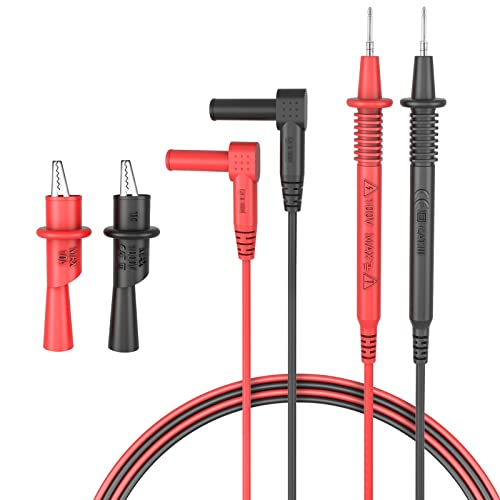
HANDSKIT Multimeter Test Leads Set, CAT III 1000V Best Safety Upgrade
This is a lead set rather than a meter, and it is on this page deliberately, because it is the only product in the group with a published safety rating: CAT III 1000V. A meter and its leads form one measuring system, and the system takes the lower of the two ratings. Fitting rated leads to an unrated meter does not make the meter safe, but fitting unrated leads to a properly rated meter certainly makes the system unsafe, and that is the more common mistake.
The practical content is two leads in red and black, two removable alligator clip adapters and standard 4 mm banana plugs, so they fit essentially any meter. The alligator adapters matter more than they sound: hands-free connection on one probe means one hand stays out of the enclosure, which is a real safety practice rather than a convenience.
Buy these alongside a properly rated field meter. The lead set does not upgrade any of the meters on this page, and it should not be read as doing so.
Short answer: the Digcreat XDM1041-DG is the most trustworthy instrument in this group because it is the only one that publishes an accuracy figure, 0.05 percent on DC voltage, alongside 55,000 counts and a dual line display. The FNIRSI 2C53T is the pick for controls and intermittent faults because it shows the waveform rather than a number, and the HANDSKIT CAT III 1000V lead set is the only item here with a published safety rating and belongs on whichever rated field meter you already own.
The finding that shapes this page
We assessed ten instruments against trade requirements, and the most important result is a negative one: not one of the meters publishes a CAT safety rating. The only product in the group that does is a set of test leads, rated CAT III 1000V. We are stating that plainly rather than working around it, because it changes the advice. A CAT rating is not marketing; it classifies the transient energy available at the point of measurement, and it exists because the hazard in electrical work is a spike arriving on a circuit you are already connected to. A meter with no published rating has no declared ability to survive that. Everything below is written on that basis: these are excellent bench, control-circuit and verification instruments, and for live distribution work you need a meter whose manufacturer publishes CAT III or CAT IV at your working voltage.
Accuracy is not counts, and only one listing gives it
Three meters here state 55,000 counts, which sounds like precision and is not. Counts is display resolution: how many distinct values the screen can show before the range changes. It says nothing about whether those values are correct. Accuracy is the separate specification, normally written as a percentage of the reading plus a number of least significant digits, and it is what bounds the error. The Digcreat XDM1041-DG states 0.05 percent on DC voltage; every other listing in the group states nothing. For an electrician who commissions equipment, sets a control reference or has to stand behind a recorded value, an unbounded reading is a problem regardless of how many digits it shows.
True RMS, ghost voltage and the two failure modes of a modern installation
Two measurement errors dominate trade work and both are invisible while they happen. The first is average-responding AC measurement on a distorted waveform. Dimmers, variable speed drives, LED drivers and switched-mode supplies all chop or synthesize the sine wave, and an average-responding meter reads low on them with no indication that anything is wrong. Two instruments here state True RMS. The second is ghost voltage: a high impedance digital meter draws so little current that capacitive coupling from an adjacent live cable produces a convincing reading on a dead conductor. The answer is a low impedance function that loads the circuit and collapses the phantom, plus proving the meter on a known source before and after. Our guide on measuring AC voltage sets out the procedure.
Why a scope belongs in a modern electrician’s bag
The work has changed. A large share of faults now sit in control circuits, drive outputs, sensor lines and communications, and a meter is structurally the wrong instrument for those because it collapses a waveform into a single number. A drive producing a badly distorted output, a PWM signal that has lost its edge, a 4 to 20 mA loop with noise on it, or an intermittent lasting a few milliseconds will all read normal on a meter and be immediately visible on a trace. The FNIRSI 2C53T states a 50 MHz two-channel scope with cursor measurement, math operations and persistence mode, that last one being what catches an event that has finished before you can react. It is not a replacement for a rated field meter and it is not pretending to be.
Display, format and the riser test
A specification that never appears on a datasheet is whether you can read the thing where you work. A dim cupboard, a plant room lit by one bulkhead, a riser at head height with a torch in your teeth: these are the conditions that decide whether a measurement is taken once or three times. Backlighting, physical display size and a dual line readout all matter here, and the Digcreat unit states a backlit 3.5 inch 480 by 320 TFT with two lines. Format matters too. The desktop instruments in this group are van-shelf and workshop tools, not something you hang on a panel door, and the pocket meters are for quick checks rather than for the measurement that goes in a certificate.
Instruments were compared on manufacturer listing text: stated CAT rating, stated counts and accuracy, True RMS, display, function list and format. Two panel-mounted battery monitors with shunts and an analogue movement present in the source data were excluded as unsuited to trade field work. Where no CAT rating is published, the table records that rather than assuming a rating. We ran no tests. Amazon data supplies images, availability and links only.
A voltage range describes what an instrument will read, a measurement category describes where it may be connected, and a listing that gives one without the other leaves the safety question unanswered.
A meter fuse protects the current input path and its interrupting capacity has to match the fault energy the category implies, but the category itself comes from clearances and input protection rather than from the fuse.
Exceeding a measurement category usually ends in a flashover across internal clearances rather than a blown display, and the most common outcome is an instrument that still reads correctly with its safety margin gone.