As an Amazon Associate, Akermin earns from qualifying purchases. Product links on this page are affiliate links.
Choose a plug-in electricity monitor that measures real power (W) and power factor, states an accuracy of a few percent or better, resolves down to about 0.5 W for standby measurements, accumulates kWh and keeps the total through a power cut or unplugging, and is rated for your outlet standard and current. Add tariff entry for on-device cost, and choose a smart version with an app if you want logging, graphs, remote reading or scheduling; choose a display version if you want to read it where it sits without pairing anything.
Specifications that matter
| Spec | Look for | Why |
|---|---|---|
| Real power and power factor | W and PF displayed, not just VA | Motors and electronics draw more VA than W; W is what you pay for |
| Accuracy | ±2% or better stated | Cheap meters can be 10% out on electronics |
| Resolution and floor | 0.1 W resolution; measures from 0.5 W | Standby loads are 0.5 to 10 W |
| Cumulative kWh | Retained through unplugging; resettable | Daily and weekly averages of cycling loads |
| Elapsed time | Shown alongside kWh | To compute average watts |
| Rating | 15 A / 1,800 W (120 V) or 13 A / 3,000 W (230 V) | Never exceed |
| Plug and socket format | Matches your region; grounded | |
| Tariff entry | Price per kWh, optionally tiers | Cost on the display |
| Display | Backlit; readable at floor level; some have a cable to the display unit | Outlets are behind furniture |
Basic versus smart
- Basic display meters (P3 Kill A Watt P4400, MECHEER and similar): plug in, read. No app, no account, no logging beyond the cumulative counter. Reliable and cheap.
- Smart meters and smart plugs with energy monitoring (Kill A Watt Connect, TP-Link, Shelly Plug, Meross and others): app graphs, history, export on some, schedules and remote switching. Require Wi-Fi and an account; check that the energy data can be exported.
- Multi-outlet monitored strips: per-socket monitoring of an entertainment center or office; some smart strips also cut standby loads.
Uses and what to buy
| Use | Choose |
|---|---|
| One-off checks of appliances | Basic display meter |
| Standby hunting | Basic meter with 0.1 W resolution and a low floor |
| Logging a fridge or server for weeks | Smart plug with history and export |
| Home energy audit, several devices | Two or three basic meters, or smart plugs on the suspects |
| Automation (turn off at idle) | Smart plug with power-based rules |
Checking a meter
Plug in a known resistive load: an incandescent bulb or a kettle. A 60 W bulb should read about 60 W at PF 1.0; a 2,000 W kettle about 2,000 W. Large errors on that test mean the meter is not worth trusting on harder loads. See how to measure appliance power consumption for the method once you have it.
Limits
Plug-in meters cannot reach hard-wired loads (HVAC, water heating, ovens, EV charging), which dominate most bills. For those, a clamp meter or a whole-home monitor; see plug-in vs whole-home energy monitors and how to choose a whole-home energy monitor. Cost arithmetic is in what a kilowatt-hour is.
Recommended Tools


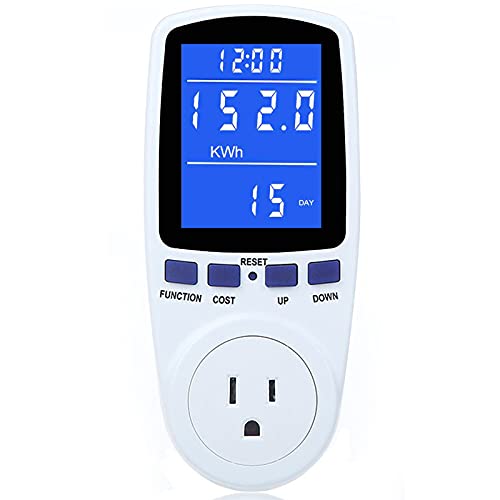
Products shown because their documented specifications fit this guide. Price and availability are on Amazon and can change.
Frequently Asked Questions
Are plug-in power meters accurate?
Good ones are within 1 to 3 percent on resistive loads and within a few percent on electronics. Cheap units can be poor at low power factor and below a few watts.
Is a smart plug with energy monitoring as good as a dedicated meter?
For logging and remote reading, often better. For accuracy at very low loads and for a display you can read on the spot, a dedicated meter is usually better. Check the stated accuracy either way.
What rating do I need?
A standard 15 A (120 V) or 13 A (230 V) meter covers everything that plugs into a normal outlet. Do not exceed the rating; use a clamp meter for larger loads.
Affiliate disclosure: Akermin earns a commission from qualifying Amazon purchases made through links on this page. Our editorial picks are based on documented specifications and owner feedback, not commissions.