As an Amazon Associate, Akermin earns from qualifying purchases. Product links on this page are affiliate links.
For anything with a plug, put a plug-in power meter between the outlet and the appliance: read watts now, then leave it for a day (a week for fridges and freezers) and read the accumulated kWh. For hard-wired or high-power loads, clamp one conductor at the panel with a clamp meter and multiply amps by volts (and by power factor for motors), or install a whole-home monitor with a clamp on that circuit. Convert kWh to cost with your tariff. Nameplate watts overstate cycling appliances by two to three times, which is why the measurement is worth making.
Method 1: Plug-in power meter
- Plug the meter into the outlet and the appliance into the meter.
- Read watts (W): instantaneous power. Note it during different modes (heating, idle, standby).
- Read volts, amps and power factor if shown.
- Reset the kWh counter and leave the meter in place for 24 hours or more.
- Read accumulated kWh; divide by elapsed hours for average watts; multiply by 24 for daily kWh.
Basic meters (P3 Kill A Watt P4400) show the numbers on the display; connected versions (Kill A Watt Connect, smart plugs with energy monitoring) log to an app. Accuracy is typically within 1 to 3 percent for loads above a few watts.
Method 2: Clamp meter
- Clamp one conductor: at the panel on the breaker’s wire, at the appliance terminal box, or on a line splitter for a plug-in load beyond the plug-in meter’s rating.
- Read amps.
- Power (W) = volts × amps × power factor. Use PF 1 for heaters and incandescent lamps; 0.6 to 0.9 for motors and electronics.
- For energy, note how long the load runs, or use a logging clamp.
See how to measure current with a clamp meter and the watts / volts / amps calculator.
Method 3: Whole-home monitor
A monitor with per-circuit clamps (Emporia Vue, Sense with clamps, IoTaWatt) logs each circuit continuously and shows daily kWh per circuit in the app. It covers HVAC, water heaters, ovens and EV chargers that no plug-in meter can reach. See how to choose a whole-home energy monitor.
What to expect
| Appliance | Running watts | Typical daily kWh |
|---|---|---|
| Refrigerator-freezer (modern) | 80 to 150 W when running | 0.8 to 1.5 |
| Chest freezer | 60 to 100 W | 0.6 to 1.2 |
| Television, 55 inch | 60 to 120 W | 0.3 to 0.6 (4 h) |
| Desktop computer | 60 to 200 W | 0.5 to 1.5 |
| Washing machine (cold to warm) | 300 to 2,000 W in phases | 0.3 to 1 per cycle |
| Tumble dryer | 2,000 to 3,000 W | 2 to 4 per cycle |
| Dishwasher | 1,200 to 2,000 W in phases | 1 to 1.5 per cycle |
| Electric kettle | 2,000 to 3,000 W | 0.3 to 0.6 |
| Space heater | 1,500 W | 6 to 12 |
| Router and modem | 8 to 15 W | 0.2 to 0.36 |
See what a kilowatt-hour is and standby power explained.
Cost
Daily kWh × price per kWh × 365 gives the yearly cost. The electricity cost calculator does the arithmetic from watts and hours; use measured average watts rather than nameplate.
Pitfalls
- Reading instantaneous watts once on a cycling appliance and multiplying by 24.
- Exceeding the plug-in meter’s rating (usually 15 A / 1,800 W at 120 V, 13 A / 3,000 W at 230 V); use a clamp for larger loads.
- Ignoring power factor on motor loads when using a clamp.
- Loads under 1 W, which many plug-in meters read as zero.
Plug-in meter selection is in how to choose a plug-in electricity usage monitor.
Recommended Tools


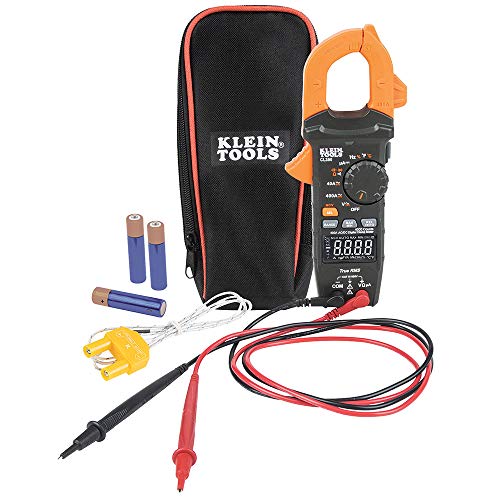
Products shown because their documented specifications fit this guide. Price and availability are on Amazon and can change.
Frequently Asked Questions
How long should I leave a power meter on a fridge?
At least 24 hours, ideally a week, so the accumulated kWh includes compressor cycles, door openings and defrost. Divide by days for a daily figure.
Can I measure a hard-wired oven or water heater?
With a clamp meter on one conductor at the panel or terminal, multiplied by voltage (and power factor for motors), or with a whole-home monitor that has a clamp on that circuit.
Why does the meter show more VA than W?
Power factor. Motors and electronics draw current out of phase with voltage; W is real power (what you pay for), VA is apparent power (what the circuit carries).
Affiliate disclosure: Akermin earns a commission from qualifying Amazon purchases made through links on this page. Our editorial picks are based on documented specifications and owner feedback, not commissions.