As an Amazon Associate, Akermin earns from qualifying purchases. Product links on this page are affiliate links.
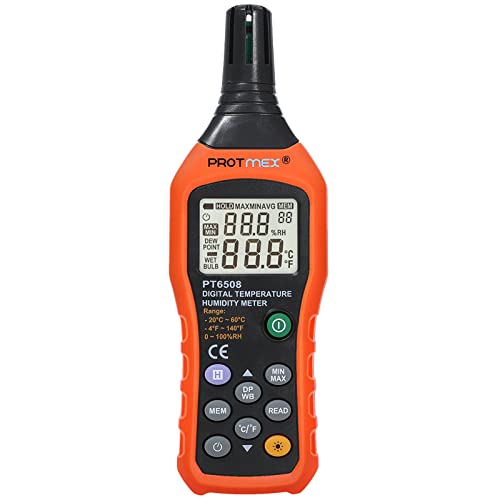
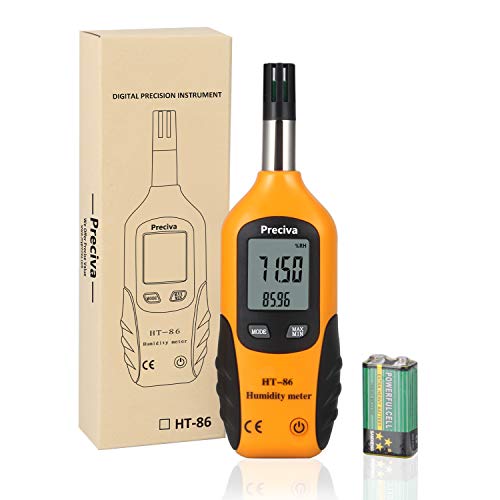
Short answer: For most HVAC diagnostics, the Fieldpiece JL3RH is the strongest pick because it measures dry bulb, wet bulb, relative humidity, dew point, and enthalpy, and its flexible wand and magnet let you position the probe inside ducts and plenums. If you want a low-cost handheld, the Protmex PT6508 and ERAY yellow unit both cover the four core modes. For teaching or calibration checks where you want to see the wet bulb depression directly, the Sper Scientific 736700 (P10) is the sling to choose. The EISCO 15-pack (P11) is a classroom kit, not a service tool, and the Kessler (P12) publishes almost nothing beyond its temperature range.
Wet bulb and dew point are calculated, not measured
A psychrometer does not have a wet bulb sensor and a dew point sensor. It has a temperature sensor and a humidity sensor, and it calculates the two derived values from those. That is true of every digital model on this page. The calculation uses the relationship between air temperature, moisture content, and the cooling that happens when water evaporates into the air. When you press the button to show wet bulb, the meter is doing arithmetic, not switching to a different sensor.
Understanding this matters because it tells you where errors come from. If the humidity sensor reads two percent high, the wet bulb and dew point will both be wrong by an amount that depends on the temperature. A small humidity error at high temperature produces a larger wet bulb error than the same humidity error at low temperature. This is why a stated accuracy figure is more useful than a long feature list. The Digvliy HM-01 is the only handheld here that publishes one, and it states plus or minus 5 percent RH for humidity and plus or minus 2 percent C for the derived values.
The sling psychrometer works the other way round. It measures wet bulb directly, by cooling a thermometer with evaporation, and you look up the humidity and dew point on a chart or slide rule. The Sper Scientific 736700 (P10) uses this method. There is no sensor to drift, but the reading depends on your whirling technique and on using clean water on the sleeve.
What each derived value is actually used for
Wet bulb temperature is the temperature air reaches when water evaporates into it until it is saturated. In HVAC work it is the input to evaporative cooling calculations, and it is used in the charging procedure for some refrigeration systems alongside pressure readings. If you are working on a cooling tower or an evaporative cooler, wet bulb is the number that tells you how much cooling the air can provide.
Dew point is the temperature at which moisture in the air begins to condense. It is the number you use for condensation risk. If a duct surface, a window, or a cold water pipe is below the dew point of the surrounding air, water will form on it. That is how you diagnose sweating ducts and how you judge whether a basement or a cold store will stay dry. The Protmex PT6508 and the ERAY yellow unit both publish dew point ranges down to -50 C, which covers dry conditions as well as damp ones.
Relative humidity, the value most cheap hygrometers show, tells you how close the air is to saturation at its current temperature. It changes when the temperature changes even if the moisture content stays the same. That is why dew point is the more stable and more useful number for judging whether moisture will cause a problem. For a broader look at instruments that track these values over time, see our guide to digital hygrometers.
The common mistake: reading the air where you stand
The most frequent error in psychrometric measurement is taking the reading in the wrong place. A handheld meter reads the air at the sensor, which is the air in the room or at the end of your arm. If you are trying to measure the air inside a supply duct, that is not the same air. Duct air can differ from room air by several degrees and by a large margin in humidity, especially on a system that is not running or is short of charge.
The Fieldpiece JL3RH addresses this directly. Its 9.25 inch bendable wand and sliding magnet let you fix the probe inside a duct, register, or plenum, and the Bluetooth link with a stated range of up to 1000 ft lets you read the value from somewhere else. That is the mechanism that makes it a duct diagnostic tool rather than a handheld. It also measures enthalpy, which is the total heat content of the air and the value used for load calculations and for comparing supply air against return air.
The second common mistake is assuming a psychrometer can do a job it cannot. It is not a gas detector and not an alarm. It will not tell you about a refrigerant leak, a combustion problem, or low oxygen. If your work involves those hazards, you need the appropriate detector, such as the instruments in our guide to A2L refrigerant leak detectors. A psychrometer measures moisture and temperature and nothing else.
Maintenance that nobody mentions
Digital psychrometers need their sensors kept clean and dry. Dust, oil, and condensation on the sensor element will bias the humidity reading, and because wet bulb and dew point are calculated from humidity, both derived values drift with it. Store the meter with the sensor protected, and if the listing mentions a cover protector, use it. The Protmex HT607 is described as having a cover protector, which is a small detail that matters over the life of the instrument.
Sling psychrometers need different care. The cloth sleeve must be clean and must be moistened with distilled water, not tap water. Tap water leaves minerals in the cloth as it dries, and those minerals change the evaporation rate, which changes the wet bulb reading. Replace the sleeve when it becomes stiff or discoloured. The EISCO classroom kit (P11) includes cloth sleeves and rubber bands, which gives you an idea of the consumable nature of the part.
Neither type needs calibration in the way a gas detector does, but a digital psychrometer can be checked against a sling psychrometer in stable conditions. If the two disagree by more than the stated tolerance, the digital sensor is the likely culprit. This is one reason a sling remains useful even in a digital toolkit. For instruments that log these values over time rather than showing a single reading, see our page on environmental data loggers for building monitoring.
Where a psychrometer stops being the right answer
A psychrometer is the right tool when you need to know the moisture content and temperature of air, and when you need wet bulb or dew point for a calculation or a diagnosis. It stops being the right answer in three situations.
The first is when you need continuous monitoring rather than a spot reading. A handheld psychrometer tells you what the air is doing at the moment you press the button. If you need to know whether a space stays within a humidity band over days or weeks, you need a data logger, not a handheld. Our guide to environmental data loggers for building monitoring covers that category.
The second is when the hazard is not moisture. A psychrometer will not detect carbon monoxide, combustible gas, or refrigerant leaks. Those need dedicated detectors, and a meter is not an alarm. The third is when you need a measurement you can defend in a legal or contractual context. For that you need a stated accuracy, a calibration certificate, and a documented method. Most of the instruments here publish ranges but not accuracy, and only the Digvliy HM-01 states a tolerance. If your work requires traceable measurements, check the manufacturer’s documentation before you rely on any of these.