As an Amazon Associate, Akermin earns from qualifying purchases. Product links on this page are affiliate links.
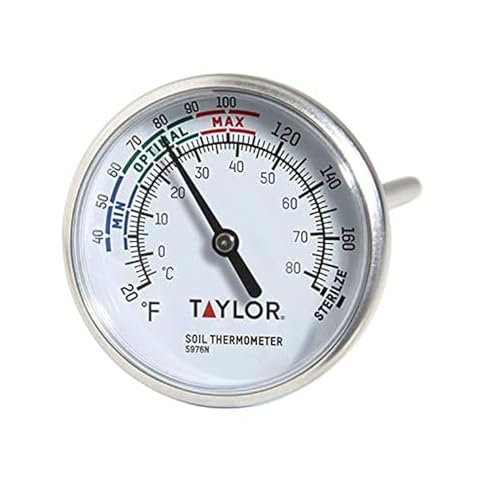
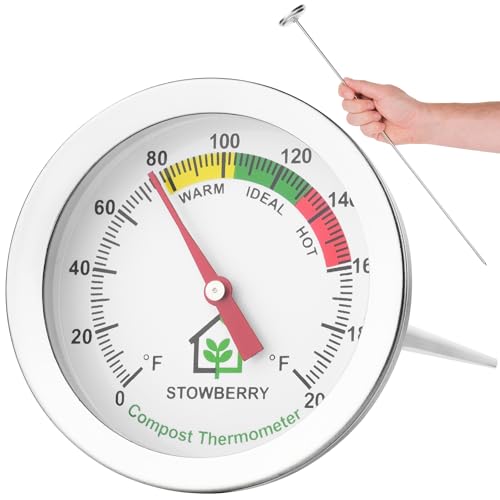
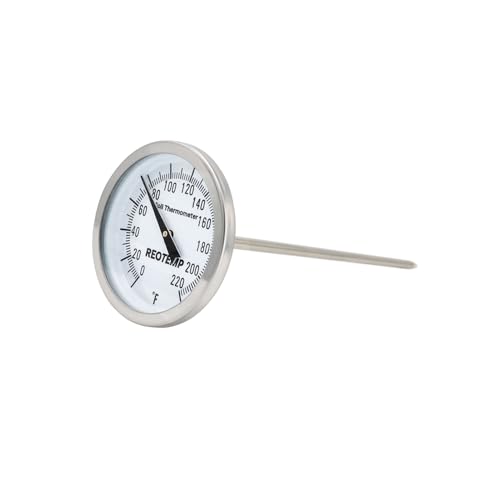
Short answer: For seed germination and raised beds, the Taylor and the REOTEMP K82-3 are the two most sensible picks: both use a 5 inch stainless stem, a sealed analog dial and a Fahrenheit scale that covers the full soil range, and neither needs a battery. For compost heaps, the STOWBERRY 20 inch and the Garden Weasel 36 inch reach the active core, which a 5 inch probe cannot do in a large pile. The Urban Worm is the narrowest tool here and is aimed specifically at worm bins, where the useful band is 55F to 90F. Avoid buying a long compost probe for a seed tray, and avoid buying a short garden probe for a cubic yard pile; depth is the specification that decides whether the number you read means anything.
What soil temperature actually controls
Soil temperature is the switch that starts germination, and it is also the variable that decides whether a seed survives long enough to germinate. A seed absorbs water and its metabolic rate rises with temperature; below a species-specific minimum, that process stalls and the seed sits in damp soil where fungi and bacteria can attack it. Above the minimum, germination accelerates quickly, but past the optimum the seedling grows fast and thin, which is a weaker plant going into the season. This is why the threshold matters more than the exact reading. You are not trying to hit a number, you are trying to be on the right side of a line.
The same logic applies to transplanting. A seedling moved into soil below its comfort range stops growing and sits until the soil warms, which is the opposite of what you want from an early start. Checking the bed before you plant, rather than after, is the whole value of owning the instrument. The humidity and temperature instruments used indoors work on the same principle but measure air, not soil, and the two are not interchangeable.
Depth is the specification that decides everything
The most common mistake with a soil thermometer is buying a short probe and using it in a deep pile, or buying a long probe and using it in a seed tray. Both produce a number, and both numbers are misleading. In a compost heap, the outer six inches are cool and dry while the core is hot and active; a 5 inch probe reads the shell and tells you the pile has gone cold when it has not. In a seed tray, a 20 inch probe cannot be inserted without hitting the base, so you end up reading the tray floor rather than the seed depth.
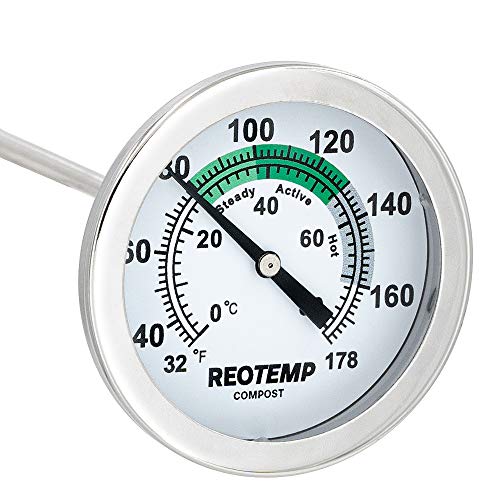
The rule is simple: match the stem to the depth you care about. Seeds sit half an inch to two inches down. Raised bed root zones sit six to eight inches down. Compost cores sit eighteen inches or more down in a large heap. The Taylor and the REOTEMP K82-3 at 5 inches cover the first two. The STOWBERRY and P11 Greenco at 20 inches and the Garden Weasel at 36 inches cover the third. The P10 REOTEMP K83B1 at 12 inches sits between the two jobs and suits small bins and tumblers.
Morning, afternoon and the reading you should trust
Surface soil is not a stable environment. It warms through the morning, peaks in mid afternoon, and cools overnight, and the swing is largest in the top inch or two. A dark raised bed in full sun can be several degrees warmer than an open border a few feet away, and both will read differently at eight in the morning and at four in the afternoon. If you take one reading and act on it without knowing when it was taken, you are partly measuring the weather.
The practical approach is to measure at a consistent time and a consistent depth. Early morning is the most useful single moment for sowing decisions, because it is close to the overnight minimum and therefore close to the coldest the seed will experience. If the soil is above the germination threshold at dawn, it will stay above it. Deeper readings are more stable and less time-sensitive, which is another argument for a longer stem when you are monitoring a bed rather than a tray. For tracking conditions across a whole growing space rather than a single bed, the approach used in environmental data logging is worth understanding, because the same principle applies: a single spot reading is a snapshot, and a trend is what tells you something.
Compost monitoring and the zones that matter
A compost pile is a biological reactor, and temperature is the readout. When the carbon to nitrogen ratio and moisture are right, microbial activity generates heat and the core climbs; when the pile dries out, goes anaerobic, or runs out of easily digested material, the temperature falls. Reading the core tells you which of those has happened before you start turning and rebuilding.
The zone-marked dials on the STOWBERRY and the colour-coded ranges on the P11 Greenco exist to turn a number into a decision. A pile holding in the active band is working. A pile that has dropped to steady has either finished or stalled, and the fix depends on which. A pile running hot is doing its job but may need turning to keep the outer material in the cycle. None of these thermometers is an alarm; they are instruments you read on a schedule. If you want automatic notification when a condition is crossed, that is a different class of device, and the logic is closer to the threshold alarms used for gas safety than to a dial thermometer.
Where a soil thermometer stops being the right tool
A soil thermometer measures one thing: the temperature at the point where its stem sits. It does not measure moisture, pH, nutrient levels or light, and it does not control anything. If your problem is that seedlings are damping off, the temperature may be part of the story, but so is overwatering and air circulation. If your compost is not heating, the thermometer will confirm that, but the cause is usually the ratio or the moisture, not the instrument.
There is also a limit to what a mechanical dial can tell you. None of the listings on this page publishes an accuracy figure, and none is a calibrated reference. For gardening decisions, that is fine: you need to know which side of a threshold you are on. For anything requiring a traceable measurement, you need a different instrument entirely. Buy the stem length that matches your job, read it at a consistent time and depth, and treat the number as a guide to a decision rather than a measurement in its own right. If you are monitoring a whole growing environment rather than a single bed, the broader category of environmental monitoring devices is where to look next.