Best Air Quality Monitors for Basements: 6 Picks for Radon, Damp and Combustion
A basement is not a living room with lower ceilings. It sits against the soil, it is the coldest surface in the house, and it usually contains the boiler. Those three facts decide which sensors matter, and the answer is not the same as for the rest of the house.
As an Amazon Associate, Akermin earns from qualifying purchases. Product links on this page are affiliate links.
Our Top Picks
Monitors were sorted by which of the three basement problems each listing states it measures, the ranges and storage published, and how results are read. We did not run laboratory tests and publish no measurements of our own. Where a listing gives no figure, the entry reads Not stated.
Best Overall
Airthings View Plus
The only monitor here that covers radon, particulates, carbon dioxide and humidity together.
Radon, PM2.5, CO2, VOC, humidity, temperature and pressure
WiFi connected, app and account required per the listing
Only the two Airthings units measure anything other than radon and climate. If combustion appliances are in the basement, a separate carbon monoxide alarm is required regardless of which monitor you choose.
How to Choose a Basement Monitor
A basement has three problems, and no single instrument on this page solves all three.
Radon Comes First
It is the only basement hazard that is both serious over years and completely undetectable without an instrument. If the basement is occupied, radon monitoring is not optional.
Humidity Is the Second Sensor
Basement walls are the coldest surfaces in the house, so condensation and mould start there. A radon monitor that also reports humidity saves buying a second device.
Combustion Needs Its Own Alarm
None of these are certified carbon monoxide alarms. If a boiler, furnace or water heater is down there, fit a proper CO alarm as well. A monitor is not a substitute.
Watch the Operating Temperature
The View Plus states a 4 to 40 C range. An unheated basement in a cold climate can fall below that, and a monitor outside its stated range is not a monitor.
Seasons Matter More Than Days
Radon is highest in winter when the house is sealed and warm air rising upstairs pulls soil gas in. A summer test that passes proves very little about January.
WiFi Reaches Badly Through Concrete
A connected monitor in a basement often is not. Bluetooth models or long-battery local loggers are the more reliable choice below ground.
Why does a basement need a different monitor from the rest of the house?
Because it has different problems. Radon enters from the soil and is highest at the lowest level. Condensation forms first on the coldest surfaces, which are basement walls. And combustion appliances are usually down there. A living room monitor measuring carbon dioxide and particulates does not address any of the three.
Is a radon monitor the same as an air quality monitor?
No. Most air quality monitors do not measure radon at all, because it needs a completely different detection method that counts radioactive decay. Of the devices here, only the two Airthings units combine radon with general air quality sensors.
Do I still need a carbon monoxide alarm?
Yes. None of these devices is a certified CO alarm, and a monitor that displays a number is not the same as an alarm designed to wake a household at levels and exposure times that protect people. See CO meter versus CO alarm.
How long should I test for radon before deciding?
Days give you a hint, weeks give you an answer, and a full year across seasons gives you the truth. Radon varies with weather, ground conditions and how sealed the house is, so a single short test in mild weather is the least informative measurement you can take.
Where exactly should the monitor go?
At breathing height in the part of the basement people actually occupy, away from exterior doors, windows, sump covers and draughts. Do not place it on the floor in a corner, and do not place it next to a dehumidifier, which will distort both the humidity and the radon reading.
Will a dehumidifier reduce radon?
Not directly. It addresses condensation and mould, which is a separate basement problem. Radon reduction is a matter of sealing entry points and, where levels justify it, a sub-slab depressurisation system installed by a qualified contractor.
Reviews
Airthings View Plus Best Overall
A basement has three separate problems and most instruments address one. This addresses all of them in a single device on a single wall, which is the practical argument for it: one monitor in the right place beats three monitors you have to check separately.
Radon is the reason it belongs here rather than upstairs, because radon comes from the soil and is highest at the lowest occupied level. Humidity matters because a basement wall is the coldest surface in the house and condensation forms there first. Carbon dioxide matters if anyone sleeps down there. The listing states a 4 to 40 C operating range, which is worth checking against an unheated basement in winter, and it is explicit that the device requires the app and an account to function.
Basements are exactly where WiFi is worst, and a connected monitor that cannot reach the router is a monitor that reports nothing. This one works over Bluetooth, so the data is collected when somebody walks down with a phone, and the wave gesture gives an instant colour verdict without any phone at all.
That gesture is more useful than it sounds for a space people pass through rather than occupy. Anyone fetching something from the basement gets a green or red answer in a second, which is the only interaction most household members will ever have with an air quality device. The compromise against the View Plus is no particulate sensor and no remote alerting.
AEGTEST HOUND-2070 Radon Monitor Best for Long Records
Radon is a seasonal problem, and a basement that tests clean in July can be well above the action level in January with the house sealed and the heating drawing air upward. A device storing up to 504 days of history is the cheapest way to see that cycle rather than guess at it.
Adding temperature and humidity is the right pairing for a basement, because the two problems arrive together: the same sealed winter conditions that raise radon also raise condensation risk on cold walls. The listing states a first reading within 12 hours and hourly updates after, which is normal for the technology and a reminder that radon measurement is inherently a waiting game.
Strengths
Up to 504 days of history on the device
Humidity alongside radon
Multiple averaging windows on screen
Inexpensive enough to place in two rooms
Limitations
No CO2 or particulate measurement
Semiconductor sensor type, with no accuracy figure published
This is the only radon pick here that publishes a measurement range, and 0.09 to 1000 pCi/L is a wide one. For a device whose entire purpose is a number, publishing the range is the minimum expectation and surprisingly rare in this category.
An adjustable alarm threshold matters because action levels differ by country and by how the space is used. A basement bedroom deserves a lower trigger than a storage room nobody sleeps in, and a device that lets you set that is more useful than one with a fixed point. The adjustable alpha particle sound is a nice touch for anyone who wants to hear the detector working rather than trust a silent box.
Strengths
Published measurement range in both units
Adjustable alarm threshold
Colour display with long history
Rechargeable
Limitations
Radon only
No accuracy or uncertainty figure stated
Semiconductor sensor with no calibration route described
A six hour first reading is the fastest here, and the triple-vent design the listing credits for it is a real design choice rather than marketing: radon has to diffuse into the chamber before it can be counted, and vent area drives how quickly that happens.
Fast first readings are useful for one specific job, which is comparing rooms. Move the detector, wait six hours, read, move again, and in a weekend you know which part of the basement is worst and where a mitigation point should go. A monitor with a 48 hour settling period makes that survey take a fortnight. Treat any short reading as indicative and let it run for weeks before drawing conclusions about the house.
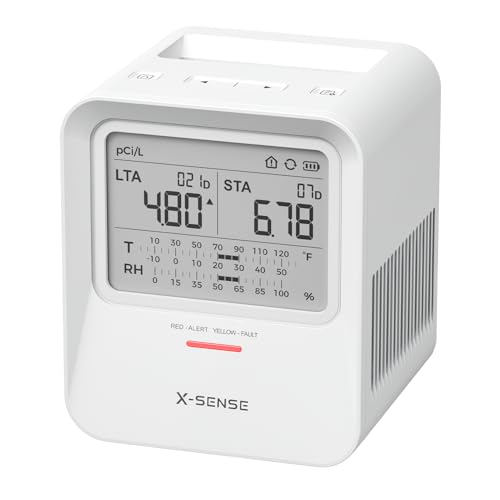
X-Sense XR0B-SR Radon Detector Best Set and Forget
The strongest argument for this one is that it asks nothing of you. A two year battery with no charging means it can be placed in a corner of a basement and genuinely forgotten, which is the correct behaviour for a device tracking a slow hazard that nobody thinks about.
The listing is also unusually direct about the statistics, stating results in 24 hours with accuracy described as reaching 95 percent after seven days or more. That is an honest framing of how radon measurement works: short readings are noisy because the instrument is counting decay events, and confidence builds with time. Treat the first day as a hint and the first week as an answer.
Strengths
Two year battery, nothing to charge
Honest statement about accuracy improving with time
Short answer: the Airthings View Plus is the best single device because it covers radon, humidity and carbon dioxide together; the Airthings Wave Plus is the better choice where WiFi does not reach, which in a basement is common; and the AEGTEST HOUND-2070 is the cheapest way to get radon and humidity with a long stored history.
Three problems, not one
A basement gives you radon from the ground, condensation on cold walls, and combustion products if the boiler lives down there. Those are three different hazards with three different sensors and three different responses, and buying one device without knowing which problem you are solving is how people end up with a monitor that measures carbon dioxide in a room nobody breathes in.
Radon is the one you cannot sense
Damp announces itself with a smell and a stain. Combustion problems usually come with symptoms and, if you have the right alarm, a sound. Radon gives you nothing at all: no smell, no taste, no immediate effect, and a risk that accumulates over years of exposure. That asymmetry is why radon leads this page. If the basement is used as a bedroom, an office or a playroom, radon monitoring is the first purchase and everything else is secondary.
Winter is when the number changes
Radon entry is driven partly by the pressure difference between the soil and the house. In winter, warm air rising through the building draws air in at the lowest level, and the house is sealed against the cold, so both the driving force and the lack of dilution work in the same direction. A basement that tests comfortably in summer can be well above the action level in January. This is why every device here emphasises long-term storage, and why a single short test is the weakest evidence available.
Humidity is the problem you can actually fix this week
Basement walls are in contact with the ground and are the coldest surfaces in the building. Warm, moist air from upstairs meets them and condenses, which is why mould starts in basement corners and behind stored boxes rather than in the middle of the room. A monitor reporting humidity alongside radon lets you see both patterns at once, and the fix, improving ventilation or running a dehumidifier, is something a homeowner can act on immediately. Our humidity checker explains what the percentages mean.
What none of these do
Not one of the six is a certified carbon monoxide alarm. If there is a boiler, a furnace, a water heater or any fuel burning appliance in the basement, a proper CO alarm is a separate and non-negotiable purchase, and the reason is that an alarm is engineered around protecting sleeping people rather than displaying a number. The carbon monoxide detector roundup covers that decision, and the radon detector roundup goes deeper on the radon instruments themselves.
How We Research
Monitors were compared on which of the three basement problems their listings state they measure, published ranges and units, first reading time and update interval, history storage, battery life and connection method, and stated operating temperature. We did not run laboratory tests and publish no measurements of our own. No figure appears here unless the manufacturer published it.
A WiFi monitor claiming AQI, CO2, PM2.5, PM1.0, PM10, TVOC and HCHO with Tuya app logging, reviewed from a listing that never says how any of it is measured.
A seven inch multi sensor monitor with an NDIR CO2 sensor, electrochemical formaldehyde, semiconductor TVOC and laser particle sensing, reviewed from the listing.
Two mail-in lab kits listed under EPA measurement programmes, and four digital monitors that charge no lab fee, compared on what each one is actually for.