Best Radon Detectors: 9 Essential Picks for Safer Homes
Radon is a colorless radioactive gas that seeps up from soil and collects in basements and ground floors, and the only way to know a house has a problem is to measure it over time. This hub compares the continuous radon monitors currently listed, sorted by how fast they report, how they connect and what each manufacturer actually states. It also links down to the specific radon and gas detection guides on this site.
As an Amazon Associate, Akermin earns from qualifying purchases. Product links on this page are affiliate links.
Our Top Picks
These nine monitors were sorted by what the manufacturer states on the listing: how quickly the first reading appears, how often it updates, whether the unit connects to an app, what range it covers and how much data it stores. We did not run laboratory tests and publish no radon measurements of our own. Where a listing gives no figure, the cell reads Not stated.
Best Overall
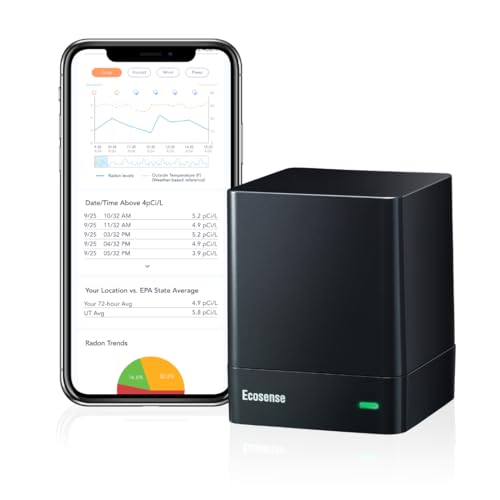
Ecosense Continuous Home Radon Monitor EQ100
First reading in ten minutes, then continuous Wi-Fi monitoring through the app.
Listing states a first radon reading 10 minutes after the power cable is connected
Ecosense describes a patented high counting efficiency design
Wi-Fi connected and app enabled for remote checking
Continuous monitoring rather than a fixed test period
All figures come from the manufacturers' own Amazon listings at the time of research. The AEGTEST HOUND-2070 listing states 504 days of data storage. Where a listing publishes no value the cell reads Not stated; that is a gap in the published specification, not a judgement about the product.
How to Choose a Radon Detector
Four questions settle it before price does:
Screening or Long-Term
A one-off kit answers whether to worry. A continuous monitor answers what the level does across a winter, which is the number a mitigation decision rests on.
How Fast It Reports
Ten minutes to a first reading is convenient, but short intervals are statistically noisy. Value fast reporting for seeing change, not for a single verdict.
Where It Has to Sit
Radon comes from the ground, so the lowest occupied floor decides. A mains-powered plug-in stays put; a battery unit can move room to room.
App or Screen Only
An app gives history, alerts and a record you can show a contractor. A screen-only unit is cheaper and has nothing to configure.
How long should a radon detector run before I trust the number?
Long enough to average out the weather. Radon levels move with barometric pressure, wind, heating and how often doors open, so a single hour or a single day can be well off the long-run average for the house. Screening tests are commonly run for two to seven days with the house closed up; a continuous monitor is better read over weeks and across a heating season.
Where in the house should the monitor go?
On the lowest floor that people actually use, in a room that is occupied rather than a sealed store. Keep it away from exterior doors, windows, vents, fans and the sump lid, roughly at breathing height and not right against an outside wall. Moving it mid-test restarts the picture, so pick a spot and leave it.
Is a continuous monitor better than a mail-in charcoal kit?
They answer different questions. A charcoal kit gives one laboratory-analysed average for a short period at low one-off cost. A continuous monitor gives an ongoing record with no repeat laboratory fees, which is what you want when you are checking seasonal variation or confirming that mitigation work did something. Many households start with a kit and add a monitor if the result is borderline.
What do pCi/L and Bq/m3 mean on the display?
They are two units for the same thing, the radioactivity of the radon in a volume of air. Picocuries per litre is the common US unit and becquerels per cubic metre the international one; 1 pCi/L is about 37 Bq/m3. Several detectors let you switch units, so check which one the screen is showing before comparing against any published guidance.
Do I need to retest after building work?
Yes. Anything that changes how air moves through the lowest floor can change radon: a new floor slab or membrane, a sealed crawl space, replacement windows, a new extract fan, or a mitigation system going in. A monitor that is already running makes this automatic, which is the practical argument for a continuous unit over repeat kits.
Reviews
Ecosense Continuous Home Radon Monitor EQ100 Best Overall
The EQ100 is the monitor to buy if you want the radon question answered on the day the box arrives and then kept under permanent watch. Ecosense states a first reading ten minutes after the power cable goes in, which is unusual: most consumer radon devices ask for 24 to 48 hours before the number means anything, and charcoal kits take days plus a laboratory turnaround.
The listing credits that speed to what Ecosense calls a patented high counting efficiency design, and claims counting sensitivity many times better than typical consumer sensors. Counting sensitivity is the figure that decides how quickly a radon device can separate a real level from statistical noise, so a higher figure is what buys the short first reading. Ecosense does not publish the detection range or the stated uncertainty on this listing, so those go down as Not stated.
In practice the value is the record, not the first number. Radon swings with weather, season, and whether windows are open, so a single reading proves very little. A permanently powered monitor that logs to an app lets you see the winter peak, the effect of closing a sump, and whether a mitigation fan actually worked. The trade-off is that the EQ100 needs mains power, so it stays where you put it.
Strengths
First reading stated at 10 minutes
Wi-Fi and app for remote checking
Continuous monitoring rather than a fixed test window
High counting efficiency claimed by the manufacturer
Aranet Radon One Home Radon Detector Best for Watching Changes
Where most home radon monitors report hourly or daily averages, Aranet states that the Radon One updates its concentration figure every ten minutes. That matters if you are trying to see cause and effect rather than a long-run average: opening a basement window, switching on a mitigation fan, or a storm dropping the barometric pressure all move radon, and a ten-minute cadence shows the move while you are still standing there.
Aranet does not publish a detection range, a stated uncertainty or a sensor technology on this listing, so the comparison table carries Not stated across those columns. What the listing does commit to is the update interval and the intended setting, which is a home rather than a laboratory or a commercial survey.
Use it the way the physics demands. A ten-minute number is noisy by nature, because radon measurement is a counting process and short windows carry large statistical spread. Read the trend over days and weeks for the decision, and use the short-interval readings to understand what drives the level in your particular house.
Strengths
Stated 10-minute update interval
Good for seeing the effect of a change in the house
Designed for living areas rather than a plant room
Simple home-focused presentation
Limitations
Detection range not stated
Connectivity not stated on the listing
Short-interval readings are statistically noisy by nature
X-Sense Radon Detector for Basement XR0A-SR Best Value
The XR0A-SR is the entry into continuous radon measurement for a household that has never tested. X-Sense states reliable data within 24 hours and, more usefully for the budget comparison, zero laboratory fees. That is the honest advantage over a mail-in charcoal kit: a kit costs less once, but every retest costs again, and radon is a gas you are supposed to retest after any work that changes the airflow in the house.
The listing keeps its claims narrow. It states compliance with standard performance requirements and a 24-hour window to reliable data, but it names no detection range, no uncertainty figure and no sensor type. For a screening decision, that is enough: you are looking for whether the level is comfortably low, borderline, or high enough to act on.
Because it is aimed at basements, put it where the listing intends. Radon enters from the ground, so the lowest occupied floor is where the number matters, and a bedroom on that floor is the most meaningful spot of all. Keep it away from windows, vents and sump lids, and leave it running for weeks rather than reading it once.
Short answer: the Ecosense EQ100 is the radon monitor to buy if you want a first reading in ten minutes and a permanent Wi-Fi record afterwards; the Aranet Radon One updates every ten minutes, which is what you want for seeing whether a change in the house moved the level; and the X-Sense XR0A-SR is the low-cost way into continuous basement monitoring with no laboratory fees to pay again.
What a radon detector is actually counting
Radon is a radioactive gas produced by the decay of uranium in soil and rock. It has no smell, no color and no taste, it seeps into buildings through slab cracks, service penetrations, sump pits and crawl spaces, and it accumulates on the lowest floors. A radon detector does not sense the gas chemically the way a combustible gas sniffer does. It counts decay events, either in an ion chamber or with a semiconductor sensor behind a vented housing, and converts the count rate into a concentration. That is why counting sensitivity, the figure Ecosense leans on for the EQ100 and the EF100, is the specification that really drives how quickly a device can give you a number you can rely on. A sensor that registers more events per hour separates signal from statistical noise sooner.
Why the reading interval matters less than the record
Three of the monitors here make a speed claim: the EQ100 and the RD200 state a first reading ten minutes after power-up, and the Aranet Radon One states an updated concentration every ten minutes. Those are genuinely useful, but not for the reason most buyers assume. Radon in a house is not a fixed quantity. It rises when the house is closed up and the heating is on, it falls when windows are open, and it responds to barometric pressure and wind loading on the building. A ten-minute figure is a snapshot of a moving target, and because radon measurement is a counting process, short windows carry wide statistical spread. The number that matters for a decision is the long-run average across weeks, ideally across a heating season. Read the fast interval to understand your house and the long average to decide about it.
Plug-in, portable and what that changes
The nine units here split into three shapes. Plug-in monitors such as the EQ100 and the SunRADON luft take mains power and stay in one place, which suits a permanent watch on the lowest floor. Battery units such as the Ecosense EF100 and the AEGTEST portables can be moved between rooms, which suits a survey of a whole house before deciding where the permanent unit goes. Desktop units such as the Ecosense RD200 sit on a shelf with an OLED readout and hand their history to a phone over Bluetooth. None of these is better in the abstract; the question is whether you are surveying or monitoring. If you are surveying, portability wins. If you are monitoring one known problem area, a plug-in unit that is never accidentally switched off wins.
Connectivity, logging and proving the work
If radon mitigation work is ever done on the house, someone is going to ask what the level was before and after. That is an argument for either an app-connected monitor or a device with real on-board storage. The X-Sense XR0A-iR states 2.4 GHz Wi-Fi with app notifications, the EQ100 is Wi-Fi and app enabled, and the RD200 uses Bluetooth to a phone. On the storage side, the AEGTEST HOUND-2070 listing states 504 days of data storage, which is the longest on-device history quoted in this group and enough to cover a full year plus the comparison period. Most of the other listings say nothing about storage at all, which is why the table carries so many Not stated cells in that column.
Multi-parameter monitors and the trade-off
The SunRADON luft is the odd one out here because it does not only measure radon. Its listing states radon plus VOCs, carbon dioxide, humidity, temperature and pressure in a single plug-in unit. For a household that wants one device on the shelf rather than four, that is genuinely attractive, and the pressure and humidity channels help explain why radon moved on a given day. The trade-off is focus: a device splitting its display across six parameters gives radon less screen space and less of the manufacturer’s specification detail, and the listing publishes no radon range or uncertainty figure. If radon is the reason you are buying, a dedicated monitor is easier to interpret. If indoor air quality generally is the reason, see the air quality monitor hub and the indoor air quality guide.
Units, thresholds and what to do with a high reading
Displays show either picocuries per litre or becquerels per cubic metre, and 1 pCi/L is roughly 37 Bq/m3. The AKSTEST RM-60 is the one listing in this group that states a range, 0.09 to 1000 pCi/L, which spans everything a house is likely to produce. A high long-term average is a building problem rather than a gadget problem: the usual remedy is sub-slab depressurisation, which is a fan and pipework that vents soil gas above the roofline, plus sealing of obvious entry points. A monitor cannot fix anything, but it is the only way to know whether the fix worked. For the unit conversions and the general concentration vocabulary, see how to understand ppm, LEL and volume in gas detection.
Guides in This Category
How to choose a radon monitor for the homeowner deciding between a short-term kit and a permanent continuous monitor.
Monitors were compared on manufacturer listing text: stated first-reading time, update interval, connectivity, detection range, data storage, power source and any additional parameters measured. Owner feedback was reviewed for recurring comments on drift and app reliability. We did not run laboratory tests, did not expose any unit to a reference radon chamber and publish no measurements of our own. Amazon data supplies images, availability and links only.