As an Amazon Associate, Akermin earns from qualifying purchases. Product links on this page are affiliate links.
A short-term radon reading (typically the last 24 hours or 7 days) shows what the level is doing now, in response to weather, heating and whether windows are open. A long-term reading (30 days, 90 days or a year) averages those swings out and is the figure that health guidelines and action levels refer to. The two can differ by a factor of three or more. Use the short-term number to understand what drives radon in your home and the long-term number to decide whether to act.
Two sources of variation
Real variation
Radon entry depends on the pressure difference between the soil and the building, which changes with temperature, wind, barometric pressure, rain and ventilation. Overnight with the heating on and the house closed, levels rise; a mild afternoon with windows open, they fall. Winter averages often run two to three times summer averages. A 24-hour reading captures whichever of these happened to be going on. See what radon is and why long-term monitoring matters.
Counting statistics
Consumer monitors detect individual alpha decays in a small chamber. At 100 Bq/m³ a typical sensor registers only a few counts per hour, and random decay means the count fluctuates. Statistical uncertainty falls with the square root of the number of counts, so a day of data is noisy, a week is usable, and a month is good. Manufacturers state accuracy that improves with averaging time for this reason.
What monitors typically show
| Reading | Window | Use it for |
|---|---|---|
| Short-term | 24 hours to 7 days | Seeing the effect of ventilation, weather, mitigation fan on/off; spotting a rising trend |
| Long-term | 30 days to 1 year | Comparing against action levels; deciding on mitigation; documenting for a sale |
How much they can differ
In a home averaging 150 Bq/m³ over the year, daily readings of 50 in July and 400 in January are ordinary. A monitor placed in the basement in June could show a reassuring long-term figure for its first two months and then climb through the autumn. That is why guidance calls for at least 90 days and preferably a period that includes the heating season, and why a monitor left running permanently is more informative than any single test.
Practical rules
- Ignore the first week; the sensor is settling and the statistics are poor.
- Judge against the 30-day or longer figure. If it is below 100 Bq/m³ across a winter, the home is fine.
- Use the short-term figure to test changes: open the basement window for a day, run the mitigation fan, seal a crack, and watch.
- If the long-term figure is near or above the action level, confirm with a laboratory alpha-track detector over 90 days before spending on mitigation, and keep the monitor running afterward to verify the fix.
Which monitors report both
Airthings, Aranet and Ecosense consumer monitors all display short-term and long-term averages, and the Airthings app charts them over time. Passive laboratory detectors report a single average for the exposure period. Both types appear in the office air quality guide, and the statistical logic is the same one that governs accuracy versus precision in any sensor.
Recommended Tools

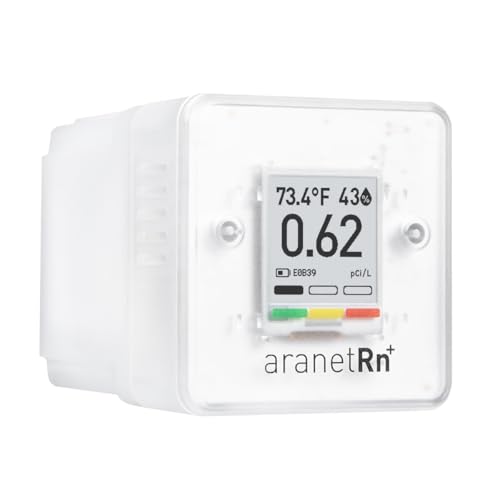
Products shown because their documented specifications fit this guide. Price and availability are on Amazon and can change.
Frequently Asked Questions
Which radon reading should I compare with the action level?
The long-term average, ideally covering 90 days or more including a heating season. Action levels are defined as annual averages.
Why is my short-term radon reading jumping around?
Radon detection counts random radioactive decays, so short windows have large statistical noise, and real levels also swing with weather. Both effects shrink as the averaging period lengthens.
How long until a consumer radon monitor is accurate?
Manufacturers typically state about ±20 percent after 7 days and ±10 percent after 30 days at moderate levels. Treat the first week as settling time.
Affiliate disclosure: Akermin earns a commission from qualifying Amazon purchases made through links on this page. Our editorial picks are based on documented specifications and owner feedback, not commissions.