As an Amazon Associate, Akermin earns from qualifying purchases. Product links on this page are affiliate links.
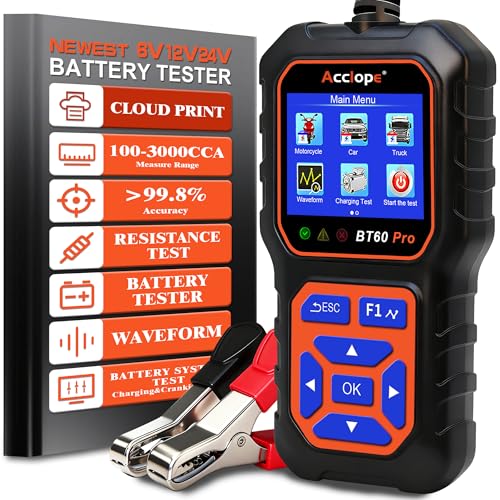
Short answer: For a genuine capacity check on a deep cycle battery, the Auto Meter SB-300 (P10) is the pick because the listing states it applies a true 40 amp load consistent with BCI testing standards, which is the closest thing here to a real capacity test. The Battery Tender 026-0020 is the value alternative if you want a resistive load tester that works on both 6V and 12V. If you prefer a conductance tester that needs no heavy load, the Acclope BT60 PRO covers 6V, 12V and 24V and states a 2 to 120Ah range. None of these replaces a shunt monitor for tracking capacity over time, and none of them is a substitute for a proper timed discharge test if you need a number in amp hours.
What a capacity test actually means
A battery’s capacity is the amount of charge it can deliver, usually expressed in amp hours. The standard way to measure it is a timed discharge: apply a known current and measure how long the battery holds above a cutoff voltage. A 100Ah battery discharged at 5 amps should last about 20 hours. If it lasts eight, it has lost more than half its capacity, whatever its voltage says.
Handheld testers do not do this. A load tester applies a heavy current for a few seconds and watches the voltage response. The Auto Meter SB-300 (P10) states a true 40 amp load consistent with BCI testing standards, which is a recognised way to stress a battery and see whether it holds up. The Battery Tender 026-0020 states 100 amps at 12V. Both are short tests. They tell you whether the battery can deliver high current, which correlates with capacity but is not the same measurement.
A conductance tester takes a different route. It applies a small signal and measures the battery’s internal resistance, then compares that against a model to estimate state of health. The Acclope BT60 PRO states a 2 to 120Ah capacity range and reports resistance directly. The ANCEL BA101 and MOTOPOWER MP0515A report state of health and internal resistance. Conductance testing is fast and safe, but it infers condition rather than measuring it, and it can be fooled by a battery with a single bad cell. If you want to understand how resistance relates to battery condition, the internal resistance testers for maintenance page goes deeper.
Why a voltage check is not enough
A voltmeter is the cheapest battery tool there is, and it is genuinely useful. A flooded lead-acid battery at rest reads about 12.6 volts when fully charged and about 12.0 volts at half charge. That tells you state of charge. It does not tell you state of health.
The failure mode that catches people out is sulphation. When a lead-acid battery sits discharged, lead sulphate crystals form on the plates and harden. The battery will still accept a charge and still read 12.6 volts at rest, but the effective plate area is reduced, so it cannot deliver much current. A voltage check passes it. A load test fails it. This is why a deep cycle battery that has been left flat over winter can read fine and still be useless.
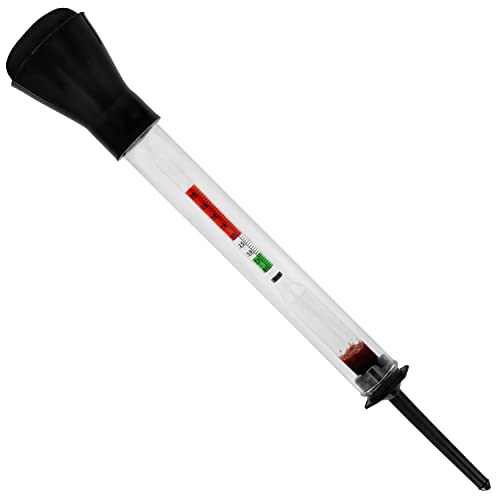
A hydrometer, such as the Mighty Max, gets closer to the chemistry. It reads the specific gravity of the electrolyte, which reflects the acid concentration and therefore the state of charge. Reading each cell individually can reveal one weak cell that drags the whole battery down. But a hydrometer only works on flooded batteries with removable caps, and it still measures state of charge rather than capacity. For a broader look at electrical test instruments, see the electrical testers comparison.
Load testing, conductance testing and the shunt monitor
Three different tools, three different jobs. A load tester draws a heavy current and watches the voltage. It is the closest a handheld instrument gets to a real capacity test, and it is the only method here that puts the battery under genuine stress. The Auto Meter SB-300 (P10) states a 40 amp load; the Battery Tender states 100 amps at 12V. Both will heat up, and neither listing states a duty cycle, so apply the load briefly.
A conductance tester applies a small signal and estimates condition from internal resistance. It is fast, repeatable and safe to use on a battery that is still connected. The Acclope BT60 PRO covers 6V, 12V and 24V and states a 2 to 120Ah range. The ANCEL BA101 and MOTOPOWER MP0515A are 12V units with stated CCA ranges of 100 to 2000. Conductance testers are good for screening a batch of batteries quickly, but they are not load tests.
A shunt monitor is a different category altogether. It stays installed, measures current in and out, and counts amp hours over time. It tells you how much capacity you have actually used and replaced, which is the closest thing to real-world capacity tracking. It does not apply a load or stress the battery. If you are running a solar or marine bank, a shunt monitor is the tool that tells you whether your capacity is declining over months. A handheld tester gives you a snapshot; the monitor gives you the trend. For DC current measurement in related work, the clamp meters for DC motor checks page covers the instruments.
The maintenance nobody mentions
The most common mistake with deep cycle batteries is testing them at the wrong state of charge. A conductance tester or load tester expects a reasonably charged battery. Test a flat battery and you will get a bad reading that says more about your charging habits than about the battery’s health. Charge it fully, let it rest, then test.
Temperature matters too. The ANCEL listing states you should enter the correct battery type, rating value and temperature for the most accurate test. Conductance testers model the battery’s behaviour, and that model assumes a temperature. A cold battery has higher internal resistance and will read worse than it is. If you test in an unheated garage in winter, expect a pessimistic result.
The second thing nobody mentions is that a load tester needs recovery time. After a heavy load test, the battery’s voltage dips and slowly recovers. Testing again immediately gives a misleading result. Wait, and test again if you are unsure. And keep a record: voltage, state of health and the conditions each time. A single reading is noise; a series of readings over months is a trend, and the trend is what tells you when to replace the battery.
Where this category stops being the right answer
If you need a capacity figure in amp hours, none of these instruments will give it to you. The only way to get that number is a controlled discharge test: apply a known load, time it, and calculate. That takes hours and requires you to take the battery out of service. For a critical bank, it is worth doing occasionally, but it is not a handheld tester’s job.
If you need to know how your battery behaves in daily use, a shunt monitor is the right tool. It tracks charge in and out and shows you the real capacity you are using. A handheld tester cannot do that because it is not installed.
And if your battery is lithium, be careful. The Acclope listing states that LiFePO4 support is limited to voltage and health checks and does not guarantee precise CCA measurement. Conductance testers are calibrated for lead-acid, and lithium iron phosphate has a very different resistance profile. For lithium banks, a shunt monitor plus the battery’s own management system is a more reliable combination than a handheld conductance tester. Finally, remember that a tester is not an alarm. It tells you the condition at the moment you connect it. It will not warn you that a cell is about to fail while you are asleep. For that, you need monitoring, not testing.