Best Electrical Testers: 12 Essential Tools for Accurate Diagnostics
Electrical tester is a category, not a product. It covers the pocket pen that says a wire is live, the two-pole tester that proves it dead, the clamp that reads load current and the socket analyzer that measures trip time. This hub sorts twelve current listings by what each one actually states it measures, and links down to the specific guides beneath it.
As an Amazon Associate, Akermin earns from qualifying purchases. Product links on this page are affiliate links.
Our Top Picks
Tools were sorted by the measurement each manufacturer listing actually claims: voltage presence, true RMS voltage and current, continuity, GFCI and RCD function, trip time and battery condition. We did not run laboratory tests and publish no measurements of our own. Where a listing gives no figure the entry reads Not stated.
Best Overall
Klein Tools 80197 AC/DC Clamp Meter Kit
An auto-ranging true RMS clamp with a voltage pen in the same kit.
Auto-ranging true RMS clamp meter, 400 amp, stated on the listing
Kit pairs the clamp with a non-contact voltage tester
Rare-earth magnetic hanger for hands-free measurement, stated
Every figure here is taken from the manufacturer listing for that product at the time of research. Where a listing publishes no value the cell reads Not stated rather than an estimate. Nothing on this page is a measurement of ours.
How to Choose an Electrical Tester
Four questions settle the purchase:
What Question Are You Asking?
Is it live, how much is flowing, and where is the fault are three different questions. A pen answers the first, a clamp the second, an analyzer or meter the third.
Category Rating
CAT II covers outlets and appliances, CAT III distribution panels and feeders, CAT IV the service entrance. Only the ZMIWNIED kit states a rating on its listing here. Check the manual before a panel.
True RMS
Drives, LED drivers and switching supplies distort the waveform. An averaging meter reads them low. The Klein, KAIWEETS, Testo 770-2, JASLEEN and MAXRIENY listings all state true RMS.
One Tool or a Kit
A kit costs less than the same pieces bought separately and keeps the pen with the meter. A single instrument is lighter if you already own the rest.
What is the difference between an electrical tester and a multimeter?
A multimeter is one kind of electrical tester. The wider term also covers non-contact voltage pens, two-pole voltage testers, receptacle and circuit analyzers, clamp meters, insulation testers and battery testers. Each answers a narrower question faster than a multimeter does, which is why most technicians carry two or three rather than one.
Can a non-contact pen prove a circuit is dead?
No. A pen senses the electric field around an energised conductor, so it can be fooled by shielding, by conduit, by the way it is held and by a flat battery. To prove a circuit dead, use a two-pole or contact tester, and test it on a known live source before and after the dead check. That live, dead, live routine is the only sequence that catches a failed instrument.
Do I need true RMS for household wiring?
For a plain resistive load such as a heater or an incandescent lamp, no. For anything with electronics in it, which now means LED lighting, variable-speed motors, inverters and most appliances, yes. An averaging meter reads distorted waveforms low, and the error is not a fixed percentage you can correct for.
What does the CAT rating on a tester mean?
It describes the transient energy the instrument is built to survive at that point in the installation, not the voltage it can read. CAT II is the outlet, CAT III the distribution panel and fixed wiring, CAT IV the service entrance and outdoor supply. A meter used above its rating can fail catastrophically even when the steady voltage is within range.
Is a plug-in circuit analyzer better than a three-light receptacle tester?
It answers more questions. A three-light tester shows wiring order and nothing else, so it misses a bootleg ground, a high-resistance connection and a protective device that has stopped tripping. An analyzer that measures voltage drop under load and RCD or GFCI trip behaviour finds those. The three-light tester still wins on speed and price for a quick sweep of a house.
Reviews
Klein Tools 80197 AC/DC Clamp Meter Kit Best Overall
Most electrical questions are answered by two tools used in sequence: a pen that tells you a conductor is energised, and a clamp that tells you how much current it is carrying. Klein sells that pairing as one kit. The listing states an auto-ranging true RMS clamp rated at 400 amp, a non-contact voltage tester in the box and a rare-earth magnetic hanger so the meter can sit on a panel door while both hands stay on the work.
True RMS is the specification that matters most here. Motor drives, LED drivers and switching supplies distort the current waveform, and an averaging clamp reads those circuits low. Klein states true RMS on the clamp, so a reading taken on a drive-fed motor is a reading you can quote.
What the listing does not state is the voltage range of the clamp, the category rating, the count resolution or the battery type, so a buyer who needs a CAT III or CAT IV figure for a job specification has to read the manual before taking it to a distribution panel. Never use any meter above its stated category or voltage rating.
Strengths
Clamp and voltage pen bought together
True RMS stated, so drive-fed circuits read correctly
Magnetic hanger frees both hands at a panel
400 amp auto-ranging stated on the listing
Limitations
Category rating not stated on the listing
Voltage range and counts not stated
A clamp is bulkier than a pocket pen for a simple live check
intendvision Digital Circuit Analyzer Best for Fault Finding
A three-light receptacle tester tells you whether the hot, neutral and ground are in the right holes. It tells you nothing about how much the circuit sags under load, or whether the protective device actually opens. This analyzer is the step up. The listing states true RMS AC voltage measurement, RCD and GFCI testing, voltage drop and line fault location, and describes the tool as being built for quick fault location on AC low-voltage distribution circuits.
Voltage drop is the measurement that finds the faults the light pattern misses: a backstabbed receptacle, a loose lug, an undersized run feeding a long circuit. The socket reads normal until current flows, then the voltage collapses, and only a tester that loads the circuit will show it.
The listing does not state the trip current settings, the trip time resolution, the display type or the safety category, so treat those as unverified. The brand is not a household name in test equipment, and for compliance paperwork a tester with a published standards reference is the safer purchase.
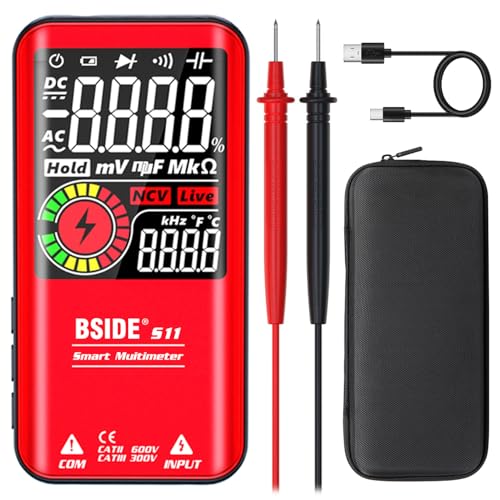
For a homeowner or a maintenance generalist, the barrier to using a meter is not the price, it is the dial. BSIDE answers that with Smart Mode: the listing states the meter automatically measures AC and DC voltage, resistance and continuity at the best resolution without being told which one you want. Touch the leads to a socket and it reads volts; touch them across a fuse and it beeps.
The 9999 count display gives one more digit of resolution than the 6000 count meters that dominate this price band, and the three-result display shows more than one value at a time. The colour LCD is easier to read in a dim basement than a grey segment display.
The listing stops there. It does not state a category rating, a maximum voltage, an accuracy figure, true RMS or the charge method beyond the word rechargeable. That is a meaningful gap: without a stated CAT rating this should be treated as a low-energy tool for outlets, appliances and low-voltage circuits, not a panel instrument.
Short answer: the Klein Tools 80197 kit is the best general-purpose buy, because it pairs an auto-ranging true RMS clamp with a non-contact voltage pen and covers the two questions asked most often; the intendvision circuit analyzer is the one to add when the problem is a fault rather than a reading, since its listing states voltage drop plus RCD and GFCI testing; and the BSIDE colour LCD multimeter is the value pick for a homeowner, with automatic function selection and 9999 counts, provided it is kept off distribution panels because no category rating is stated.
What counts as an electrical tester
The phrase covers at least six instrument families, and buying badly usually means buying the wrong family rather than the wrong model. A non-contact voltage pen answers one question, is this conductor energised, with no metal contact and no leads. A two-pole voltage tester answers the opposite question, is this conductor definitely dead, by loading the circuit slightly so ghost voltage collapses. A clamp meter reads current without breaking the circuit. A multimeter reads voltage, resistance and continuity with leads. A receptacle or circuit analyzer plugs into a socket and reports wiring order, voltage drop and protective-device behaviour. A battery tester reads state of charge and internal resistance. The twelve products in the table above span all six, which is why the comparison column asks what each listing says it tests rather than trying to rank them on one number.
Live, dead, live: the only sequence that is safe
Every instrument on this page can fail silently. A pen with a flat battery does not warn you, and a meter with a broken lead reads zero volts on a live bus. The routine that catches both is simple and non-negotiable: test the instrument on a known live source, test the conductor you intend to work on, then test the known live source again. If the instrument passed before and after, the dead reading in the middle can be trusted. Non-contact pens have a second failure mode worth knowing about, covered in what non-contact voltage detection actually senses: they respond to the field around a conductor, so metal conduit, a shielded cable or the way the tool is held can hide a live wire. That is why a pen is a screening tool and a contact tester is the proof.
Category ratings are about energy, not voltage
Only one listing in this group, the ZMIWNIED FS899L kit, states a category rating, and it states CAT III 1000 V and CAT IV 600 V. The rest publish nothing, which is a reason to check the manual rather than a reason to assume the worst. The rating describes how much transient energy the instrument can absorb without turning into an arc source, and it changes as you move upstream: an outlet is CAT II, a subpanel or a feeder is CAT III, and the service entrance and the supply outside the building are CAT IV. A 600 V CAT II meter used on a 240 V service entrance is being used out of category even though the number on the screen looks safe. What a CAT rating means and the four category levels explained go through it properly.
True RMS and the circuits that break averaging meters
Five of the twelve listings state true RMS: the Klein 80197 clamp, the KAIWEETS inrush clamp, the Testo 770-2, the JASLEEN and the MAXRIENY. That matters more every year. A cheap averaging meter is calibrated for a clean sine wave, and it reads low on anything chopped by electronics, which now includes LED lighting circuits, variable-speed fans, inverter-fed compressors and most switching power supplies. The error is not a fixed percentage, so it cannot be corrected after the fact. The full explanation is in what true RMS means on a multimeter, and if a reading will not sit still for you at all, why multimeter readings jump around covers the usual causes.
Finding a fault instead of taking a reading
A voltage reading at a socket is taken with no load on the circuit, which is exactly the condition under which a bad connection looks perfect. The intendvision analyzer is here because its listing states voltage drop and line fault location, meaning it loads the circuit and watches what happens to the voltage. That is the measurement that exposes a backstabbed receptacle, a loose neutral or an overlong run on undersized conductors. The same instrument states RCD and GFCI testing, which answers a different and equally important question: the device is installed, but does it still open, and how fast. For deeper coverage of those two jobs see our RCD tester hub and outlet tester hub.
Where the battery and ground testers fit
Two entries in the table sit outside AC troubleshooting and are worth explaining. The OBDResource BR502 is a battery tester: its listing states 6 V, 12 V and 24 V coverage from 100 to 2000 CCA and an internal resistance measurement, which is how a battery near the end of its life is identified before it strands a vehicle. The Ideal Electrical 3-pole unit is an earth ground tester using the fall of potential method, a soil measurement rather than a circuit measurement, and it belongs to grounding work rather than fault finding. Both appear here because the category term reaches that far; both are compared properly on their own hubs, battery capacity testers and earth ground testers.
Listings were compared on the measurement functions stated, stated ranges and resolution, true RMS, safety category, display type and power source. Owner feedback was reviewed for recurring reports of inaccurate readings and early failure. We did not run laboratory tests, we publish no measurements of our own, and no figure appears on this page unless the manufacturer published it. Amazon data supplies images, availability and links only.
A voltage range describes what an instrument will read, a measurement category describes where it may be connected, and a listing that gives one without the other leaves the safety question unanswered.
A meter fuse protects the current input path and its interrupting capacity has to match the fault energy the category implies, but the category itself comes from clearances and input protection rather than from the fuse.
Exceeding a measurement category usually ends in a flashover across internal clearances rather than a blown display, and the most common outcome is an instrument that still reads correctly with its safety margin gone.