As an Amazon Associate, Akermin earns from qualifying purchases. Product links on this page are affiliate links.
Multimeter readings jump for a handful of reasons, each with its own pattern. Random numbers with nothing connected are the open input picking up stray fields. A steady flicker in the last digit is normal noise. Slow drifting on a dead conductor is ghost voltage. Values that hunt between two ranges are auto-ranging at a boundary. A reading that changes when you wiggle the probe is a bad contact or lead. Understanding which one you are seeing turns an annoyance into a diagnostic.
Sources of unstable readings
| Symptom | Likely cause | Fix |
|---|---|---|
| Random values with leads not connected | High-impedance input floating; picks up mains fields | Normal; connect to a circuit or short the leads to see zero |
| Last digit flickers by 1 or 2 counts | Resolution and noise | Normal; within spec. See resolution in a digital meter |
| Tens of volts on a supposedly dead wire, drifting | Capacitive coupling from a live conductor | Use LoZ mode; see ghost voltage |
| Display cycles between two values or ranges | Auto-ranging at a boundary | Select the range manually |
| Reading changes when you move the probe or lead | Poor contact, corroded terminal, damaged lead | Clean the contact; replace leads; check lead resistance (should be under 0.5 Ω) |
| DC reading wobbles on a supply | AC ripple on the DC; a switching supply or an unfiltered rectifier | Check with AC range; use a meter with AC+DC RMS if the true value matters |
| Reading wanders slowly on low millivolt ranges | Thermal EMF at dissimilar-metal junctions; hand warmth on probes | Let temperatures settle; use the relative (REL) function to zero |
| All readings erratic, display dim or battery symbol | Low battery | Replace it; low batteries also cause wrong readings |
| Resistance reading will not settle on a large value | Capacitance in the circuit charging; body resistance through fingers touching probe tips | Wait; keep fingers off the metal tips |
| Reading jumps when a motor or heater nearby switches | Real transients on the circuit | Use MIN/MAX or a logging meter to capture them |
| Frequency or duty cycle reading unstable | Noisy signal, wrong trigger level, low amplitude | Use a scope; frequency counters on meters need a clean signal |
The floating input
A modern meter presents about 10 MΩ to the circuit. With nothing connected that input is an antenna; mains wiring in the walls and the meter’s own user induce a few volts of 50 or 60 Hz hum, and the display shows a changing value in the tens of volts on AC ranges or a wandering number on DC. This is not a fault and does not indicate a calibration problem. Touch the leads together and it reads zero.
Getting a steady reading
- Check the battery.
- Check the leads: continuity, low resistance, no cracks, firm in the jacks.
- Choose the right function and, if hunting, a manual range.
- Make firm contact on clean metal; use clips rather than hand-held probes for readings that must be watched.
- Keep fingers off probe tips and away from high-resistance measurements.
- For genuinely noisy circuits, use the meter’s averaging or MIN/MAX/AVG functions.
- For distorted AC, use a True RMS meter; see what True RMS is.
When instability is the finding
A voltage that dips every time a compressor starts, a resistance that changes as a component warms, a current that fluctuates on a failing motor: these are real and the meter is reporting them faithfully. Meters with MIN/MAX capture the extremes; logging meters record the pattern. Meters for the job are in best multimeters for home and DIY.
Recommended Tools

Fluke 117 Digital Multimeter, Non-Contact AC Voltage Detection, Measures Resistance/Continuity/Frequency/Capacitance/Min
View on Amazon
Products shown because their documented specifications fit this guide. Price and availability are on Amazon and can change.
Frequently Asked Questions
Why does my meter show random numbers with nothing connected?
A high-impedance input with no circuit attached picks up stray fields from mains wiring and your body. It is normal. The display settles when the leads touch a real circuit.
Why does the reading flicker in the last digit?
That is noise at the limit of the meter's resolution. A change of one or two counts in the last digit is normal and is within the accuracy specification.
Why does an auto-ranging meter keep switching?
The value sits near a range boundary, so the meter hunts between ranges. Lock the range manually if the meter allows it.
Affiliate disclosure: Akermin earns a commission from qualifying Amazon purchases made through links on this page. Our editorial picks are based on documented specifications and owner feedback, not commissions.
Related Guides

Fluke 1AC II VoltAlert Review: Two Detection Thresholds in One Listing
A pocket sized non contact voltage tester whose tip glows red and beeper sounds when voltage is detected, with a continuous self test and a choice of audible or silent operation.
Read More→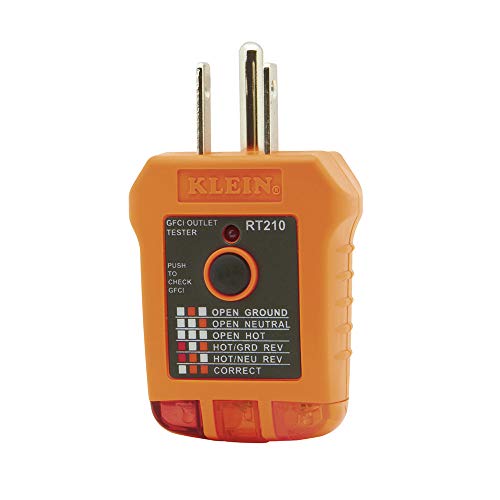
Klein Tools RT210 Review: A Fault Finder That Does Not List Its Faults
A three wire receptacle tester for standard and GFCI North American outlets, specified for 110 to 125 volts AC at 50 or 60 Hz, a 6.6 foot drop and an operating range of 32 to 140 degrees Fahrenheit.
Read More→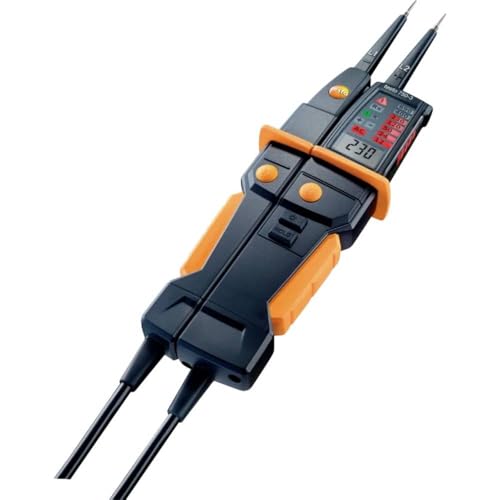
Testo 750-3 Review: Four Bullets, and No Published Category Rating
A two pole voltage tester with a three digit LCD showing measured voltage, a patented LED voltage bar viewable from any angle, polarity detection on DC and a GFCI test function for AC outlets.
Read More→