Best RCD Testers: 9 Reliable Picks for Fast Electrical Safety Checks
A residual current device that has not tripped in ten years may not trip when it has to. Testing one properly means measuring the current at which it opens and how long it takes, not just pressing a button. This hub separates the nine testers into those that indicate and those that measure.
As an Amazon Associate, Akermin earns from qualifying purchases. Product links on this page are affiliate links.
Our Top Picks
Testers were separated into instruments that measure trip current and trip time and plug-in devices that confirm a protective device operates. Comparison uses stated trip current settings, stated voltage and frequency ranges and stated standards references. All figures are the manufacturers' own.
Best Overall
PEAKMETER MS5910 RCD Loop Resistance Tester
Trip current, trip time, voltage and loop resistance with selectable settings.
Stated RCD trip current settings of 10, 30, 100, 300 and 500 mA
Measures trip current, trip time, voltage and loop resistance, per the listing
AC voltage range 0 to 440 V and frequency 45 to 65 Hz stated
Automatic range selection with manual override stated
Only the PEAKMETER MS5910 publishes trip current settings on its listing. Plug-in testers apply a fault current the manufacturer does not state, so a pass from one is an indication that the device operated, not a measurement against a standard.
How to Choose an RCD Tester
Decide what the result has to prove:
Indicate or Measure
A plug-in tester says the device tripped. A measuring instrument says it tripped at 24 mA in 31 milliseconds. Certification needs the second.
Trip Current Settings
Devices are rated at 10, 30, 100, 300 or 500 mA. Only the PEAKMETER states selectable currents, which is what lets you test a device against its own rating.
Loop Impedance Too
An RCD is only half the protection. If earth fault loop impedance is too high, overcurrent protection will not clear a fault fast enough. The PEAKMETER and both Kyoritsu units state loop testing.
External Test Beats the Button
The device's own test button uses its internal circuit. An external tester sends fault current through the installation ground, so it checks the wiring as well as the mechanism.
They are the same protective concept under different regional names. Residual current device is the term used in Europe, the UK, Australia and much of Asia; ground fault circuit interrupter is the North American term. Both compare the current flowing out with the current returning and open the circuit when the difference exceeds a threshold. Typical thresholds differ, with 30 mA common for personal protection in RCD territory and around 5 mA for GFCI receptacles.
Is the test button on the device enough?
It is better than nothing and should be used regularly, but it only exercises the device's internal circuit. It does not confirm that the earth conductor is intact, that the device is correctly wired, or how fast it opens. An external tester injects the fault current through the installation's ground path, so it tests the wiring as well. If the internal button trips the device but an external tester does not, the ground is usually missing.
How fast should an RCD trip?
The maximum disconnection times are set by the standard applying to your installation, and they vary with the device type and the test current. The point of measuring trip time rather than observing a trip is that the number can be compared to that limit and to the previous year's result. A device that has slowed from 30 to 200 milliseconds is deteriorating even if both figures pass.
Why does my RCD trip when I test it but also trip randomly?
Nuisance tripping usually means genuine leakage somewhere on the circuit rather than a faulty device. Every appliance with a filter leaks a small current to earth, and enough of them on one circuit sums to a meaningful fraction of a 30 mA threshold. Damp, damaged cable and failing heating elements add more. Splitting the circuit or measuring leakage with a leakage clamp is the diagnostic; see our leakage current clamp meter guide.
Can these testers check a type B or a DC-sensitive RCD?
None of these listings states type B or DC-sensitive testing, so treat it as unsupported. Type B devices, used on EV charge points and some inverter installations, respond to smooth DC residual current that a standard AC tester does not produce. Testing those requires an instrument that explicitly states the capability.
Reviews
PEAKMETER MS5910 RCD Loop Resistance Tester Best Overall
This is the instrument on the page that actually measures rather than indicates. PEAKMETER states selectable trip currents of 10, 30, 100, 300 and 500 mA, which matches the standard device ratings found in domestic and commercial installations, and it reports trip current, trip time, voltage and loop resistance.
The trip current settings are what make it useful for real testing. A 30 mA device should not trip at half its rating and must trip at its rating within a defined time; testing only at one current tells you far less than testing at several. The stated AC range of 0 to 440 V and 45 to 65 Hz frequency coverage puts single-phase and 400 V three-phase distribution within scope.
Loop resistance in the same instrument matters because a residual current device is only half of the protection. If the earth fault loop impedance is too high, an overcurrent device will not operate quickly enough on a line to earth fault regardless of the RCD. The listing does not state accuracy, a category rating or a standards reference, so for formal certification work confirm all three in the manual.
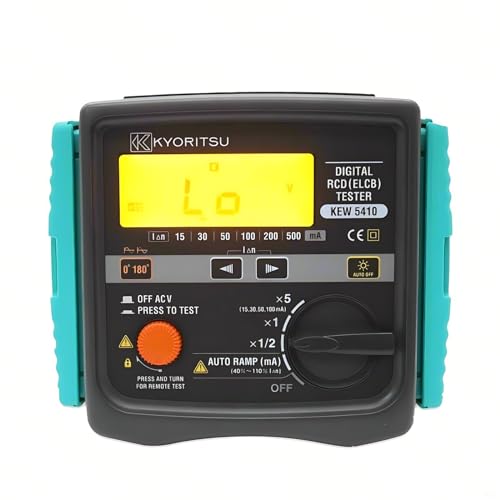
Kyoritsu KEW 5410 RCD Tester Best for Documentation
When a test result is going on a certificate, the instrument that produced it matters as much as the number. Kyoritsu is a test-equipment manufacturer whose instruments are built and documented to IEC standards, and the KEW 5410 listing states measurement of RCD trip time alongside loop testing, portable appliance testing and resistance measurement.
Trip time is the figure that turns a pass into evidence. Standards define maximum disconnection times for residual current devices, and a device that opens at 180 milliseconds and one that opens at 38 milliseconds both trip, but only one of them is doing its job. Recording the number lets a periodic inspection compare this year to last and see a device degrading before it fails.
The listing publishes no trip current settings, no accuracy figures and no category rating, which is frustrating on an instrument at this level, and the sibling KEW 6010B in the table is the fuller multifunction unit if insulation and continuity are also needed. Availability of Kyoritsu instruments and their accessories varies by region.
Strengths
Trip time measurement stated explicitly
Manufacturer with published standards compliance across its range
For the everyday question of whether the protective device on this socket still works, a plug-in tester is the right amount of tool and the ST120 plus is a well-made example. Fluke states an integrated GFCI test button that verifies correct operation of GFCI-equipped outlets, with an audible beeper alongside the indicators.
The beeper is a genuinely useful difference. Testing a run of sockets behind furniture or under a worktop means you often cannot see the tester while you press the button, and a tone tells you what happened without contorting yourself.
What it will not do is measure. There is no trip time, no trip current selection and no loop impedance, so a pass here means the device opened under whatever fault current the tester applies, which the listing does not state. That is enough for a homeowner or a fast service check and not enough for certification. An external test like this is still better than the button on the device itself, because it routes the fault current through the installation's ground conductor and therefore tests the wiring as well as the device.
Strengths
Verifies the device actually opens, not just that it exists
Audible confirmation when the tester is out of sight
Short answer: the PEAKMETER MS5910 is the instrument to buy for real testing, stating selectable trip currents of 10, 30, 100, 300 and 500 mA plus trip time, voltage and loop resistance; the Kyoritsu KEW 5410 is the choice where results go onto a certificate, from a manufacturer that documents to IEC standards; and the Fluke ST120 plus is the value pick, a plug-in GFCI check with an audible beeper for fast confirmation that a device still opens.
What a residual current device does, and how it fails
An RCD or GFCI compares the current flowing out on the line conductor with the current returning on the neutral. In a healthy circuit they match. If some current is leaving by another route, through a person, through damaged insulation, through a wet enclosure, the difference appears and the device opens the circuit. The threshold is small, typically 30 mA for personal protection in RCD territory and around 5 mA for a North American GFCI receptacle, and the disconnection has to happen fast enough to matter. The failure mode that makes testing necessary is that a device can sit undisturbed for years, pass power perfectly and have a mechanism that has stiffened or a sensing circuit that has drifted. Nothing about its appearance or its ability to supply a load reveals that.
Indicating versus measuring
Six of the nine products here indicate. The Klein RT210 and RT250, the Fluke ST120 plus, the Testo 750-3, the intendvision analyzer and, by implication, the multifunction units apply a fault current and report whether the device opened. That is a useful answer and it takes seconds. Three measure, or state that they do: the PEAKMETER MS5910 with selectable trip currents from 10 to 500 mA plus trip time and loop resistance, and the two Kyoritsu instruments, the KEW 5410 stating trip time measurement and the KEW 6010B stating continuity, insulation, loop, RCD and voltage testing to IEC 61010-1 and IEC 61557. The difference matters when the result is written down. A trip is a pass. A trip at 24 mA in 31 milliseconds is evidence that can be compared with the standard and with last year.
Why testing at several currents tells you more
A device rated at 30 mA is meant to do two things: not trip at half its rating, so the installation is usable, and trip at its rating within a defined time, so a person is protected. Testing at a single current only ever answers half of that. An instrument with selectable trip currents, which among these listings means the PEAKMETER, can apply half the rated current and confirm the device holds, then apply the rated current and record the time, then apply a multiple and confirm the faster disconnection. A device that trips at 12 mA is as much of a problem as one that does not trip at 30, because it will nuisance trip and eventually be bypassed by a frustrated occupant.
The external test beats the device’s own button
Every RCD and GFCI has a test button, and pressing it regularly is good practice that should not be discouraged. But the button drives the device’s own internal test circuit, which deliberately creates an imbalance inside the unit. It proves the mechanism moves. It does not prove the device is correctly wired, does not prove the protective earth conductor is intact, and gives no timing information. An external tester creates the imbalance by diverting current into the earth conductor of the installation, which means the test passes only if that conductor is present and connected. That is why a socket where the built-in button trips but a plug-in tester does not is a specific and common finding: the ground is missing. The outlet tester hub covers the socket-level checks in more detail.
Loop impedance is the other half of protection
A residual current device protects against current leaving the circuit. It does nothing about a short between line and neutral, and it is not the primary protection against a line to earth fault carrying hundreds of amps. That job belongs to the overcurrent device, and whether it operates fast enough depends on the earth fault loop impedance, the total impedance of the path from the fault back through the earth conductor and the supply transformer. Too high, and the fault current is too small to trip the breaker quickly. The PEAKMETER states loop resistance measurement and both Kyoritsu instruments state loop testing, which is why instruments in this class usually combine the two. The full installation test set is compared on the multifunction tester hub.
Nuisance tripping and cumulative leakage
When an RCD trips repeatedly with no obvious fault, the cause is usually real leakage rather than a faulty device. Almost every modern appliance includes filtering that deliberately passes a small current to earth, typically a fraction of a milliamp, and a circuit with enough of them accumulates a standing leakage that eats into the 30 mA budget before any fault occurs. Add a damp outbuilding, an ageing immersion heater or a damaged flex and the total crosses the threshold intermittently. The diagnostic is to measure the standing leakage with a leakage current clamp, which reads down into the milliamp region around the line and neutral together; see leakage current clamp meters. The remedy is usually to split the circuit rather than to fit a less sensitive device.
Instruments were separated into measuring testers and plug-in indicators, then compared on stated trip current settings, whether trip time is measured, stated voltage and frequency ranges, and any published standards reference. Owner feedback was reviewed for repeated reports of nuisance tripping and failed tests. We ran no tests of our own and publish no measurements. Amazon data supplies images, availability and links only.
A voltage range describes what an instrument will read, a measurement category describes where it may be connected, and a listing that gives one without the other leaves the safety question unanswered.
A meter fuse protects the current input path and its interrupting capacity has to match the fault energy the category implies, but the category itself comes from clearances and input protection rather than from the fuse.
Exceeding a measurement category usually ends in a flashover across internal clearances rather than a blown display, and the most common outcome is an instrument that still reads correctly with its safety margin gone.