As an Amazon Associate, Akermin earns from qualifying purchases. Product links on this page are affiliate links.
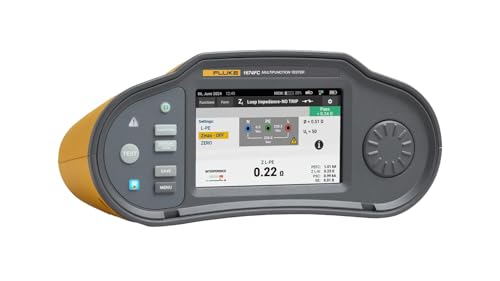
Short answer: the Fluke 1674FC is the installation tester to buy for AC certification work, with touch screen or PC setup and remote test capability; the Fluke SMFT-1000 Pro Kit is the solar equivalent and the only product here that names its standard, stating IEC 62446-1 Category 1 and Category 2; and the ACEIRMC LCR-TC1 is the value pick for a completely different job, identifying and measuring discrete components on a bench at a fraction of the price.
Four different instruments, one label
Multifunction tester is the least precise term in electrical test equipment, and the table above deliberately leads with a group column because of it. Three of these ten are installation testers, built to perform a certification sequence on fixed wiring: the Fluke 1674FC and the Srliya insulation and RCD loop tester. Two are photovoltaic test kits, the SMFT-1000 Pro Kit and the SMFT-1000 Solar Tools Kit. Two are bench component identifiers, the ACEIRMC LCR-TC1 and the HiLetgo LCR-T4. Two are multi-parameter battery monitors, the CGELE 300 A and 100 A shunt units. One is a wall scanner, the Jurgen K five-in-one stud locator. Every one of them legitimately does several things, and almost none of them substitutes for another. Choosing correctly means naming the job before comparing any specification.
What an installation tester replaces
Certifying a fixed installation means running a defined sequence: continuity of protective conductors, insulation resistance, polarity, earth fault loop impedance, prospective fault current and residual current device operation, all recorded against the circuit they were measured on. Done with separate instruments that is four or five tools, four or five sets of leads and a clipboard, with a transcription error waiting at every step. An installation tester performs the sequence from one connection and stores the results together. The Fluke 1674FC listing emphasises the part that actually consumes time on a large job, which is setup and data handling: a colour touch screen on the instrument, or configuration from a PC, plus remote test capability and the Fluke Connect designation for getting results off the instrument without retyping. The individual measurements are compared on our insulation tester, RCD tester and earth ground tester hubs.
Solar is a separate discipline with its own standard
Both SMFT-1000 listings state something no other product here does: compliance with IEC 62446-1 for Category 1 and Category 2 tests. Category 1 is the commissioning set every new array requires, covering continuity of protective earthing and equipotential bonding, polarity, combiner box checks, string open-circuit voltage, operating or short-circuit current, functional testing and insulation resistance. Category 2 adds I-V curve measurement, which plots current against voltage across the string and compares the shape to the expected curve, revealing shading, mismatch, degradation and hot cells that static readings miss. The reason a general installation tester cannot simply be pointed at an array is physical: the string is an energised DC source whenever light falls on it, voltages reach 1000 V residentially and commercially and 1500 V on utility systems, and everything connects through MC4 rather than probes. See how to choose a solar PV tester, PV commissioning testers and solar I-V curve tracers.
Component testers, and why they are here
The LCR-TC1 and the LCR-T4 do something genuinely useful and completely unrelated to installation work. Clip an unknown discrete part across the terminals and the instrument identifies what it is, determines the pinout and measures the parameters that matter for that type. The ACEIRMC listing names NPN and PNP transistors, capacitors, resistors, diodes, triodes, N-channel and P-channel MOSFETs, IGBTs, JFETs, triacs and batteries; the HiLetgo listing names resistors, capacitors, diodes, SCRs, inductors, triodes and MOSFETs with a 128 by 64 graphical LCD. For board-level repair that automatic identification saves consulting a datasheet for every unmarked part. The warning that has to accompany them is unambiguous: these are bench instruments with no safety rating, and connecting one to mains or to any energised circuit will destroy it and may injure the user.
Monitors are not testers
The two CGELE units are the other easily confused group. Each uses an external shunt and displays nine parameters on one screen: voltage from 0 to 200 V, current to 300 A or 100 A depending on model, power, impedance, internal resistance, accumulated capacity and energy. That is a lot of functions, hence the multifunction label, but the purpose is continuous monitoring of an installed system such as an off-grid battery bank or a vehicle house battery, not portable testing. They are wired in and left there. For portable battery assessment the relevant tools are on how to choose a battery capacity tester and battery internal resistance testers, and for system monitoring see how to choose a battery monitor for an off-grid system.
The two outliers
The Ansbell power circuit probe is an automotive tool: its listing states 6 V, 12 V and 24 V DC circuit testing, short circuit location and continuity checking for faults such as headlights that will not light or windows that will not move. It is powered, so it can activate components as well as test them, which is a vehicle diagnostic technique with no building equivalent. The Jurgen K five-in-one stud locator is a wall scanner, stated to find metal, studs and live AC wires behind drywall using multi-sensing technology. Both carry the multifunction description honestly and neither belongs in a certification bag. They are compared properly on automotive diagnostics and wall scanners.
What to check before buying at this level
Three things, in order. First, the group: confirm the instrument tests what you actually need tested, because this is the category where that goes wrong most often. Second, the standards reference: if results will appear on a certificate, the instrument must be documented as testing to the standard that governs your work, and only two listings here state one. Third, data handling: on a job with fifty circuits, the difference between an instrument that exports results and one that does not is measured in hours, which is why the 1674FC listing leads with setup and remote tests rather than with ranges. Ranges and accuracies still matter, but on instruments at this level they are rarely the thing that makes a day go badly.
Guides in This Category