As an Amazon Associate, Akermin earns from qualifying purchases. Product links on this page are affiliate links.
Switch the circuit off and prove it dead; discharge any capacitors; disconnect at least one end of the component so no parallel path exists. Select ohms (Ω) and auto-range or a range above the expected value. Touch the leads together and note or zero the lead resistance (usually 0.1 to 0.5 Ω). Place the probes on the component without touching the metal tips, wait for the reading to settle, and read. OL means open; a few tenths of an ohm means a good connection or a short; the value in between is compared with the specification.
Why safety comes first
In ohms mode the meter is a small power source. External voltage on the circuit swamps its measurement and pushes current into its input circuitry. Most meters protect the ohms input to a few hundred volts for a moment, but repeated abuse blows fuses or damages the meter. Isolate and prove dead with a voltage test before every resistance measurement.
Procedure
- Isolate: switch off, unplug, or open the breaker; lock or label it.
- Prove dead: measure voltage across the points; expect zero. See measuring AC voltage.
- Discharge capacitors: motor run capacitors, power supply capacitors and camera flash circuits store charge; discharge through a resistor or the appliance’s bleed circuit per the manual.
- Isolate the component: disconnect one lead or lift one leg so the meter measures only it.
- Select ohms; auto-range or a manual range above the expected value.
- Zero the leads: touch the tips together; press REL if the meter has it, or subtract the reading from low-value measurements.
- Measure: probes on clean metal, fingers off the tips, wait for the reading to stabilize (high values and capacitance take seconds).
Reading the result
| Reading | Meaning |
|---|---|
| OL / infinity | Open circuit: broken wire, blown fuse, open element or winding, or the range is too low |
| 0.0 to 0.5 Ω | Continuity or a short; subtract lead resistance |
| Expected value ±10% | Component within specification |
| Much lower than expected | Shorted turns in a winding, or a parallel path still connected |
| Much higher than expected | Corroded connection, failing element, or finger contact |
| Reading that drifts | Capacitance charging, moisture, temperature change, or fingers |
Typical values
- Kettle or heater element (2 to 3 kW at 230 V): 15 to 30 Ω; at 120 V, 8 to 15 Ω.
- Oven element (2 kW at 230 V): about 26 Ω.
- Small motor winding: a few ohms to tens of ohms; compare windings against each other.
- Thermistor (NTC 10 kΩ): 10 kΩ at 25 °C, falling as it warms.
- Automotive coolant temperature sensor: 2 to 3 kΩ cold, a few hundred ohms hot.
- Spark plug lead: a few kΩ per meter.
- Fuse: near 0 Ω good; OL blown. See how to test continuity.
Sources of error
- Fingers on both tips: your body adds a parallel path of 100 kΩ to a few MΩ; irrelevant for low values, decisive for high ones.
- Lead resistance: 0.2 to 0.5 Ω, significant below 10 Ω.
- Temperature: copper windings rise about 0.4 percent per °C.
- Semiconductors in circuit: diodes and transistors conduct one way and confuse readings; use diode test or isolate.
- Range too low: shows OL for a good high-value component.
The four-wire method on bench meters removes lead resistance for milliohm work; a clamp meter and voltage drop test is the field equivalent for cables. See why multimeter readings jump around for unstable readings. Meters are compared in best multimeters for home and DIY.
Recommended Tools

Fluke 117 Digital Multimeter, Non-Contact AC Voltage Detection, Measures Resistance/Continuity/Frequency/Capacitance/Min
View on Amazon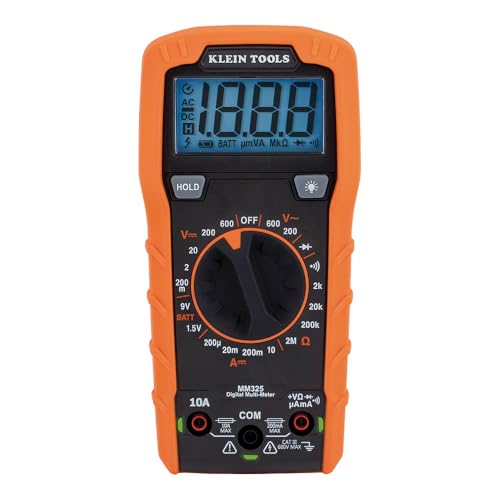
Products shown because their documented specifications fit this guide. Price and availability are on Amazon and can change.
Frequently Asked Questions
Can I measure resistance on a live circuit?
No. The meter injects its own current and expects no external voltage. A live circuit gives meaningless readings and can blow the meter's input protection. Isolate and prove dead first.
What does OL mean on the ohms range?
Over limit: the resistance is higher than the range can display, which for an open circuit (a blown fuse, a broken wire) is the expected reading.
Why does a resistor read lower in circuit than its marked value?
Parallel paths through other components share the meter's current. Lift one leg of the component to measure it alone.
Affiliate disclosure: Akermin earns a commission from qualifying Amazon purchases made through links on this page. Our editorial picks are based on documented specifications and owner feedback, not commissions.
Related Guides

Fluke 1AC II VoltAlert Review: Two Detection Thresholds in One Listing
A pocket sized non contact voltage tester whose tip glows red and beeper sounds when voltage is detected, with a continuous self test and a choice of audible or silent operation.
Read More→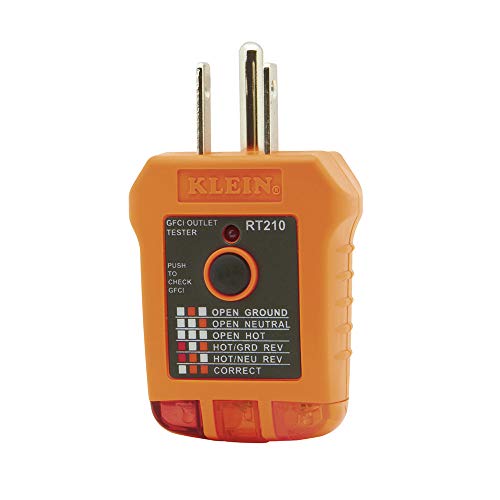
Klein Tools RT210 Review: A Fault Finder That Does Not List Its Faults
A three wire receptacle tester for standard and GFCI North American outlets, specified for 110 to 125 volts AC at 50 or 60 Hz, a 6.6 foot drop and an operating range of 32 to 140 degrees Fahrenheit.
Read More→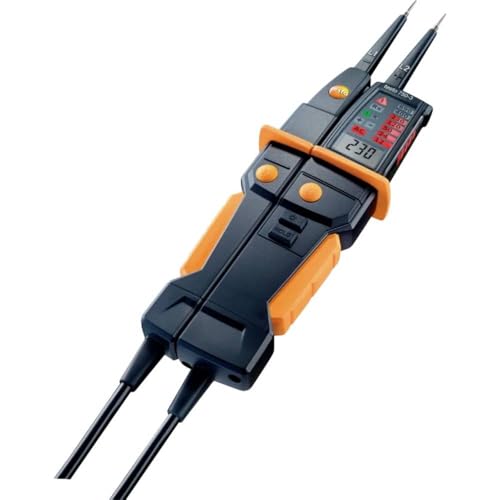
Testo 750-3 Review: Four Bullets, and No Published Category Rating
A two pole voltage tester with a three digit LCD showing measured voltage, a patented LED voltage bar viewable from any angle, polarity detection on DC and a GFCI test function for AC outlets.
Read More→