As an Amazon Associate, Akermin earns from qualifying purchases. Product links on this page are affiliate links.
No. A thermal camera images the surface temperature of the first opaque object in its view, and drywall, plaster, brick, wood and glass are all opaque to the long-wave infrared it detects. What a camera can do is show how things behind a surface change the temperature of that surface. Studs, pipes, wiring, insulation gaps and wet materials each conduct heat differently, so with a temperature difference across the wall they leave a visible pattern on it. That is inference from the surface, not sight through it.
Why not
Thermal cameras detect radiation at 8 to 14 micrometers. Building materials absorb and re-emit at those wavelengths, so what reaches the camera comes from the outer few micrometers of the surface. Glass is a special case: it blocks long-wave infrared and reflects it, so a window shows its own temperature and a mirror-image of the room. The idea of seeing through walls comes from films and from confusing thermal cameras with radar or terahertz imaging, which use entirely different physics.
What the surface reveals
| Hidden feature | Surface signature (winter, heated interior) |
|---|---|
| Timber studs | Vertical stripes slightly cooler than the insulated bays between them |
| Missing or slumped insulation | Larger cool patches, often at the top of a wall or in irregular shapes |
| Hot water or heating pipes | Warm lines, clearest shortly after the system runs |
| Wet insulation or damp drywall | Cool, irregular patch from evaporation; often below a window or at a ceiling stain |
| Air leakage paths | Cool streaks or feathering at joints, outlets and around windows |
| Cables carrying heavy current | Faint warm line; obvious only under load |
| Concrete lintels and steel | Cool bands where thermal bridging carries heat out |
Conditions that make it work
- A temperature difference of at least 10 °C across the wall, sustained for several hours. Early morning in the heating season is ideal.
- No direct sun on the surface; solar heating masks everything.
- A camera with sensitivity under about 70 mK; the signatures are often under 2 °C. See what NETD is.
- Time for the pattern to develop after a change; walls take hours to settle.
See why thermal images change with weather for the effect of conditions.
Misreadings to avoid
- A cool patch is not automatically moisture. Confirm with a moisture meter; see can thermal imaging find water leaks.
- A warm patch on a wall where someone leaned or a pet slept is residual heat, not a hidden object.
- A reflection in glossy paint or glass moves with you; a real feature does not.
- Different paints and materials have different emissivity, producing apparent temperature differences that are not real. See what emissivity is.
Cameras suited to building surveys are in best thermal cameras for home inspection; the detector physics is in how a thermal camera sees heat.
Recommended Tools

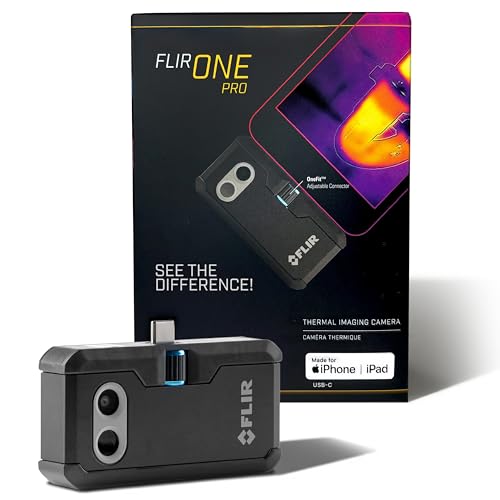
Products shown because their documented specifications fit this guide. Price and availability are on Amazon and can change.
Frequently Asked Questions
Can a thermal camera see people through walls?
No. Infrared at the wavelengths cameras use does not pass through building materials. A person leaning on a wall for a while may warm a patch of it, which the camera sees as a warm patch, not as a person.
Can it see through glass?
No. Glass is opaque to long-wave infrared and also reflective, so pointing a camera at a window shows the window's surface and a reflection of the room.
How does it show studs and pipes then?
By conduction. A stud conducts heat differently from the insulation beside it, so the drywall over it reaches a slightly different surface temperature, and the camera shows the stripe.
Affiliate disclosure: Akermin earns a commission from qualifying Amazon purchases made through links on this page. Our editorial picks are based on documented specifications and owner feedback, not commissions.
Related Guides

PHOEBUS LINK RCX100 Review: 40 mK Is the Figure This Job Needs
A handheld thermal camera with a 160 by 120 infrared detector, a 320 by 240 enhanced image, 40 mK sensitivity, a focus free 40 by 30 degree field of view, a 25 Hz refresh rate and still JPG image capture.
Read More→
Fluke 62 MAX+ Review: The Cold End Is Printed Three Different Ways
A non contact infrared thermometer for electrical, mechanical, HVAC and automotive surfaces, with dual rotating lasers that mark the edges of the measurement area, minimum, maximum, difference and average readings, and an IP54 rating.
Read More→
General Tools MMD7NP Review: Percent on Wood, Relative on Drywall
A pinless non invasive moisture meter that reads up to three quarters of an inch into a surface, with scales of 0 to 53 percent for softwood, 0 to 35 percent for hardwood and relative readings on wallboard, drywall and masonry.
Read More→