As an Amazon Associate, Akermin earns from qualifying purchases. Product links on this page are affiliate links.
Verdict
The testo 871s is the model to choose when the 868s’s 160×120 detector is the only thing holding it back. testo documents a 240×180 detector with SuperResolution to 480×360, the same thermal sensitivity class as its siblings, and the same assistance functions: ScaleAssist, the IFOV warner, automatic hot and cold spot marking, an integrated visible camera and the Thermography App for reports. It is not currently listed on Amazon US, so this review is based on testo’s documentation and on the listed 868s as the closest reference. For a building surveyor or maintenance electrician who wants more pixels without paying for the 872s, it is the sensible middle option.
What Is Different Across the Range
| Item | testo 868s | testo 871s | testo 872s |
|---|---|---|---|
| Detector | 160×120 | 240×180 | 320×240 |
| SuperResolution | 320×240 | 480×360 | 640×480 |
| Measurement pixels | 19,200 | 43,200 | 76,800 |
| ScaleAssist, IFOV warner, hot/cold spot | Yes | Yes | Yes |
| Visible camera and app | Yes | Yes | Yes |
| Amazon US listing | Listed | Not currently | Not currently |
What 240×180 Buys
Resolution in thermography is about distance and target size. With 43,200 pixels the 871s measures a target of a given size from roughly one and a half times the distance of the 868s, or resolves a target two-thirds the size from the same distance. On a building survey that means a whole facade in one frame with enough detail to see individual window reveals; in a plant room it means reading a terminal on a contactor without opening the enclosure door wider than necessary. SuperResolution to 480×360 makes the displayed image correspondingly sharper. Our guide to comparing thermal camera resolution explains how to translate detector size into working distance.
The Assistance Functions
The 871s inherits the functions that distinguish testo’s handhelds. ScaleAssist fixes the display scale from entered indoor and outdoor temperatures so that images from a survey are directly comparable. The IFOV warner shows the smallest measurable spot at the current distance. Hot and cold spot detection marks the extremes automatically. The integrated visible camera records a matching photograph for reports. These are the same on the 868s, so the decision between the two really is about detector size alone.
App and Reporting
The testo Thermography App connects to the 871s for live view on a phone or tablet, on-site analysis and PDF reports. For larger surveys, testo’s desktop software handles batches of radiometric images. Owners of testo handhelds describe the software as functional rather than elegant; the strength is that every image carries the scale, emissivity and reflected temperature settings, which is what makes a report defensible. See setting emissivity for why those settings matter.
Availability
Because the 871s is not on Amazon US, it is bought from testo directly or from instrument distributors, often as a kit with a case and sometimes with a calibration certificate. Buyers should confirm the current specification and warranty from testo, and compare the distributor price against the listed 868s and the 860i before deciding. For most building-diagnostics buyers the 871s is the sweet spot of the three; for those who mainly inspect at close range, the 868s does the same job for less. A useful way to decide is to list the three or four targets you photograph most often and the distance you can stand from each. If any of them is a small target at more than a few metres, such as a busbar connection in a switchroom or a flat-roof detail from the ground, the 871s pays for itself on the first report; if every target is a wall or a panel within arm’s reach, it does not. Our guide to choosing a thermal camera for home inspection covers the residential end of that decision.
Strengths
- More than double the measurement pixels of the 868s.
- Same assistance functions and reporting workflow as the rest of the range.
- Integrated visible camera.
Limitations
- Not currently listed on Amazon US.
- Fixed focus.
- Higher price than the 868s for the same functions.
How It Compares
The testo 868s is the listed, lower-cost sibling. The testo 872s adds 320×240 for professional inspection at distance. The testo 860i offers a 256×192 detector in a wireless phone-connected format at a lower price than the handhelds. The FLIR E5 Pro is the FLIR alternative at the 160×120 level with cloud upload.
How We Research
This review is based on testo’s published specifications for the 871s and the rest of the handheld range, the Amazon listing for the 868s as the closest listed model, and owner reports. We did not run laboratory tests. Buyers should verify current specifications with testo, since the model is not on Amazon US.
Recommended Tools

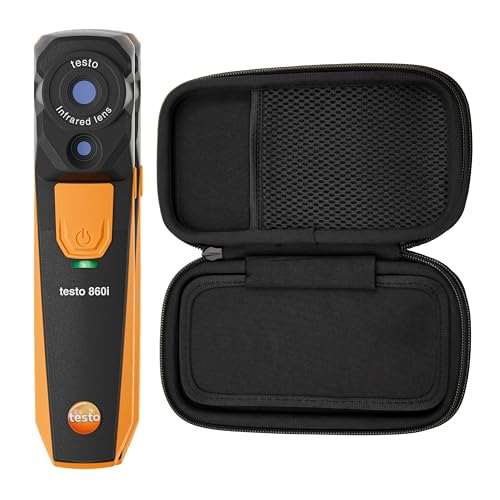
Products shown because their documented specifications fit this guide. Price and availability are on Amazon and can change.
Frequently Asked Questions
Is the testo 871s on Amazon?
Not on Amazon US at the time of writing. The 868s and the 860i are the testo thermal cameras listed. The 871s is sold through testo and instrument distributors.
How much better is 240×180 than 160×120?
It is 43,200 measurement pixels against 19,200, more than double. In practice you can measure a target of the same size from about one and a half times the distance.
Does it have the same functions as the 868s?
Yes. testo documents ScaleAssist, the IFOV warner, hot and cold spot detection, a visible camera and the Thermography App across the 868s, 871s and 872s.
Which should I buy, 871s or 872s?
The 872s has 320×240 and is aimed at professional inspection from distance. The 871s is the better value for building work and close-range electrical inspection.
Affiliate disclosure: Akermin earns a commission from qualifying Amazon purchases made through links on this page. Our editorial picks are based on documented specifications and owner feedback, not commissions.
Related Guides

PHOEBUS LINK RCX100 Review: 40 mK Is the Figure This Job Needs
A handheld thermal camera with a 160 by 120 infrared detector, a 320 by 240 enhanced image, 40 mK sensitivity, a focus free 40 by 30 degree field of view, a 25 Hz refresh rate and still JPG image capture.
Read More→
Fluke 62 MAX+ Review: The Cold End Is Printed Three Different Ways
A non contact infrared thermometer for electrical, mechanical, HVAC and automotive surfaces, with dual rotating lasers that mark the edges of the measurement area, minimum, maximum, difference and average readings, and an IP54 rating.
Read More→
General Tools MMD7NP Review: Percent on Wood, Relative on Drywall
A pinless non invasive moisture meter that reads up to three quarters of an inch into a surface, with scales of 0 to 53 percent for softwood, 0 to 35 percent for hardwood and relative readings on wallboard, drywall and masonry.
Read More→