As an Amazon Associate, Akermin earns from qualifying purchases. Product links on this page are affiliate links.
A refrigerant leak detector is a handheld sniffer with a probe that senses refrigerant gas in air at very low concentrations and indicates it with a tick rate, bar graph or number, so a technician can trace a leak to a joint, valve or coil. Heated-diode sensors are sensitive and inexpensive; infrared sensors are more selective and longer-lived and are becoming the standard for the flammable A2L refrigerants now in new equipment. Sensitivity is stated in grams per year of leak rate, and the good ones detect 3 g/yr or better.
Sensor types
| Sensor | How it works | Detects | Notes |
|---|---|---|---|
| Heated diode | Refrigerant molecules break down on a heated element, releasing halogen ions that change a current | CFC, HCFC, HFC; some HFO | Sensitive; sensor life about 1 to 2 years; false alarms on some oils and solvents; needs warm-up |
| Infrared | Refrigerant absorbs infrared at specific wavelengths in a sample cell | HFC, HFO, A2L blends, CO₂ (with appropriate optics) | Selective; long sensor life (5 to 10 years); stable; higher cost; the Inficon D-TEK 3 and Fieldpiece infrared units are examples |
| Corona discharge | Halogens change the current across a high-voltage spark | Halogenated refrigerants | Older technology; prone to false alarms |
| Ultrasonic | Hears the hiss of gas escaping under pressure | Any gas, any refrigerant | Finds large leaks fast in noisy environments; poor for small leaks |
| Semiconductor (MOS) | Resistance change of a heated oxide film | Hydrocarbon refrigerants (R-290, R-600a) and many others | Non-specific; used in combined combustible/refrigerant sniffers |
Sensitivity and standards
Leak rate sensitivity is quoted in grams of refrigerant per year: 3 g/yr is the common professional benchmark, and premium infrared detectors reach under 1 g/yr. Standards define test methods: EN 14624 in Europe, SAE J2791 (HFC) and J2913 (HFO) in the US automotive sector. Regulations for larger commercial systems require periodic leak checks with instruments meeting these. See why gas sensor response time matters for the speed side.
Refrigerant classes
- HFC (R-134a, R-410A, R-404A): non-flammable; detected by all halogen-sensitive types.
- HFO (R-1234yf, R-1234ze): mildly flammable (A2L); detected by infrared and newer heated-diode units.
- A2L blends (R-32, R-454B, R-452B): mildly flammable; require detectors rated for them, and often intrinsically safe designs.
- Hydrocarbons (R-290 propane, R-600a isobutane): flammable; detected by semiconductor combustible sensors, not by halogen detectors.
- CO₂ (R-744): needs an infrared CO₂ sensor; a halogen detector cannot see it.
- Ammonia (R-717): needs an ammonia-specific electrochemical sensor.
Searching for a leak
- Warm up in clean air; let the detector zero. See how to test a refrigerant leak detector before use.
- Turn off fans and close doors; moving air disperses the gas.
- Move the probe slowly (a few centimeters per second) along every joint, flare, Schrader valve, service port, brazed connection and coil return bend, keeping the tip within about 5 mm of the surface.
- Refrigerants are heavier than air; check below joints and at the lowest points of the system.
- When the detector indicates, back off, let it recover, and approach again to pinpoint.
- Confirm with leak-detection bubbles before repair.
Maintenance
Heated-diode sensors wear out and must be replaced on schedule; infrared sensors last years. Keep the probe filter clean; oil on the tip ruins sensitivity. Verify against a reference leak before each job. Detectors are covered in the gas detection category; the infrared versus heated-diode choice is detailed in infrared vs heated-diode refrigerant leak detectors.
Recommended Tools


Products shown because their documented specifications fit this guide. Price and availability are on Amazon and can change.
Frequently Asked Questions
What sensitivity should a refrigerant leak detector have?
Good detectors state 3 g/yr or better for HFCs; premium infrared units reach 1 g/yr or below. Regulations for larger systems require detectors meeting EN 14624 or SAE J2791 / J2913.
Can it detect the new A2L refrigerants like R-32 and R-454B?
Only if rated for them. Infrared detectors tuned for HFC/HFO generally can; many older heated-diode units cannot. Check the specification.
Why does it alarm near oil or cleaner?
Heated-diode sensors respond to some hydrocarbons and solvents. Infrared sensors are more selective. Let the detector settle in clean air and confirm suspect leaks with bubbles.
Affiliate disclosure: Akermin earns a commission from qualifying Amazon purchases made through links on this page. Our editorial picks are based on documented specifications and owner feedback, not commissions.
Related Guides

WiFi Natural Gas Alarm Review: One Unit Reveals the Whole Design
A WiFi natural gas alarm with an LCD showing gas concentration status and temperature, a stated response within 30 seconds, an alarm of at least 85 decibels and notifications to a phone app.
Read More→
Forensics Detectors Cl2 Review: 5 Percent of Full Scale Is 2.5 ppm
A rechargeable chlorine detector with an electrochemical sensor reading 0 to 50 ppm at 0.1 ppm resolution, a response time under 30 seconds, adjustable audible, visual and vibrating alarms and a supplied calibration certificate.
Read More→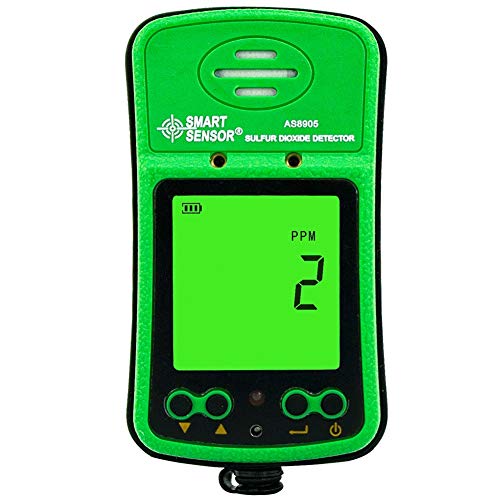
Smart Sensor SO2 Detector Review: 0.1 ppm Steps, No Accuracy Figure
A clip on sulfur dioxide monitor built on an electrochemical sensor, reading 0 to 20 ppm in 0.1 ppm steps, with adjustable high and low alarms signalled by sound, flash and vibration and a rechargeable cell quoted at 8 to 9 hours.
Read More→