As an Amazon Associate, Akermin earns from qualifying purchases. Product links on this page are affiliate links.
Heated-diode detectors break refrigerant molecules on a hot ceramic element and detect the halogen ions released; they are sensitive and inexpensive but the element degrades in one to two years, they need a minute to warm up, and they respond to some oils and solvents. Infrared detectors pass the sample through a cell and measure absorption at refrigerant-specific wavelengths; they are selective, stable for five to ten years, recover quickly and handle A2L and HFO refrigerants, at two to three times the price. For daily HVAC work infrared usually pays for itself; for occasional use it avoids a sensor that dies on the shelf.
Side by side
| Heated diode | Infrared | |
|---|---|---|
| Principle | Thermal decomposition, halogen ion current | Optical absorption at refrigerant wavelengths |
| Sensitivity (typical) | 3 to 6 g/yr; degrades with age | 1 to 3 g/yr; stable |
| Selectivity | Responds to some oils, solvents, cleaners | High; minimal false alarms |
| Refrigerants | CFC, HCFC, HFC; some HFO with newer sensors | HFC, HFO, A2L blends; CO₂ with the right optics |
| Sensor life | 100 to 300 hours or 1 to 2 years; consumable | 5 to 10 years |
| Warm-up | 30 to 90 seconds | 10 to 30 seconds |
| Recovery after a hit | Slower; can saturate | Fast |
| Contamination | Oil and moisture on the element shorten life | Filter protects the cell; clean with air |
| Price | Low to moderate | Moderate to high |
| Examples | Elitech and Fieldpiece heated-diode models | Inficon D-TEK 3, Fieldpiece infrared, Bacharach |
Sensitivity in practice
Both technologies find a 3 g/yr leak when new. The difference shows at 12 months: the heated-diode element has been consumed by every hit and every hour of operation, and a detector that once responded at 3 g/yr may now need 10. Infrared sensors do not consume themselves and hold their calibration. Standards such as EN 14624 and SAE J2791 test sensitivity; look for a stated compliance rather than a marketing figure.
False alarms
Heated-diode sensors respond to halogen-containing compounds and to some hydrocarbons, so brake cleaner, certain oils, flux residues and cleaning sprays trigger them. On a job with recent solvent use that means chasing phantoms. Infrared sensors look at specific wavelengths and ignore most interferents. For a technician on a busy site, fewer false alarms is the argument that usually wins.
A2L refrigerants
Equipment on R-32 and R-454B is now common. These mildly flammable refrigerants need a detector rated for them and, in some jurisdictions, an intrinsically safe design. Infrared units built for A2L are widely available; only some newer heated-diode designs qualify. Check the listing for the refrigerants named. See what a refrigerant leak detector is.
Choosing
- Daily HVAC or refrigeration work: infrared. Sensor life and false-alarm resistance outweigh the price.
- Occasional home or automotive use: either; infrared avoids replacing an aged diode sensor, but a heated-diode unit costs less if the sensor is treated as a consumable.
- Hydrocarbon refrigerants (R-290, R-600a): neither; use a combustible gas sniffer.
- CO₂ systems: infrared CO₂-specific.
Whichever you choose, verify it before each use; see how to test a refrigerant leak detector, and replace sensors on schedule; see sensor lifespan.
Recommended Tools


Products shown because their documented specifications fit this guide. Price and availability are on Amazon and can change.
Frequently Asked Questions
Which is more sensitive, infrared or heated diode?
Both reach the 3 g/yr benchmark; premium infrared units reach 1 g/yr or better and hold that sensitivity over their life, whereas heated-diode sensitivity fades as the sensor ages.
How long does each sensor last?
Heated-diode sensors are typically rated for 100 to 300 hours of operation or one to two years and are replaced as a consumable. Infrared sensors are rated for 5 to 10 years.
Is infrared worth it for occasional use?
A heated-diode sensor ages even when idle, so an occasional user may replace it before wearing it out. For infrequent use, an infrared unit's long shelf life is a real advantage despite the price.
Affiliate disclosure: Akermin earns a commission from qualifying Amazon purchases made through links on this page. Our editorial picks are based on documented specifications and owner feedback, not commissions.
Related Guides

WiFi Natural Gas Alarm Review: One Unit Reveals the Whole Design
A WiFi natural gas alarm with an LCD showing gas concentration status and temperature, a stated response within 30 seconds, an alarm of at least 85 decibels and notifications to a phone app.
Read More→
Forensics Detectors Cl2 Review: 5 Percent of Full Scale Is 2.5 ppm
A rechargeable chlorine detector with an electrochemical sensor reading 0 to 50 ppm at 0.1 ppm resolution, a response time under 30 seconds, adjustable audible, visual and vibrating alarms and a supplied calibration certificate.
Read More→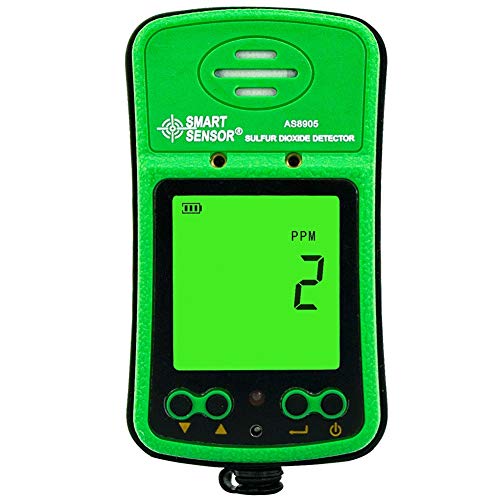
Smart Sensor SO2 Detector Review: 0.1 ppm Steps, No Accuracy Figure
A clip on sulfur dioxide monitor built on an electrochemical sensor, reading 0 to 20 ppm in 0.1 ppm steps, with adjustable high and low alarms signalled by sound, flash and vibration and a rechargeable cell quoted at 8 to 9 hours.
Read More→