A refrigerant leak detector earns its place the first time it finds a 0.1 oz/yr weep that soap bubbles never showed. The sensor inside decides how sensitive it is, how long it lasts and whether it can be trusted on the A2L refrigerants now shipping in new equipment. These picks were compared on those specifications.
As an Amazon Associate, Akermin earns from qualifying purchases. Product links on this page are affiliate links.
Our Top Picks
Refrigerant leak detectors were compared on sensor technology, manufacturer-stated sensitivity, sensor life, refrigerant coverage including A2L, probe length and power, using manufacturer documentation and owner feedback. We did not run laboratory tests and publish no sensitivity figures of our own.
Sensitivities are the manufacturers' stated maximum-sensitivity figures and are not directly comparable across sensor types or test gases. "Not stated" means the Amazon listing gives no figure; consult the datasheet.
How to Choose a Refrigerant Leak Detector
Four specifications decide the purchase:
Sensor Type
Infrared lasts ten years and shrugs off background refrigerant. Heated diode is cheaper and very sensitive but the cell wears out in a few hundred hours.
Sensitivity in oz/yr
Under 0.1 oz/yr finds micro-leaks on brazed joints. 0.2 to 0.25 oz/yr is enough for the leak that empties a system in a season.
A2L and A3 Coverage
R-32 and R-454B are mildly flammable; R-290 is flammable. Buy a detector the manufacturer rates for the refrigerants you actually service.
Probe, Power and Filters
A 17-inch probe reaches inside a condenser. Rechargeable units need a charger on the van; filter tips are a consumable on every model.
Which is better, an infrared or a heated diode refrigerant leak detector?
Infrared for a tool used daily: ten-year sensor life, stable in refrigerant-contaminated air, and the best units reach under 0.03 oz/yr. Heated diode for the highest sensitivity per dollar, accepting a sensor that lasts a few hundred hours and reacts to moisture and oil. Our infrared vs heated diode article goes through the trade-offs.
Do I need an A2L-rated leak detector?
If you service equipment built after the 2025 residential transition, yes. R-32 and R-454B are A2L (mildly flammable) refrigerants, and manufacturers such as Fieldpiece, Inficon and testo now state A2L compatibility on specific models. Older detectors still sense the halogen, but the rating covers safe use around a flammable charge.
What does 0.03 oz/yr mean?
It is the smallest leak rate the manufacturer states the detector can find under its test conditions, expressed as mass of refrigerant lost per year. 0.03 oz/yr is under a gram a year, a leak that takes years to affect performance. 0.25 oz/yr is about 7 g/yr. The figures are not directly comparable between brands or sensor types.
Why does my leak detector alarm everywhere?
Refrigerant already in the air from an earlier leak or a recent recovery saturates a heated diode. Move to clean air, let the unit auto-zero, then approach slowly. Infrared detectors handle this better. Oil residue on the probe tip and a wet filter also cause constant triggering; replace the tip.
Can a refrigerant leak detector find a natural gas leak?
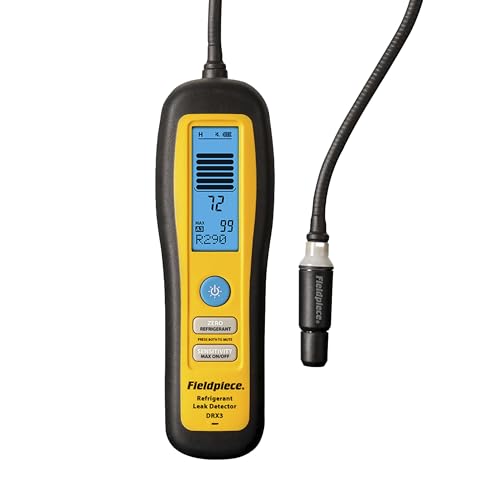
Most cannot: heated diode and infrared refrigerant sensors respond to halogenated compounds, not methane or propane. The Fieldpiece DRX3 is an exception because it is rated for combustible gases as well. For fuel gas, use a combustible gas detector.
Reviews
Fieldpiece DR82 Infrared Refrigerant Leak Detector Best Overall
The DR82 is the detector to buy when the tool will be used every week. Fieldpiece pairs an infrared sensor with a stated sensitivity under 0.03 oz/yr, which is the class of a micro-leak on a brazed joint, and the infrared cell is rated for ten years rather than the few hundred hours a heated diode lasts. That combination is why it costs what it does.
Infrared sensing also brings a practical advantage on a contaminated job: it does not saturate when there is refrigerant already in the air, so the auto-zero holds and the tone still rises at the joint. The backlit LCD shows leak size as a bar, the tip LED lights the fitting, and the 17-inch probe reaches the coil end of a condenser without removing the panel.
Fieldpiece lists CFC, HCFC, HFC and HFO coverage, which spans R-22, R-410A, R-32 and R-454B. Battery is USB-C with a stated 10+ hours. The filter tips are replaceable and should be treated as consumables.
Strengths
Highest stated sensitivity here
Ten-year infrared sensor
IP54 housing for wet, oily coils
Long probe and USB-C charging
Limitations
Premium price
Infrared needs a moment at each joint rather than a fast sweep
Fieldpiece DRX3 Refrigerant and Combustible Gas Leak Detector Best for A2L Systems
New residential systems now ship on A2L refrigerants such as R-32 and R-454B, which are mildly flammable, and a growing number of refrigeration cabinets use R-290 propane, which is A3. The DRX3 exists for that transition: one instrument that Fieldpiece rates for A1, A2L and A3 refrigerants and for combustible gases, so the technician who services a gas furnace in the morning and an A2L heat pump in the afternoon carries a single sniffer.
The sensor is a heated diode, which gives strong sensitivity at lower cost than infrared, and here it is field-replaceable, so a worn cell is a swap rather than a new tool. Three sensitivity settings, auto and manual zero, and escalating audio and visual feedback cover the usual workflow. It connects to Fieldpiece's Job Link app for reporting.
Heated diode sensors are consumed by use and are affected by moisture and oil, so expect to replace the cell on a schedule. Fieldpiece does not state an oz/yr figure on the listing for this model.
Strengths
Rated for A1, A2L and A3 refrigerants and fuel gas
Replaceable sensor and batteries
Job Link app reporting
Case included
Limitations
Sensitivity figure not stated on the listing
Heated diode needs periodic sensor replacement
More tool than a residential-only technician needs
Elitech ILD-200 Infrared Refrigerant Leak Detector Best Value
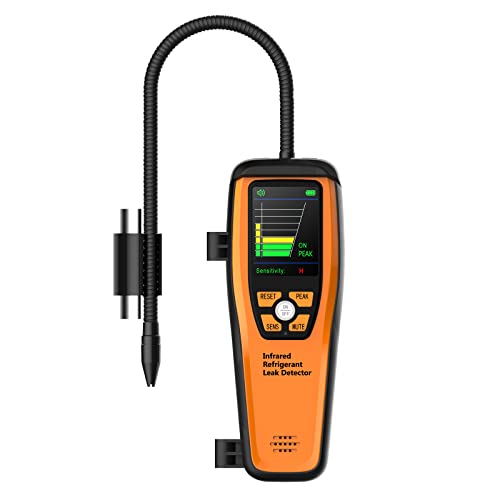
The ILD-200 puts an infrared sensor within reach of a small shop or a serious DIYer. Elitech states a 10-year sensor life and a maximum sensitivity of 0.14 oz/yr, which is less sensitive than the Fieldpiece DR82 but enough for the leaks that empty a residential system over a season.
The 2.8-inch screen shows a peak indicator that points you back toward the strongest reading, which is helpful when a leak is somewhere in a coil rather than at one fitting. Three sensitivity levels and a mute button cover the basics. Elitech lists coverage from R-22 and R-410A through R-1234yf and R-600a.
It lacks the IP rating, the tip LED and the field service network of the Fieldpiece. For a technician who does not sniff for leaks every day, or a homeowner checking a mini-split lineset, it is the sensible infrared choice; if you need sensitivity below 0.1 oz/yr at this price, the heated-diode HLD-100+ is the alternative.
Strengths
Infrared sensor life at a mid-range price
Peak display helps trace back to the source
Wide stated refrigerant coverage
Three sensitivity levels and mute
Limitations
0.14 oz/yr is the least sensitive of the three picks
Short answer: the Fieldpiece DR82 is the refrigerant leak detector for a technician who sniffs for leaks every week: infrared, under 0.03 oz/yr, a ten-year sensor and an IP54 housing. If your work now includes A2L heat pumps and R-290 cabinets alongside gas furnaces, the Fieldpiece DRX3 covers all of them with one replaceable-sensor tool. For occasional use or a mini-split at home, the Elitech ILD-200 gives infrared sensor life at a mid-range price.
What separates these detectors
Every model here sniffs for halogenated refrigerant at a fitting and turns the concentration into a tone or a bar. The differences are in the sensor. A heated diode breaks down halogen molecules on a hot element and reads the ions; it is very sensitive and inexpensive, but the element is consumed by use, quoted lives run from about 100 hours (Inficon TEK-Mate) to 300 hours (Fieldpiece DR58), and it is thrown off by moisture and oil. An infrared cell measures how much light a refrigerant absorbs; it lasts around ten years, is not consumed by exposure, and keeps working when the room already smells of refrigerant. The ion pump in the CPS Leak-Seeker is a third approach with a long track record. Our infrared vs heated diode comparison covers the physics; what a refrigerant leak detector is covers the basics.
Reading the sensitivity figure
Manufacturers quote sensitivity as a leak rate in ounces per year. Fieldpiece states under 0.03 oz/yr for the DR82 and DR58; Elitech states 0.14 oz/yr for the ILD-200 and 0.1 oz/yr for the HLD-100+; Inficon states 0.25 oz/yr for the TEK-Mate; Robinair states 0.05 oz/yr on R-134a for the LD7. Two cautions apply. The figure is the manufacturer’s own test under its own conditions, so a 0.1 oz/yr heated diode and a 0.1 oz/yr infrared unit will not behave identically on a wet coil. And smaller is not always necessary: a system that loses its charge over a season is leaking far more than 0.25 oz/yr, and any detector here will find that. The sub-0.1 oz/yr class matters for warranty work, sealed refrigeration and finding a weep before it becomes a callback.
A2L, A3 and the 2025 transition
New residential air conditioners and heat pumps in the US now ship on A2L refrigerants, chiefly R-32 and R-454B, which are classed as mildly flammable. Commercial refrigeration is moving to R-290 propane, which is A3. A heated diode or infrared sensor still detects the halogen in an A2L blend, but the detector also has to be safe to operate around a flammable charge, which is why manufacturers now state A2L compatibility per model: the Fieldpiece DR82, DRX3, Inficon D-TEK 3 and TEK-Mate, and the testo 316-3 all do on their listings. R-290 contains no halogen at all, so a standard refrigerant detector will not see it; the DRX3 is the model in this group rated for A3 and for combustible gases. Which refrigerants you service should decide the purchase before price does.
Probe, power and the wet coil
A 17-inch flexible probe on the Fieldpiece units reaches the return bends of an evaporator coil without removing the cabinet; the 7.9-inch probe on the Elitech WJL-6000 suits automotive and lineset work. An IP54 rating (DR82, DR58) matters on a condenser that has just been hosed down or an evaporator running wet. Rechargeable units (DR82, DR58, ILD-200 max at 8 hours) save batteries but need a charger on the van; the Robinair LD7 runs on four AA cells. Filter tips are consumables on every model and a clogged or oily tip is the most common reason a detector alarms constantly or not at all.
Using one properly
Zero the detector in clean air away from the system, then move the probe slowly, about an inch per second, along each joint. Most refrigerants are heavier than air, so pass beneath the fitting as well as around it. When the tone rises, back off and approach from another side to confirm rather than chasing the first hit. Soap bubbles remain a useful second check on a suspect joint. Before relying on any detector, confirm it responds to a known source; how to test a refrigerant leak detector before use describes the reference-leak check. For the full decision process see how to choose a refrigerant leak detector.
Automotive and UV dye
Automotive systems on R-134a and R-1234yf are where the Robinair LD7 fits: Robinair states 0.05 oz/yr on R-134a and 0.0123 oz/yr on R-1234yf, adds three UV LEDs for dye-traced leaks and a sweep-mode graph for tracing along a line. Elitech’s listings also name R-1234yf. A UV lamp and dye are a complement to an electronic sniffer, not a replacement, because dye only shows a leak after it has run and stained.
Where refrigerant detection fits with gas detection
A refrigerant sniffer ignores methane and propane, and a combustible gas sniffer ignores halogenated refrigerants, which is why HVAC technicians who also service gas appliances end up with both or with a combined instrument such as the DRX3. Our combustible gas detector guide covers the fuel-gas side, and the main gas leak detector guide covers home alarms. If a leak of any gas is large enough to smell across a room, treat it as a ventilate-and-leave situation first and a tracing job second.
How We Research
Detectors were compared on manufacturer documentation: sensor technology, stated sensitivity, stated sensor life, refrigerant classes covered, probe length, power and ingress rating. Owner feedback was reviewed for sensor wear, false triggering near oil and moisture, and battery complaints. We did not run laboratory tests and we do not publish sensitivity figures of our own. Amazon data supplies images, availability and links only.
A WiFi natural gas alarm with an LCD showing gas concentration status and temperature, a stated response within 30 seconds, an alarm of at least 85 decibels and notifications to a phone app.
A rechargeable chlorine detector with an electrochemical sensor reading 0 to 50 ppm at 0.1 ppm resolution, a response time under 30 seconds, adjustable audible, visual and vibrating alarms and a supplied calibration certificate.
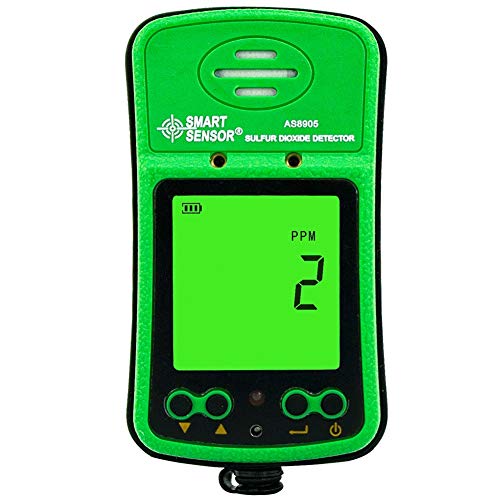
A clip on sulfur dioxide monitor built on an electrochemical sensor, reading 0 to 20 ppm in 0.1 ppm steps, with adjustable high and low alarms signalled by sound, flash and vibration and a rechargeable cell quoted at 8 to 9 hours.