As an Amazon Associate, Akermin earns from qualifying purchases. Product links on this page are affiliate links.
For most R32 work the choice comes down to the Fieldpiece DR82 and the Fieldpiece DRX3. The Fieldpiece DR82 is the pick when you need to find very small leaks: the listing publishes a sensitivity below 0.03 oz/yr with an infrared sensor and an IP54 housing, which is the strongest published micro-leak figure in this group. The Fieldpiece DRX3 is the pick when you want one tool for refrigerant and combustible gas: the listing states it detects A3, A2L and A1 refrigerants plus combustible gases through a heated diode sensor, so it covers R32 and the leak-check of a gas appliance in the same visit. The Aituzero Rechargeable, the Aprvtio WJL-6000PRO and the CPS LS1 Leak-Seeker are credible alternatives with different trade-offs, and the Aprvtio WJL-6000PRO is the only one here that publishes a %LEL mode, which matters if you are monitoring A2L concentration rather than just hunting a leak.
Why R32 changes the detector question
R32 is an A2L refrigerant. A2L means mildly flammable: it will not ignite as readily as the A3 hydrocarbons, but it can burn under the right concentration and ignition conditions. That single fact changes the job in two ways. First, you are looking for a leak in a system that is also a small flammability risk, so the detector has to be rated for the refrigerant family and not just for halogen gases in general. Second, some work now involves watching concentration rather than only pinpointing a pinhole, because a slow leak in a plant room or a basement can build up.
Most of the detectors sold as refrigerant sniffers are halogen detectors. They respond to the halogen content of the molecule, which is why a CFC, HCFC, HFC or HFO all trigger the same sensor. R32 is an HFC, so a halogen detector will see it. The difference is in the certification wording and in whether the listing publishes an A2L-specific mode. If you want the background on how A2L leaks are handled in service, the A2L leak detector explainer covers the category in more depth.
The practical trap is assuming any sniffer is fine because it beeps on R32. It will beep. Whether it is the right instrument for an A2L system is a separate question, and the only evidence you have before purchase is what the listing states.
What the sensitivity figures actually mean
The sensitivity number is the one buyers read first and understand last. It comes in two units. Some listings quote a leak rate, such as 0.1 oz/yr or 0.03 oz/yr. Others quote a concentration in parts per million. These are not the same measurement, and a detector that publishes ppm is not automatically more or less sensitive than one that publishes oz/yr.
An oz/yr figure describes the smallest leak the instrument can find when the probe is held at the leak point. It is the number that matters for finding a slow leak on a coil or a flare. The Fieldpiece DR82 publishes a figure below 0.03 oz/yr and states that this is 20 times more sensitive than bubbles. The Aituzero Rechargeable publishes sensitivity up to 3 g/yr, which the listing converts to 0.1 oz/yr. Those are the only two picks here with a published leak-rate figure. The Fieldpiece DRX3, the Aprvtio WJL-6000PRO and the CPS LS1 Leak-Seeker do not publish one in the supplied bullets.
A ppm figure describes concentration in the air around the probe, which is what you want if you are monitoring a space rather than chasing a joint. The Aituzero Rechargeable publishes real-time ppm readings on its display. The Aprvtio WJL-6000PRO publishes a ppm mode and a %LEL mode. %LEL is the fraction of the lower explosive limit, and it is the unit a safety monitor uses because it maps directly onto flammability. Neither ppm nor %LEL tells you the size of the hole; they tell you how much gas is in the air where you are standing.
The common mistake is comparing a ppm number with an oz/yr number and concluding one detector is better. They answer different questions. For leak hunting, compare oz/yr. For space monitoring, compare ppm or %LEL.
Sensor type: heated diode, infrared, semiconductor, E_MOS
The sensor is the part that reacts to refrigerant, and its type sets the detector’s character.
- Heated diode. A ceramic element heated to a high temperature. Halogen molecules break down on the hot surface and change the current, which the electronics read as a leak. Heated diodes are fast and sensitive, and they respond to a wide range of halogenated refrigerants. They are also consumable: the element degrades with contamination, which is why the listing for the Fieldpiece DRX3 calls the sensor field-replaceable. That is a genuine maintenance advantage.
- Infrared. The sensor measures how much infrared light the gas absorbs at a characteristic wavelength. Infrared sensors are less prone to poisoning than heated diodes and generally hold calibration longer. The Fieldpiece DR82 uses this type and publishes an IP54 rating, meaning the housing resists dust and water spray, plus a stated 10-year sensor life. Infrared is the type to favour if you want the sensor to survive oily, damp condenser work.
- Semiconductor. A metal-oxide film whose resistance changes when reducing gases are present. Semiconductor sensors are cheap and sensitive but less selective, so they respond to solvents, exhaust and other gases as well as refrigerant. The Aituzero Rechargeable uses a semiconductor sensor and manages the selectivity problem with three sensitivity levels and a real-time ppm display.
- E_MOS. A metal-oxide variant used by CPS. The CPS LS1 Leak-Seeker publishes a 500-hour nominal sensor life and states that the sensor is not contaminated by R404a, which is a specific claim about a known failure mode of older sensors.
None of these types detects the leak location for you. They detect gas at the probe tip. The operator sweeps the probe and watches the reading, which is why probe reach and display readability matter as much as the sensor.
The five R32 leak detectors, and who each one is for
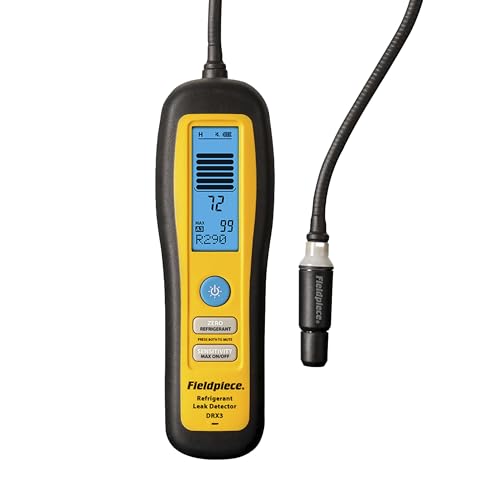
Fieldpiece DRX3
Combined refrigerant and combustible gas detection with a heated diode sensor that the listing says is field-replaceable.
Fieldpiece DR82
Infrared sensor with a published sub-0.03 oz/yr sensitivity figure and an IP54 rating, the micro-leak specialist here.
Aituzero Rechargeable
Semiconductor sensor, three sensitivity levels, colour display with real-time ppm and a 14.5-inch gooseneck probe.
Aprvtio WJL-6000PRO
Dual ppm and %LEL modes with an all-metal probe, the only pick here that publishes an A2L safety-monitoring mode.
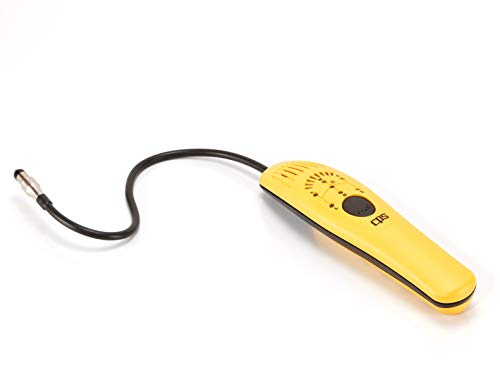
CPS LS1 Leak-Seeker
E_MOS sensor with a 500-hour nominal sensor life and a stated immunity to R404a contamination.
The comparison table: what each listing publishes
| Pick | Sensor type | Published sensitivity | Refrigerant families stated | Alarm and display | Probe and power |
|---|---|---|---|---|---|
| Fieldpiece DRX3 | Heated diode, field-replaceable | Not stated in the listing bullets | A3, A2L, A1; HC, HFC, HCFC, CFC, HFO, H2/N2 tracer and blends; combustible gases | Visual and audio indicators that change with leak intensity; auto and manual zero; high, medium, low sensitivity | Not stated; field-replaceable batteries |
| Fieldpiece DR82 | Infrared | Below 0.03 oz/yr, stated as 20x more sensitive than bubbles | CFC, HCFC, HFC, HFO and blends | Backlit LCD showing size and intensity; LED tip and beep | Not stated; IP54 housing; 10-year sensor life |
| Aituzero | Japanese semiconductor | Up to 3 g/yr (0.1 oz/yr); real-time ppm | R134a, R410A, R22, R1234YF, R32 | Sound, light and vibration, each independently switchable; quick mute; TFT funnel and trend views | 14.5-inch flexible gooseneck; 2000 mAh rechargeable, up to 8 hours, USB-C |
| Aprvtio WJL-6000PRO | Not stated | Not stated in the listing bullets | A2L referenced through the %LEL mode; r454b named in the text | Digital display; audible tone changes to siren; mute function; 2-second response, 10-second identification stated | All-metal probe; power not stated |
| CPS LS1 | E_MOS | Not stated in the listing bullets | Automotive and commercial use claimed; R404a immunity stated | Not stated in the listing bullets | Not stated; 50-plus hours on 3 C batteries; 500-hour nominal sensor life |
Two cells in this table are worth pausing on. The Aprvtio WJL-6000PRO publishes a %LEL mode, which is the only safety-monitoring figure in the group; its sensor type is not stated. The CPS LS1 Leak-Seeker publishes a sensor life and a battery life but no sensitivity figure at all, so you cannot rank it against the others on sensitivity from the listing alone.
Alarms, displays and the maintenance nobody mentions
A leak detector is a trend instrument. You sweep the probe and watch the reading rise as you approach the leak, then fall as you pass it. That is why the display matters more than the alarm. A detector with only a beep forces you to judge proximity by ear, which is hard in a noisy plant room. The Fieldpiece DR82 shows size and intensity on a backlit LCD with an LED at the tip. The Aituzero Rechargeable shows a funnel view and a trend graph, plus real-time ppm, so you can see whether you are getting closer. The Aprvtio WJL-6000PRO shows a digital reading and changes the tone to a siren. The Fieldpiece DRX3 uses audio and visual indicators that change with leak intensity. The CPS LS1 Leak-Seeker does not publish display or alarm details in the supplied bullets.
Alarm modes that can be switched off independently are useful when you work in occupied buildings. The Aituzero Rechargeable lets you disable sound, light or vibration separately, and mute the buzzer while keeping the others. The Aprvtio WJL-6000PRO has a mute button for the same reason. If you are servicing a supermarket at night or a residential unit with the owner present, that flexibility is not a gimmick.
The maintenance nobody mentions is the sensor itself. Heated diode elements and semiconductor films are consumables. They drift, they get contaminated by oil and by high concentrations of refrigerant, and eventually they stop responding. The Fieldpiece DRX3 addresses this by making the sensor field-replaceable. The CPS LS1 Leak-Seeker publishes a 500-hour nominal sensor life and a claim that the sensor resists R404a contamination, which is a known killer of older sensors. The Fieldpiece DR82 publishes a 10-year sensor life for its infrared element. Those are three different answers to the same problem, and the one you pick should match how often you use the tool. A detector used daily will reach the end of a 500-hour sensor in a few months of hard work; an infrared sensor rated at 10 years will not.
Batteries are the second maintenance item. The Aituzero Rechargeable uses a built-in 2000 mAh cell with USB-C charging and states up to 8 hours of use. The CPS LS1 Leak-Seeker runs on three C cells and publishes more than 50 hours. The Fieldpiece DRX3 uses field-replaceable batteries but does not publish a runtime. The Fieldpiece DR82 and the Aprvtio WJL-6000PRO do not publish power details in the supplied bullets. If you work long days away from a charger, the CPS LS1 Leak-Seeker runtime figure is the only one here you can plan around.
Where these detectors stop being the right answer
Every tool here is a leak detector. None of them is a gas alarm, and none of them replaces a fixed detection system in an occupied space. A hand-held sniffer tells you what is at the probe tip at the moment you hold it there. It does not watch a plant room overnight, it does not raise an alarm in a basement at 3 a.m., and it does not satisfy any requirement for continuous monitoring of an A2L charge.
If the job is confined space entry, a refrigerant sniffer is the wrong instrument entirely. Confined space work needs a multi-gas detector with oxygen, carbon monoxide, hydrogen sulfide and combustible gas channels, and even then the entry decision depends on the full procedure. The confined space detector guide covers what those instruments actually do.
If the job is finding a leak in a sealed system that the sniffer cannot reach, you need a different method: pressure testing with nitrogen, or tracer gas with a detector rated for hydrogen. The Fieldpiece DRX3 lists H2/N2 tracer gas among the gases it responds to, which is the one pick here that publishes tracer capability. The tracer gas detector guide explains how that method works.
And if the system uses a hydrocarbon refrigerant such as R290, an A2L-rated halogen detector is not automatically the right tool. A3 refrigerants sit in a different flammability class and the detector needs to be rated for them. The Fieldpiece DRX3 is the only pick here whose listing explicitly names A3 alongside A2L and A1, so it is the one to look at first if you work across both. The A3 compatible tools guide goes into the differences.
Finally, remember what a detector does not do: it does not tell you the size of the leak in engineering units unless the listing publishes a calibrated leak-rate figure, and it does not tell you whether the system charge is correct. It tells you where gas is escaping. The rest is diagnosis.
Recommended Tools


Products shown because their documented specifications fit this guide. Price and availability are on Amazon and can change.
Frequently Asked Questions
Will a standard refrigerant leak detector find R32?
Yes, if it is a halogen detector. R32 is an HFC, and halogen sensors respond to the halogen content of CFC, HCFC, HFC and HFO molecules. The Fieldpiece DRX3, the Fieldpiece DR82, the Aituzero Rechargeable and the CPS LS1 Leak-Seeker all fall into that family. The more useful question is whether the listing states A2L compatibility, because that is what tells you the manufacturer has considered the mildly flammable classification. The Fieldpiece DRX3 names A2L explicitly; the Aprvtio WJL-6000PRO publishes a %LEL mode, which is an A2L safety figure.
What is the difference between an oz/yr sensitivity figure and a ppm reading?
An oz/yr figure is a leak rate: the smallest flow of refrigerant the instrument can detect at the leak point. A ppm figure is a concentration in the air around the probe. They are measured differently and cannot be ranked against each other. Use oz/yr to compare leak-hunting ability, and ppm or %LEL to compare space-monitoring ability. The Fieldpiece DR82 and the Aituzero Rechargeable publish leak-rate figures; the Aituzero Rechargeable and the Aprvtio WJL-6000PRO publish concentration figures.
Do I need a %LEL mode for R32 work?
It depends on the task. If you are pinpointing a leak on a joint, a leak-rate figure is what you need. If you are checking whether a plant room or a basement has accumulated a flammable concentration, %LEL is the unit that maps onto flammability, and the Aprvtio WJL-6000PRO is the only pick here that publishes it. A hand-held detector with a %LEL mode is still not a fixed alarm system, so it does not replace permanent monitoring.
How long does the sensor last?
It depends on the type. The CPS LS1 Leak-Seeker publishes a 500-hour nominal sensor life for its E_MOS element. The Fieldpiece DR82 publishes a 10-year sensor life for its infrared sensor. Heated diode and semiconductor sensors are consumable and degrade with contamination; the Fieldpiece DRX3 addresses this by making the sensor field-replaceable, but does not publish a life figure. Treat any sensor life number as a nominal figure under clean conditions, not a guarantee.
Can I use these detectors for combustible gas as well?
Only the Fieldpiece DRX3 publishes combustible gas detection alongside refrigerants. Its listing names A3, A2L and A1 refrigerants and combustible gases, with a heated diode sensor. The others in this group are described as refrigerant detectors. If you need one tool for both a refrigeration system and a gas appliance, the Fieldpiece DRX3 is the only pick here whose listing supports that.
Is a hand-held leak detector enough for an A2L system?
For service work, it is the tool you use to find the leak. For occupied spaces and plant rooms, it is not a substitute for fixed detection or for a proper risk assessment. A hand-held sniffer only reads what is at the probe tip while you hold it there. It does not monitor continuously, it does not alarm remotely, and it does not satisfy any requirement for permanent A2L detection.
Affiliate disclosure: Akermin earns a commission from qualifying Amazon purchases made through links on this page. Our editorial picks are based on documented specifications and owner feedback, not commissions.