Best Heated-Diode Refrigerant Leak Detectors: Sensitive Picks Where Sensor Life Is Managed
Heated-diode sensors are still the most sensitive way to find a refrigerant leak, and they are consumed by use. These detectors were compared from manufacturer specifications on sensitivity, rated sensor hours and field replacement, so the sensor cost is planned rather than discovered.
As an Amazon Associate, Akermin earns from qualifying purchases. Product links on this page are affiliate links.
Our Top Picks
Heated-diode detectors trade sensor life for sensitivity, so every pick here is judged on both. Comparison used manufacturer documentation for stated sensitivity, sensor hours, refrigerant classes, zeroing and battery, plus owner feedback on sensor replacement; no laboratory tests were run.
Sensitivity and sensor-hour figures are the manufacturers' published claims and are not comparable test results. "Not stated" means the listing gives no figure. Heated-diode sensors are consumed by use; infrared sensors are the long-life alternative.
How to Choose a Heated-Diode Refrigerant Leak Detector
Four specifications separate these sniffers:
Stated Sensitivity
Ounces per year is a manufacturer-defined figure. Under 0.03 oz/yr is the top of the class; 0.25 oz/yr still finds most service leaks.
Sensor Hours and Replacement
The diode is used up by operation. Rated hours (300 on the DR58, 100 on the TEK-Mate) and whether you can swap it yourself decide the running cost.
A2L and A3 Coverage
R-32 and R-454B are mildly flammable A2L refrigerants and R-290 is flammable A3. Check the listing names them before buying for modern equipment.
Zeroing Behavior
Automatic background zeroing lets you work in a contaminated space; a manual zero button lets you reset at the joint. Both matter on a heated diode.
The sensor heats a ceramic element that breaks halogenated refrigerant apart and reads the resulting ions. Every exposure, including the warm-up in clean air, ages that element, so the manufacturer rates it in hours of operation. Infrared sensors read absorption instead and are rated in years, which is the trade the heated-diode buyer accepts in exchange for sensitivity and lower cost.
How do I make a heated-diode sensor last longer?
Switch the unit off between checks rather than letting it run, keep the tip out of liquid refrigerant and oil, use the filter tips the manufacturer supplies, and zero in clean air before approaching a suspected leak so the sensor is not sitting in a high concentration. Owners who follow those habits report reaching the rated hours.
Will a heated-diode detector find A2L refrigerants like R-32?
Only if the manufacturer says so. The Fieldpiece DRX3 states A2L and A3 coverage, the Inficon TEK-Mate is described as A2L certified and the testo 316-3 as A2L compliant. Older heated-diode units may respond to R-32 but were not built or rated for it; the A2L refrigerant guide covers the changes.
Is a stated 0.05 oz/yr on a budget detector the same as 0.05 oz/yr on a Fieldpiece?
Not necessarily. Ounces per year is defined by each manufacturer under its own conditions, and some listings describe it as a maximum in a stationary state. Treat the figure as a claim; the detector test in how to test a refrigerant leak detector before use is the practical check.
Reviews
Fieldpiece DR58 Heated Diode Refrigerant Leak Detector Best Overall
The DR58 is the heated-diode detector for a technician who wants the most sensitivity the class offers and is willing to manage the sensor. Fieldpiece states detection of leaks under 0.03 oz/yr, which is the same figure it quotes for its infrared DR82, and it covers HFC, CFC, HCFC and HFO refrigerants, blends and the hydrogen-nitrogen tracer mix.
The practical numbers are the ones that decide daily use: a 300-hour rated sensor, an IP54 housing that resists the moisture and oil a coil throws off, an 18-hour battery charged over USB and a 17-inch flexible probe. The backlit LCD shows leak size and intensity, and the LED at the tip and the beep rate narrow the source.
A heated diode is a consumable. Three hundred hours is generous for the class, but a busy technician will replace the sensor, and the DR58 is designed so that is a maintenance item rather than a new tool. Owners who leave it running between checks use those hours up faster than they expect.
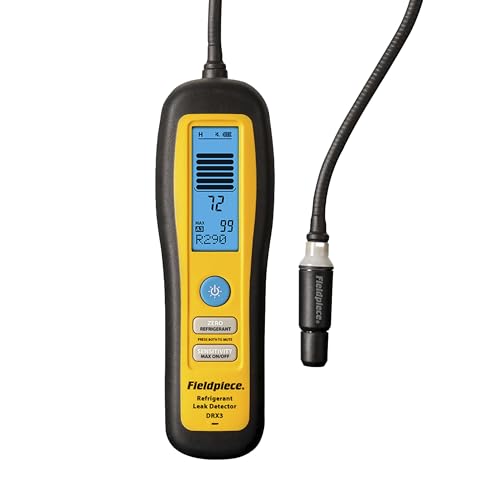
Fieldpiece DRX3 Refrigerant and Combustible Gas Leak Detector Best Replaceable Sensor
The DRX3 answers the two objections to heated-diode detectors at once. The sensor is field-replaceable, so when it is used up you swap it on the tailgate instead of sending the tool away, and the manufacturer states coverage of A3, A2L and A1 refrigerants plus combustible heating gases, which means one instrument handles R-290, R-32, R-454B and a furnace gas line.
Fieldpiece lists auto and manual zero modes, three sensitivity settings and visual and audio indicators that change with leak intensity. The batteries are also field-replaceable, and the unit connects to the Job Link System app for records. A blow-molded case and a heated-diode sensor are in the box.
The listing gives no oz/yr sensitivity figure and no sensor-hour rating, so those columns read not stated in our table; the DR58 is the one with published numbers. Buy the DRX3 for the refrigerant coverage and the swap-in sensor, not for a specification you can compare on paper.
Elitech HLD-100+ Heated Diode Refrigerant Leak Detector Best Value
The Elitech HLD-100+ (the listing also uses the name ILD-100H) is the heated-diode detector for a technician who wants a screen and adjustable sensitivity without the Fieldpiece outlay. The manufacturer states 0.1 oz/yr maximum sensitivity, three levels selected from two front buttons, and a TFT display that shows the current sensitivity, the leak alert and battery state at a glance.
Coverage is broad on paper: CFCs, HFCs, HCFCs, HCs and HFOs, with R-1234yf, R-410A and R-22 named and a 1-second stated response. A mute button on the front handles quiet interiors. The warranty is one year.
The listing gives no sensor-hour rating, no probe length and no battery specification, so plan on discovering the sensor life in use, and treat the 0.1 oz/yr figure as the manufacturer's claim rather than a certified value. For a homeowner checking a mini-split or a technician who needs a backup sniffer, that is an acceptable trade.
Short answer: the Fieldpiece DR58 is the heated-diode detector to buy for the most sensitivity the class offers, with a 300-hour sensor that makes the consumable manageable. The Fieldpiece DRX3 is the pick if A2L and A3 refrigerants are in your work and you want to swap the sensor yourself on site. The Elitech HLD-100+ covers occasional use and backup duty with a screen and three sensitivity levels for far less.
What a heated-diode sensor does
A heated-diode detector draws air past a heated ceramic element. Halogenated refrigerant molecules break apart on it and the freed halogen ions change a small current, which the instrument turns into a tone and a display. The response is fast and very sensitive to CFC, HCFC, HFC and HFO refrigerants, which is why the technology has been the trade standard for decades. The cost is that the element is consumed by use: it is rated in hours, and it ages faster in refrigerant-rich air. Infrared sensors read light absorption instead and are rated in years. The trade-offs are laid out in infrared vs heated-diode refrigerant leak detectors.
Sensitivity: what the oz/yr number is and is not
Every listing on this page quotes a figure in ounces per year: under 0.03 for the DR58, 0.1 for the Elitech, 0.15 for the testo 316-3, 0.25 for the Inficon TEK-Mate and 0.05 for the RALBIL. The unit describes the smallest leak rate the manufacturer says its instrument will respond to, under conditions the manufacturer defines. There is no common test behind the numbers, and a budget brand claiming a lower figure than a trade brand should be read as a claim. What the figure does tell you is where the manufacturer positions the tool: under 0.03 oz/yr is aimed at micro-leaks on a sealed system, and 0.25 oz/yr is aimed at the ordinary service leak.
Sensor life is the real running cost
Fieldpiece rates the DR58 sensor at 300 hours and Inficon rates the TEK-Mate at 100. The Elitech, testo and RALBIL listings give no figure, and the DRX3 listing says only that the sensor is field-replaceable. Those numbers, or their absence, are the basis for choosing. A technician who sniffs coils daily will use 100 hours in a season; a homeowner checking one mini-split will not use it in years. The habits that stretch the hours are simple: power off between checks, zero in clean air, keep the tip out of oil and liquid refrigerant, and use the supplied filter tips. How to test a refrigerant leak detector before use explains the quick check that tells you the sensor is still alive.
A2L and A3 refrigerants change the shortlist
R-32 and R-454B are classed A2L, mildly flammable, and R-290 is A3, flammable. Modern residential equipment ships with them, and a detector built only for A1 refrigerants such as R-410A may respond but was not designed or rated for the job. On this page the DRX3 states A3, A2L and A1 coverage plus combustible heating gases, the TEK-Mate is described as A2L certified and the testo 316-3 as A2L compliant. The DR58 lists HFO coverage but does not name A2L on its listing. For a technician moving to new equipment, that column matters more than a tenth of an ounce of sensitivity; the A2L refrigerant leak detector guide goes further.
Zeroing, sensitivity modes and probes
Automatic background zeroing, which Inficon, testo and RALBIL all list, lets the detector settle in a space that already has some refrigerant in the air. A manual zero, on the DRX3 and RALBIL, resets at the joint so you can confirm a hit. Three sensitivity levels are standard; the high setting finds the leak and the low setting narrows it to a fitting once the tone is continuous. Probe length decides what you can reach without disassembly: 17 inches on the DR58, 20 inches on the RALBIL.
Using one properly
Switch on in clean air and let the sensor warm up; the RALBIL listing states 35 seconds or less, and other models are similar. Move the tip slowly along joints, brazed connections, Schrader cores and the coil face, pausing at each, with the tip below the joint because most refrigerants are heavier than air. Keep oil, solvents and cleaning sprays away from the sensor. If the tone is continuous everywhere, the room is contaminated; ventilate, re-zero and start again.
When infrared makes more sense
If you sniff every day and dislike consumables, or your work is mostly A2L equipment where a long-life sensor rated for those refrigerants is available, the infrared class is the better buy despite its higher entry cost. The infrared refrigerant leak detector guide covers the Fieldpiece DR82, Inficon D-TEK 3 and Elitech ILD-200.
How We Research
Detectors were compared on manufacturer documentation: stated sensitivity in ounces per year, rated sensor hours, refrigerant classes and A2L or A3 coverage, zeroing modes, sensitivity settings, probe length, ingress rating and power. Owner feedback was reviewed for sensor replacement cost and false alarms near oil. We did not run laboratory tests and do not publish sensitivity results of our own. Amazon data supplies images, availability and links only.
A WiFi natural gas alarm with an LCD showing gas concentration status and temperature, a stated response within 30 seconds, an alarm of at least 85 decibels and notifications to a phone app.
A rechargeable chlorine detector with an electrochemical sensor reading 0 to 50 ppm at 0.1 ppm resolution, a response time under 30 seconds, adjustable audible, visual and vibrating alarms and a supplied calibration certificate.
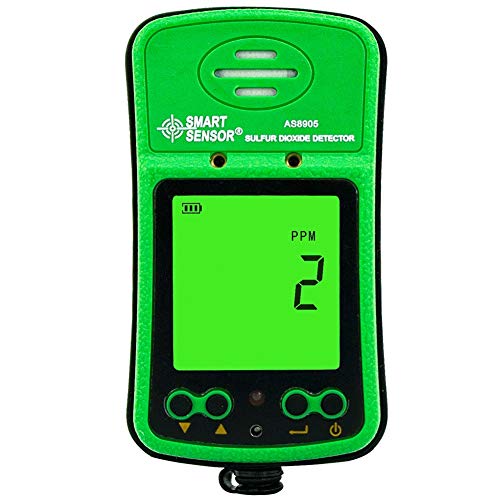
A clip on sulfur dioxide monitor built on an electrochemical sensor, reading 0 to 20 ppm in 0.1 ppm steps, with adjustable high and low alarms signalled by sound, flash and vibration and a rechargeable cell quoted at 8 to 9 hours.