As an Amazon Associate, Akermin earns from qualifying purchases. Product links on this page are affiliate links.
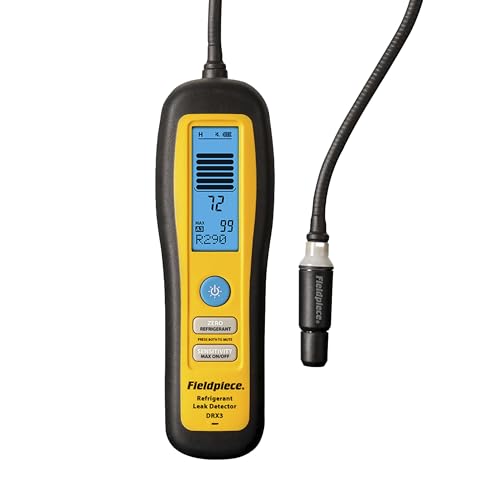
The two refrigerant picks here are the Fieldpiece DR82 Infrared Refrigerant Leak Detector and the Fieldpiece DRX3 Refrigerant and Combustible Gas, and they represent opposite strategies for sensor longevity. The Fieldpiece DR82 Infrared Refrigerant Leak Detector is the only product in the set whose listing publishes a fixed sensor life figure, ten years, for an infrared sensing element that resists moisture and oil and carries an IP54 rating. The Fieldpiece DRX3 Refrigerant and Combustible Gas does not publish a sensor life figure, but it publishes something arguably more useful: a field-replaceable heated diode sensor, which means the sensor can be renewed rather than the tool replaced, and it extends coverage to A3 and A2L refrigerants plus combustible gases. The TECKNET WiFi Water, the METAK 24Ghz and the SwitchBot 100dB are water leak detectors. They are well specified for that job, but they detect water, not refrigerant, and no amount of sensor life makes them relevant to an HVACR technician. If your question is which refrigerant detector will still be working in ten years, the choice is between a sealed infrared sensor with a published decade of life and a replaceable heated diode that trades a life figure for serviceability.
Why sensor life is the specification that decides ownership cost
A refrigerant leak detector is a sensor with a handle. The electronics, the display and the beeper will outlast the sensing element in almost every design, and when the element drifts or dies the instrument stops being trustworthy before it stops switching on. That is why sensor life matters more here than in almost any other handheld tool. A multimeter with a tired battery is a five-minute problem. A leak detector with a tired sensor is a tool that still lights up, still beeps, and still misses the leak you are standing next to.
The two sensing technologies in this comparison age differently. Infrared sensors measure the absorption of light by refrigerant gas in a small chamber. They have no consumable filament and no chemical reagent, so their life is governed mainly by contamination of the optical path and by the seals that keep moisture and oil out. That is why the Fieldpiece DR82 Infrared Refrigerant Leak Detector’s listing pairs its ten-year sensor life claim with an IP54 rating and resistance to moisture and oil: those two facts describe the same engineering problem. A heated diode works by heating a ceramic or semiconductor element and measuring the change in its behaviour when halogenated gas touches it. The element degrades with use, and the degradation is accelerated by exposure to the very gases it is designed to find. A field-replaceable heated diode, which is what the Fieldpiece DRX3 Refrigerant and Combustible Gas’s listing describes, accepts that the sensor is a consumable and makes it serviceable.
Neither approach is universally better. A sealed infrared sensor suits a technician who wants to buy once and not think about it. A replaceable heated diode suits a technician who wants the option to renew the sensor and who values the wider refrigerant coverage that the listing claims. What you should not do is buy on sensor life alone and ignore the sensitivity figure, the refrigerant list, or whether the sensor can be replaced at all. The listings here publish different subsets of those facts, and the gaps are as informative as the numbers.
What each listing publishes about the sensing element
The table below reproduces only what the manufacturer listings state. Where a listing is silent, the cell says so rather than carrying an estimate.
| Product | Sensor type as stated | Sensor life as stated | Replaceable | Refrigerant coverage as stated | Sensitivity as stated |
|---|---|---|---|---|---|
| Fieldpiece DR82 Infrared Refrigerant Leak Detector | Infrared | 10-year sensor life | Not stated in the listing bullets | CFC, HCFC, HFC, HFO and blends | Below 0.03 oz/yr, described as 20x more sensitive than bubbles |
| Fieldpiece DRX3 Refrigerant and Combustible Gas | Heated diode | Not stated in the listing bullets | Yes, field-replaceable | A3, A2L, A1, HC, HFC, HCFC, CFC, HFO, H2/N2 tracer gas and blends, plus heating gases | Not stated in the listing bullets |
Two rows, two very different disclosure patterns. The Fieldpiece DR82 Infrared Refrigerant Leak Detector gives you a life figure and a sensitivity figure, and leaves replacement unstated. The Fieldpiece DRX3 Refrigerant and Combustible Gas gives you a replacement path and the widest refrigerant list in the set, and leaves both life and sensitivity unstated. A buyer who needs to compare them on a single axis cannot, because the manufacturers chose to publish different axes. What you can do is decide which axis your work depends on.
The infrared versus heated diode question has its own page on this site, and the short version is that infrared tends to be more resistant to contamination and to false triggering from oils and solvents, while a heated diode can be more sensitive to some halogenated compounds and is the traditional choice for tracer gas work. The DRX3 listing explicitly includes H2/N2 tracer gas, which is a heated diode strength. The DR82 listing explicitly includes a decade of sensor life, which is an infrared strength. Read those two facts together and the choice becomes a statement about how you work, not about which number is bigger.
The refrigerant picks, and the three that are a different instrument entirely
Fieldpiece DR82 Infrared Refrigerant Leak Detector
The listing publishes a ten-year sensor life for an infrared element rated IP54 against moisture and oil, and claims detection of leaks below 0.03 oz per year, which it describes as twenty times more sensitive than bubbles. It covers CFC, HCFC, HFC, HFO and blends, and reports leak size and intensity on a backlit LCD with an LED tip and beep for pinpointing. The ten-year figure is the only fixed sensor life claim in the set.
Fieldpiece DRX3 Refrigerant and Combustible Gas Leak Detector
A heated diode sensor that the listing says is field-replaceable, so sensor life is not a countdown to replacing the tool. It covers A3, A2L and A1 refrigerants, HC, HFC, HCFC, CFC, HFO, H2/N2 tracer gas and blends, plus heating gases, with auto and manual zero modes and high, medium and low sensitivity settings. The listing does not publish a sensor life figure, and it does not publish a sensitivity figure either.
The sensitivity trap in the DR82 listing
The DR82 listing states that it finds leaks below 0.03 oz per year and describes that as twenty times more sensitive than bubbles. That is a leak rate, not a concentration, and the two are not interchangeable. A leak rate tells you how much refrigerant escapes over time from a known hole under known conditions. A concentration tells you how much gas is present in the air at the tip of the probe. In field work you are usually hunting a concentration gradient, moving the probe along a joint until the reading rises. A detector with an excellent leak rate figure can still struggle to find a slow leak in a large, well-ventilated space, because the gas disperses faster than the sensor can integrate it.
None of that makes the 0.03 oz/yr figure meaningless. It is a useful indication of the smallest defect the instrument is designed to notice under test conditions, and the twenty-times-bubbles comparison gives a technician a familiar reference point. The trap is treating it as a guarantee of field performance. The listing does not publish a minimum detectable concentration in parts per million, and it does not publish a response time. Those are the numbers you would need to predict how the tool behaves in a windy rooftop plant room. The honest reading of the listing is that the infrared element is very sensitive, and that the manufacturer chose to express that sensitivity as a leak rate rather than a concentration.
Something similar is true of Fieldpiece DRX3 Refrigerant and Combustible Gas. The DRX3 listing publishes three sensitivity settings, high, medium and low, and auto and manual zero modes, but no sensitivity figure at all. Three settings tell you the instrument can be tuned to the environment; they do not tell you the detection threshold. If you are choosing between these two on sensitivity alone, the listings will not settle it. Choose on sensor type and longevity instead, and treat the sensitivity claims as directional.
The three water sensors, and why they are not refrigerant detectors
The TECKNET WiFi Water, the METAK 24Ghz and the SwitchBot 100dB are water leak detectors. Their listings are detailed and internally consistent: the TECKNET WiFi Water describes a Tuya Smart App alert, a 120 dB adjustable siren, six probes and an IP67 housing. The METAK 24Ghz describes a 2.4 GHz gateway that pairs with up to 24 sensors over a stated 328 ft range, a top drip sensor and four bottom flood probes, and adjustable volume with 32 ringtones. The SwitchBot 100dB describes a 100 dB siren, four probes detecting leaks as small as 0.5 mm, IP67 sealing and up to two years of battery life from two AAA cells. Every one of those specifications is about water.
None of them detects refrigerant. A refrigerant detector responds to halogenated compounds or to tracer gas in air. A water sensor responds to conductivity across probe electrodes when liquid bridges them. The sensing mechanisms share nothing, the calibration is different, and the failure modes are different. If you are an HVACR technician looking for a long-life refrigerant sensor, these three products cannot do the job at any sensor life, because they are measuring the wrong quantity.
They were supplied in the same product set as the two refrigerant detectors, and the right thing to do is say so plainly rather than pad the list to five. If you arrived here looking for a water leak sensor, the listings above give you a reasonable starting point, but this page is about refrigerant detection and the water sensors are excluded from the picks. The one genuine cross-over point is sensor longevity as a concept: the SwitchBot 100dB’s listing publishes a two-year battery life figure, which is a consumable-life claim of the same kind as a sensor life claim, and it is worth noticing that the water sensor manufacturer published a number where the heated diode manufacturer did not.
Maintenance, replacement and where the category stops being the right answer
A refrigerant leak detector is a screening tool, not a proof. It tells you that refrigerant is present in the air near the probe tip, and it helps you narrow down where the leak is. It does not measure the size of the leak, it does not tell you whether the system charge is correct, and it does not replace a pressure test or an electronic weighing scale. For A2L and A3 refrigerants, which are mildly flammable and flammable respectively, a leak detector is one part of a safety process that also includes ventilation, ignition-source control and the correct recovery equipment. The Fieldpiece DRX3 Refrigerant and Combustible Gas’s listing covers A3 and A2L; the Fieldpiece DR82 Infrared Refrigerant Leak Detector’s listing covers HFO and blends, and a buyer working with A2L systems should check the specific compatibility page on this site rather than assume that blend coverage implies A2L coverage.
Sensor maintenance is the part nobody mentions in the listing bullets. Infrared sensors need their optical chamber kept free of oil and moisture, which is why an IP54 rating matters, and they generally benefit from being stored with the cap on and from being zeroed in clean air before each use. Heated diode sensors degrade with exposure, so a field-replaceable design like the Fieldpiece DRX3 Refrigerant and Combustible Gas’s lets you restore performance without buying a new instrument; the listing does not state how long a replacement element lasts, how much it costs, or how it is fitted, so those are questions for the supplier. Neither listing publishes a calibration interval, and neither publishes a self-test routine. If traceable calibration matters to your work, ask before you buy.
Where the category stops being right: a leak detector cannot tell you the concentration of refrigerant in a room for occupational exposure purposes, cannot serve as a fixed gas detection system, and cannot substitute for a combustible gas detector when you are working on a hydrocarbon system. The Fieldpiece DRX3 Refrigerant and Combustible Gas’s listing claims combustible gas detection as well as refrigerant detection, which makes it a dual-purpose instrument, but a handheld sniffer is still not a personal monitor and should not be treated as one. For confined space work or continuous monitoring, you need a different class of instrument entirely, and this page’s picks are not it.
Recommended Tools

Products shown because their documented specifications fit this guide. Price and availability are on Amazon and can change.
Frequently Asked Questions
How long does a refrigerant leak detector sensor actually last?
It depends on the technology and on how the tool is stored and used. The Fieldpiece DR82 Infrared Refrigerant Leak Detector's listing publishes a ten-year sensor life figure for its infrared element and pairs that with an IP54 rating against moisture and oil, which are the two contaminants most likely to shorten an infrared sensor's life. The Fieldpiece DRX3 Refrigerant and Combustible Gas's listing does not publish a sensor life figure at all; it publishes a field-replaceable heated diode, which means the sensor can be renewed, but the listing does not say how often. A manufacturer who publishes a life figure is making a stronger statement than one who does not, and you should treat the absence of a figure as an absence of information rather than as an implied long life.
Is a ten-year sensor life realistic for an infrared detector?
The listing states it, and it is a plausible design target for an infrared sensor, because the element has no consumable filament and no chemical reagent. What degrades an infrared sensor is contamination of the optical path and failure of the seals. The IP54 rating and the stated resistance to moisture and oil are the manufacturer's answer to that problem. Ten years is a design life under stated conditions, not a warranty, and it assumes reasonable storage and cleaning. The listing does not define the conditions or the maintenance required to reach ten years, so treat the figure as the manufacturer's claim rather than a guarantee.
Why is there no sensitivity figure for the DRX3?
The listing does not publish one. It publishes three sensitivity settings, high, medium and low, and auto and manual zero modes, which tell you the instrument can be adjusted to the environment, but it does not state a minimum detectable leak rate or concentration. This is common for heated diode detectors, where sensitivity depends heavily on the gas being detected and on the condition of the sensor element. If a sensitivity figure is essential to your purchase decision, the DR82 listing publishes one and the DRX3 listing does not, and that asymmetry is the honest state of the published data.
Can either of these detectors be used on A2L refrigerants?
the Fieldpiece DRX3 Refrigerant and Combustible Gas's listing explicitly claims A3, A2L and A1 coverage, along with HC, HFC, HCFC, CFC, HFO, H2/N2 tracer gas and blends. The Fieldpiece DR82 Infrared Refrigerant Leak Detector's listing claims CFC, HCFC, HFC, HFO and blends, which is broad but does not name A2L or A3 explicitly. If your work involves A2L systems, the DRX3 listing makes the claim directly and the DR82 listing does not, so the DRX3 is the safer of the two on published information. This site has a dedicated page on A2L compatibility for readers who need to go further into that question.
Do the water leak sensors belong on this page?
No. The TECKNET WiFi Water, the METAK 24Ghz and the SwitchBot 100dB are water leak detectors. They sense water bridging probe electrodes, not refrigerant in air. They were supplied in the same product set, and the honest response is to exclude them from the refrigerant picks and say why, rather than pad the list. If you want a water leak sensor, their listings are detailed enough to compare on their own terms, but they cannot detect refrigerant at any sensor life.
What does a refrigerant leak detector not do?
It does not measure leak size, it does not verify charge, and it does not prove a system is leak-free. It responds to refrigerant vapour near the probe tip, which makes it a locating tool rather than a measuring instrument. It also does not replace a fixed gas detection system or a personal monitor for flammable refrigerant work, and a handheld sniffer should not be used as the sole safety control in an enclosed space. For A3 and A2L work, follow the relevant safety procedure and use the detector as one part of it.
Affiliate disclosure: Akermin earns a commission from qualifying Amazon purchases made through links on this page. Our editorial picks are based on documented specifications and owner feedback, not commissions.