As an Amazon Associate, Akermin earns from qualifying purchases. Product links on this page are affiliate links.
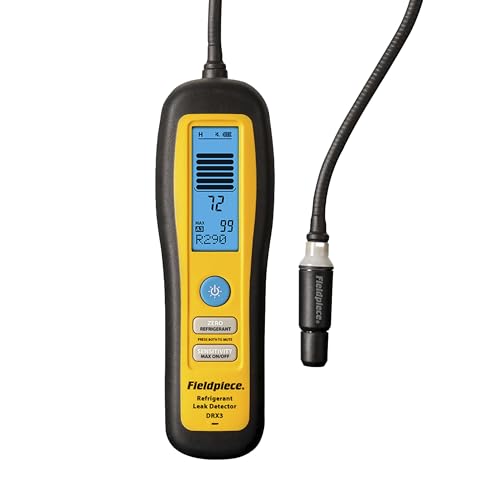
For most technicians, the Fieldpiece DRX3 is the pick because its listing states a field-replaceable heated diode sensor, covers A3, A2L and A1 refrigerants plus combustible gases, and gives you high, medium and low sensitivity settings with auto and manual zeroing. The RALBIL Heated Diode Refrigerant Leak Detector is the value alternative if you want a replaceable heated diode probe and a 20-inch reach, though its published sensitivity figure of 0.05 oz/yr is the least impressive of the three halogen detectors here. The Fieldpiece DR82 is the one to choose if you want an infrared sensor and a long stated sensor life rather than a user-replaceable element; its listing claims a 10-year sensor life and IP54 sealing, which is a different way of solving the same problem. The Bacharach 3015-0784 Maintenance Kit is not a detector at all; it is a maintenance kit, and it appears here only because it is the kind of accessory a replaceable-sensor owner eventually needs.
What a replaceable sensor actually changes about ownership
A refrigerant leak detector is a sensor with a handle. The heated diode or infrared cell at the tip is the part that reacts to halogenated gas, and it is the part that degrades. A heated diode runs hot, is exposed to oil, moisture and acid, and its response drifts as it ages. An infrared cell is sealed behind a window but the optical path can still foul. Either way, the day comes when the detector no longer finds leaks it used to find, and the question is whether you replace a sensor or replace the tool.
That is the whole point of this category. A detector with a field-replaceable sensor turns a consumable into a maintenance item. You keep the body, the electronics, the display and the battery, and you fit a new sensing element. In practice this matters most to technicians who use a detector daily, because daily use is what burns through sensors. For somebody who checks a single split system twice a year, a sealed sensor with a long stated life may be the better economic answer, and that is exactly the choice the Fieldpiece DRX3 and the Fieldpiece DR82 present.
The catch is that ‘replaceable’ in a listing can mean several things. It can mean the sensor unscrews from the probe, it can mean the whole probe assembly is a spare part, or it can mean the manufacturer services it. Read the wording carefully. The Fieldpiece DRX3 says ‘field-replaceable, heated diode sensor’. The RALBIL Heated Diode Refrigerant Leak Detector says ‘the probe can be replaced’. Both are useful, but they are not the same statement.
Heated diode versus infrared when the sensor is the decision
Heated diode sensors work by heating a ceramic or metal element and measuring the change in its electrical behaviour when halogenated gas touches it. They are fast, they respond to a very wide range of refrigerants including CFCs, HCFCs, HFCs, HFOs and blends, and they are the traditional choice for leak hunting because the tip can be pushed right up to a joint. Their weakness is that they are consumable and they can be poisoned by exposure to large concentrations of refrigerant or to contaminants.
Infrared sensors work differently. A gas sample is drawn or diffused into a cell and the absorption of infrared light at a specific wavelength is measured. Infrared cells are generally more selective and less prone to poisoning, and the listing for the Fieldpiece DR82 claims a 10-year sensor life with IP54 sealing against moisture and oil. The trade-off is usually cost and, in some designs, a slower response than a hot diode. The listing for the Fieldpiece DR82 states the detector finds leaks below 0.03 oz/yr, which it describes as 20 times more sensitive than bubbles.
If you want to understand this split in more depth, the site has a dedicated comparison in infrared versus heated diode refrigerant leak detectors. The short version for this page: a replaceable heated diode gives you the fastest tip response and the widest refrigerant coverage, while an infrared cell with a long stated life gives you less maintenance and better tolerance of dirty environments. Neither is universally better; they are different answers to the same problem.
The comparison table: what each listing publishes
| Pick | Sensor type | Sensor replaceable | Stated sensitivity | Refrigerant coverage | Zeroing | Notes |
|---|---|---|---|---|---|---|
| Fieldpiece DRX3 | Heated diode | Yes, field-replaceable | Not stated in the listing bullets | A3, A2L, A1, HC, HFC, HCFC, CFC, HFO, H2/N2 tracer, blends, heating gases | Auto and manual | High, medium, low sensitivity settings |
| Fieldpiece DR82 | Infrared | Not stated in the listing bullets | Below 0.03 oz/yr | CFC, HCFC, HFC, HFO, blends | Not stated in the listing bullets | IP54, 10-year sensor life claimed |
| Bacharach 3015-0784 Maintenance Kit | Not applicable | Not applicable | Not applicable | Not applicable | Not applicable | Maintenance kit for Bacharach H-10PM and H-10G |
| RALBIL Heated Diode Refrigerant Leak Detector | Heated diode | Yes, probe replaceable | 0.05 oz/yr (1.5 g/a) stationary | HFCs, HCFCs, CFCs, HFOs, blends, halon | Auto and manual | 9-stage leak display, 20-inch probe, 35-second warm-up |
Two things stand out. First, only the Fieldpiece DRX3 and the RALBIL Heated Diode Refrigerant Leak Detector publish a replaceable sensing element, and only the Fieldpiece DRX3 uses the words ‘field-replaceable’. Second, the sensitivity figures are not directly comparable: the Fieldpiece DR82 publishes a leak rate in ounces per year, the RALBIL Heated Diode Refrigerant Leak Detector publishes a leak rate in ounces per year, and the Fieldpiece DRX3 publishes no figure at all. Do not treat the absence of a number as a weakness; treat it as a number the listing does not publish.
The replaceable-sensor detectors in this batch
Fieldpiece DRX3
The only detector here whose listing explicitly states a field-replaceable heated diode sensor, with A3, A2L and A1 coverage plus combustible gases.
Fieldpiece DR82
Infrared rather than heated diode, with a stated 10-year sensor life and IP54 sealing; the listing does not describe the sensor as user-replaceable.
Bacharach 3015-0784 Maintenance Kit
Not a detector. A maintenance kit for two Bacharach H-10 models, listed only as the accessory a replaceable-sensor owner may need.
RALBIL Heated Diode Refrigerant Leak Detector
States a replaceable heated diode probe, a 20-inch probe, and 9-stage leak level display with three sensitivity levels.
Sensitivity numbers, and the trap in comparing them
The RALBIL Heated Diode Refrigerant Leak Detector states a maximum sensitivity of 0.05 oz/yr in a stationary state. The Fieldpiece DR82 states it finds leaks below 0.03 oz/yr. Those look like a straight comparison, and on paper the infrared unit is more sensitive. But sensitivity figures are only meaningful with the conditions attached. The RALBIL Heated Diode Refrigerant Leak Detector says ‘in stationary state’, which is a real qualification: a detector held still in a known concentration behaves differently from one being waved along a pipe in a moving air stream. The Fieldpiece DR82’s figure is quoted against bubbles, which is a field-realistic benchmark rather than a laboratory one.
The Fieldpiece DRX3 publishes no sensitivity figure at all. That is not a defect in the product; it is a gap in the listing. If a sensitivity number is the deciding factor for you, the Fieldpiece DRX3 cannot be compared on that axis from the published data, and you should treat the choice as being about the replaceable sensor and refrigerant coverage instead. The site’s broader treatment of this is in heated diode refrigerant leak detectors, where the same caution applies.
The practical advice is to use the number as a filter, not a ranking. A detector that claims 0.05 oz/yr and actually finds the leak on a rooftop unit is worth more than one that claims 0.01 and sits in the van. The number tells you what the manufacturer is willing to publish; the sensor type tells you how the tool behaves in the field.
A3, A2L and the refrigerants that change the requirement
The refrigerants a detector covers matter more than they used to. A3 refrigerants such as propane and isobutane are flammable. A2L refrigerants such as R32 and R454B are mildly flammable. A1 refrigerants are the traditional non-flammable ones. A detector that covers all three groups is doing more than detecting leaks; it is part of a safe working method on systems where a leak can create a flammable atmosphere.
The Fieldpiece DRX3’s listing states it detects A3, A2L and A1 refrigerants and combustible gases. That is the broadest stated coverage in this batch and the reason it takes the top pick for anybody working across domestic, commercial and hydrocarbon systems. The RALBIL Heated Diode Refrigerant Leak Detector covers HFCs, HCFCs, CFCs, HFOs, blends and halon, which is a halogen list rather than a flammability classification, and its listing does not use the A3 or A2L language. The Fieldpiece DR82 covers CFC, HCFC, HFC, HFO and blends, again without the A3 or A2L wording.
If your work is specifically on A2L systems, there is a separate page on A2L refrigerant leak detectors that goes deeper into the classification. The point for this page is that a replaceable sensor is only useful if the sensor is matched to the refrigerant you actually meet. A spare heated diode that is not rated for the gas in front of you is not a spare.
What the listings do not tell you, and the kit that fills the gap
The Bacharach 3015-0784 Maintenance Kit is a maintenance kit for the Bacharach H-10PM and H-10G detectors. The listing publishes a part number and nothing else: no contents, no sensor, no filter, no specification. It is included here because it is the category of thing a replaceable-sensor owner ends up buying, but it is not a detector and should not be compared as one. If you own an H-10 series instrument, the listing tells you the part number and that is all it tells you.
Across the four picks, several things are simply not published. The Fieldpiece DRX3 does not state a sensitivity figure, a warm-up time, a battery life or an IP rating. The Fieldpiece DR82 does not state whether its sensor is user-replaceable, what its warm-up time is, or how it is zeroed. The RALBIL Heated Diode Refrigerant Leak Detector does not state an IP rating or a battery life beyond the 1000 mAh capacity in its listing. The Bacharach 3015-0784 Maintenance Kit publishes only a part number. None of this is a reason to avoid a product; it is a reason to check the manufacturer’s own documentation before you buy, because the listing bullets are a summary, not a datasheet.
The maintenance nobody mentions in this category is the sensor itself. A heated diode that has been used in a system with a large leak may be saturated and need replacement sooner than its nominal life suggests. An infrared cell that has been drawing oily air may need its filter changed. Either way, the replaceable-sensor design is what lets you do that yourself rather than sending the tool away.
Recommended Tools


Products shown because their documented specifications fit this guide. Price and availability are on Amazon and can change.
Frequently Asked Questions
Which of these detectors actually has a replaceable sensor?
the Fieldpiece DRX3 states a field-replaceable heated diode sensor. The RALBIL Heated Diode Refrigerant Leak Detector states that the probe can be replaced. The Fieldpiece DR82's listing does not state that the sensor is user-replaceable; it states a 10-year sensor life and IP54 sealing. The Bacharach 3015-0784 Maintenance Kit is a maintenance kit, not a detector.
Is a heated diode or an infrared sensor better for leak hunting?
They solve different problems. A heated diode responds fast at the tip and covers a very wide refrigerant list, which suits joint-by-joint leak hunting. An infrared cell is more selective and the Fieldpiece DR82 listing claims a 10-year life with IP54 sealing, which suits dirty environments and lower maintenance. Neither is universally better.
Why does the Fieldpiece DRX3 not publish a sensitivity figure?
The listing does not publish one. That is a gap in the published data, not a statement that the detector is insensitive. If a sensitivity number is your deciding factor, the Fieldpiece DRX3 cannot be compared on that axis from the listing alone.
Can these detectors find a leak that soap bubbles miss?
The Fieldpiece DR82 listing states it finds leaks below 0.03 oz/yr and describes that as 20 times more sensitive than bubbles. The RALBIL Heated Diode Refrigerant Leak Detector states a maximum sensitivity of 0.05 oz/yr in a stationary state. The Fieldpiece DRX3 publishes no figure. In all cases the detector is a screening tool; a confirmed leak still needs a pressure test or a recovery and weigh-in.
Do these detectors detect combustible gas as well as refrigerant?
Only the Fieldpiece DRX3's listing states combustible gas detection alongside A3, A2L and A1 refrigerants and heating gases. The RALBIL Heated Diode Refrigerant Leak Detector and the Fieldpiece DR82 list halogenated refrigerants and blends. A refrigerant sniffer is not a substitute for a combustible gas detector on a gas appliance, and the site has a separate page on refrigerant leak detector versus combustible gas detector.
How often does a heated diode sensor need replacing?
No listing here publishes a replacement interval. The Fieldpiece DR82 listing claims a 10-year sensor life for its infrared design, but that is a different technology. For heated diodes, replacement is driven by use, contamination and exposure to large leaks. Buy the spare when you buy the tool if you use it daily.
Affiliate disclosure: Akermin earns a commission from qualifying Amazon purchases made through links on this page. Our editorial picks are based on documented specifications and owner feedback, not commissions.