As an Amazon Associate, Akermin earns from qualifying purchases. Product links on this page are affiliate links.
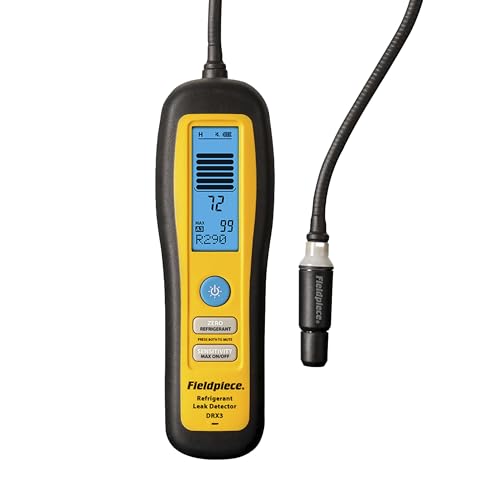
For most HVAC work on R454B systems, the Fieldpiece DRX3 is the pick to start with, because its listing states detection of A3, A2L and A1 refrigerants plus combustible gases on a field-replaceable heated diode sensor, which is the broadest stated coverage here and the only one that crosses into combustible gas work. If you want the smallest leak the listings claim to find, the Fieldpiece DR82 states under 0.03 oz/yr on an infrared sensor, but that listing does not name R454B explicitly, only CFC, HCFC, HFC, HFO and blends, so confirm A2L coverage with the maker before relying on it for an A2L system. The Aprvtio ALD-200 and the Aprvtio ALD-200PRO both state R454B by name and both quote 0.14 oz/yr; the Aprvtio ALD-200PRO adds a 16-inch flexible probe and cites EN14624, SAE J2791 and J2913 in its listing. The Simbow 3-in-1 is the budget-shaped option, states R454B and A2L coverage, and is the only pick that publishes a battery runtime, 20 hours.
Why R454B changes the detector question
R454B is a blend of R32 and R1234yf, and it carries an A2L safety classification. A2L means lower flammability than the A3 hydrocarbons such as R290 and R600, but it is not the inert A1 group that R410A belongs to. That classification matters to the instrument, not just to the label on the cylinder. A detector sold for A1 refrigerants only may still respond to R454B vapour, because the sensing element does not know the classification, but the listing will not claim it, and in a workplace the claim on the listing is what you can point to.
The practical consequence is that you cannot assume the detector in your bag is right for the job. The five picks here all publish A2L coverage, and four name R454B specifically. That is the first filter to apply. The second is the sensor technology, because it decides how small a leak you can find and how much maintenance the instrument needs.
If you want the background on how the classifications differ, the A2L detector explainer sets out the groups and what each one demands of the tool.
Heated diode, infrared, and what the sensitivity figures mean
Two sensing technologies appear across these five listings, and they behave differently in the field.
A heated diode sensor, used in the Fieldpiece DRX3 and stated as a heat diode sensor in the Aprvtio ALD-200, works by heating an element that reacts with halogenated gases. When refrigerant vapour reaches it, the ion flow changes and the instrument reports a leak. Diode sensors are fast to respond and can be very sensitive, but the element degrades with exposure to contamination, moisture and heavy leaks, which is why the Fieldpiece DRX3’s listing makes a point of saying the sensor is field-replaceable. That single word, replaceable, is the difference between a tool you keep and a tool you send away.
An infrared sensor, used in the Fieldpiece DR82, shines light through a small chamber and measures absorption at a wavelength the refrigerant absorbs. There is no hot element to burn out, so the listing can state a 10-year sensor life, and infrared sensors tolerate moisture and oil better, which is what the IP54 rating in that listing is about. The trade-off is that infrared sensors respond more slowly and can be fooled by large concentrations saturating the cell.
Now the numbers. The Fieldpiece DR82 states under 0.03 oz/yr. The Aprvtio ALD-200 and the Aprvtio ALD-200PRO both state adjustable sensitivity up to 0.14 oz/yr. The Fieldpiece DRX3 and the Simbow 3-in-1 publish no sensitivity figure at all. Those figures are not directly comparable in the way a buyer expects. A leak rate in ounces per year is a mass flow, and what the instrument actually senses is concentration at the probe tip, which depends on how close you hold it, how the air moves and how long you dwell. Treat the published number as a relative claim about the sensor, not a calibrated threshold you can rely on to the last digit.
What each listing actually publishes
The table below carries only facts stated in the listings. Where a listing is silent, the cell says so.
| Pick | Sensor type stated | Stated sensitivity | R454B named | Probe or display | Battery |
|---|---|---|---|---|---|
| Fieldpiece DRX3 | Heated diode, field-replaceable | Not stated in the listing bullets | Yes, under A2L | Not stated in the listing bullets | Field-replaceable batteries, runtime not stated |
| Fieldpiece DR82 | Infrared | Under 0.03 oz/yr | No, listing names CFC, HCFC, HFC, HFO and blends | Backlit LCD, LED tip | Not stated in the listing bullets |
| Aprvtio ALD-200 | Heat diode | Up to 0.14 oz/yr, adjustable | Yes, under A2L | 2.8-inch TFT colour display | Rechargeable, runtime not stated |
| Aprvtio ALD-200PRO | Not stated in the listing bullets | Up to 0.14 oz/yr, adjustable | Yes, under A2L | 16-inch flexible probe | Not stated in the listing bullets |
| Simbow 3-in-1 | Not stated in the listing bullets | Not stated in the listing bullets | Yes, under A2L | All-metal flexible probe, digital display | 1800 mAh, up to 20 hours |
Two things stand out. The Aprvtio ALD-200PRO’s listing is detailed about standards and probe length but does not state the sensor type, which is unusual for a professional-grade tool and worth asking about before purchase. The Fieldpiece DR82’s listing is the only one that quotes a sensitivity below 0.1 oz/yr, but it is also the only one that does not name R454B or A2L, which is the single most important gap on this page.
For a wider view of how these two sensor families compare, the infrared detector round-up and the heated diode round-up cover each type on its own terms.
The five R454B-capable picks
Fieldpiece DRX3
The only pick whose listing states A3, A2L and A1 refrigerant coverage plus combustible gases, on a heated diode sensor the listing says is field-replaceable, with auto and manual zero and three sensitivity settings.
Fieldpiece DR82
The listing states an infrared sensor good for under 0.03 oz/yr, the smallest figure published here, but it names CFC, HCFC, HFC, HFO and blends rather than R454B by name, so A2L coverage needs confirming.
Aprvtio ALD-200
States R454B and R32 by name under A2L, quotes 0.14 oz/yr with adjustable sensitivity, and carries a 2.8-inch colour display with a mute button.
Aprvtio ALD-200PRO
States R454B under A2L, quotes 0.14 oz/yr, cites EN14624, SAE J2791 and J2913, and adds a 16-inch flexible probe for coil assemblies and cramped plant rooms.
Simbow 3-in-1
States R454B and A2L coverage, reads in ppm and percent LEL, and is the only pick that publishes a battery figure, 1800 mAh giving up to 20 hours.
Probe reach, displays and the accessories nobody lists
Finding a leak is often a reach problem before it is a sensitivity problem. A split system coil sits behind a fan, a rooftop unit has its circuits buried, and a mini split head has almost no clearance. The Aprvtio ALD-200PRO’s 16-inch flexible probe is the longest stated here and is the reason to choose it over the Aprvtio ALD-200 if you work on packaged equipment. The Simbow 3-in-1 states an all-metal flexible probe but no length. The Fieldpiece DRX3 and the Fieldpiece DR82 publish no probe length at all.
Displays divide the group. The Aprvtio ALD-200 and the Simbow 3-in-1 state digital or colour displays with a mute function. The Fieldpiece DR82 states a backlit LCD and an LED at the tip. The Fieldpiece DRX3 states visual and audio indicators that change with leak intensity, without naming a display type. A mute button sounds trivial until you are working in an occupied bedroom or a quiet office, and both Aprvtio ALD-200 and the Simbow 3-in-1 publish one.
Notice what none of the five listings publish: a calibration interval, a warm-up time, a stated cross-sensitivity to other gases, or a replacement sensor part number. Those are the facts that decide the cost of ownership over several seasons, and they are absent from all five. Ask the supplier before you buy, because a detector with a sensor you cannot replace is a consumable, not a tool.
Where these detectors stop being the right answer
A refrigerant leak detector finds refrigerant. That is all it does, and several of the listings blur that line. The Fieldpiece DRX3’s listing says it detects combustible gases as well as A3, A2L and A1 refrigerants, and the Simbow 3-in-1’s listing quotes readings in ppm and percent LEL, which is a combustible gas convention. If you are buying for refrigerant work, you are paying for a function you may not use. If you are buying for combustible gas work, be aware that a refrigerant sniffer is not a substitute for a calibrated combustible gas instrument with an alarm, and a percent LEL reading on a handheld sniffer is an indication, not a safety instrument.
More importantly, none of these instruments is a gas alarm. They are leak locators. You sweep the probe, watch the reading climb, and follow it to the source. They do not sit on a wall and warn you at three in the morning, they do not log, and they do not tell you the concentration in the room in a way you can act on. If the question is whether an occupied space is safe, the answer comes from a fixed detection system or a different class of instrument, not from these.
One more limit applies specifically to A2L work. R454B is mildly flammable, and a leak in a confined space is a different risk from an A1 leak. A handheld sniffer helps you find the leak, but it does not clear the space, does not measure oxygen, and does not satisfy a permit-to-work regime on its own. If your work takes you into confined spaces, the confined space detector guide covers what that job actually requires.
Choosing between the five
Start with the refrigerant list. The Fieldpiece DRX3, the Aprvtio ALD-200, the Aprvtio ALD-200PRO and the Simbow 3-in-1 all name R454B or A2L in their listings, so any of them is defensible for A2L work on paper. The Fieldpiece DR82 does not, and that gap is the reason it sits second in the answer despite the best stated sensitivity figure.
Then ask what you actually do. If you service a mix of refrigeration and gas appliances and want one tool, the Fieldpiece DRX3’s stated coverage of A3, A2L, A1 and combustible gases on a replaceable diode is the broadest here. If you chase slow, tiny leaks on sealed systems and want the most sensitive sensor the listings claim, the Fieldpiece DR82’s infrared element is the one, provided you confirm A2L coverage. If you work on packaged units and rooftop equipment, the Aprvtio ALD-200PRO’s 16-inch probe earns its place. If you want a display you can read in a dark basement and a mute for occupied rooms, the Aprvtio ALD-200 or the Simbow 3-in-1. If battery life on a long day matters most, the Simbow 3-in-1 is the only pick that publishes a runtime.
Finally, do not overlook the consumable. The sensor is the part that wears out, and only the Fieldpiece DRX3’s listing states that its sensor is field-replaceable. On the others, ask. A detector whose sensor cannot be changed is a detector you replace, and that changes the arithmetic over a few seasons.
Recommended Tools


Products shown because their documented specifications fit this guide. Price and availability are on Amazon and can change.
Frequently Asked Questions
Will my R410A detector find R454B leaks?
It may respond, because halogen-sensitive sensors react to a range of refrigerants, but the listing for your detector probably does not claim A2L coverage. For R454B work you want a listing that names R454B or A2L, which four of the five picks here do. If your current tool does not, treat it as an A1-only instrument and do not rely on it for A2L documentation.
Which of these finds the smallest leak?
On the published figures, the Fieldpiece DR82 states under 0.03 oz/yr, the smallest number here, against 0.14 oz/yr for the Aprvtio ALD-200 and the Aprvtio ALD-200PRO. The Fieldpiece DRX3 and the Simbow 3-in-1 publish no sensitivity figure. But that number is a sensor claim, not a calibrated threshold in your hand. Probe technique, dwell time and air movement matter more than the difference between 0.03 and 0.14 in most field work.
Do these detectors alarm if refrigerant builds up in a room?
No. These are leak locators, not gas alarms. You sweep the probe and follow the reading to the source. None of the five listings describes a fixed alarm function, logging, or a room-level safety output. If you need a space monitored continuously, that is a different class of instrument.
the Fieldpiece DRX3 says it detects combustible gases. Does that make it a combustible gas detector?
It makes it a refrigerant detector that also responds to combustible gases, per its listing. That is not the same as a calibrated combustible gas instrument with an alarm and a stated range. If combustible gas detection is the primary job, buy for that job and read the combustible gas detector guide before deciding.
Why does the Aprvtio ALD-200PRO not state a sensor type?
The listing does not publish one. It is detailed about standards, R454B compatibility and the 16-inch probe, but the sensing technology is not named. That is worth a direct question to the supplier, because sensor type drives response speed, maintenance and sensor life.
How often does the sensor need replacing?
Not stated in any of the five listings. Only the Fieldpiece DRX3 states that its sensor is field-replaceable, and the Fieldpiece DR82 states a 10-year sensor life. For the others, ask the supplier for the sensor part number and the recommended replacement interval before you buy, because that cost recurs.
Affiliate disclosure: Akermin earns a commission from qualifying Amazon purchases made through links on this page. Our editorial picks are based on documented specifications and owner feedback, not commissions.