As an Amazon Associate, Akermin earns from qualifying purchases. Product links on this page are affiliate links.
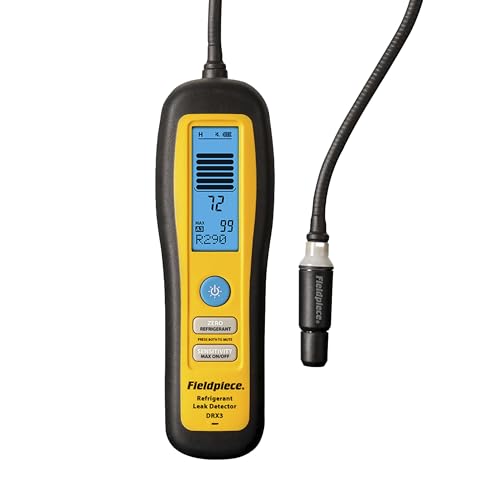
Carry the Fieldpiece DRX3 if your work now includes A3 hydrocarbon refrigerants such as R-290, tracer gas testing, or gas-fired heating equipment alongside the AC side: its listing states it detects A3, A2L and A1 refrigerants and combustible gases, including H2/N2 tracer gas and heating gases, on a field-replaceable heated-diode sensor. Carry the DR82 if you want the documented numbers: an infrared sensor with a stated 10-year life, sensitivity under 0.03 oz/yr, an IP54 rating and a 17-inch probe. The DRX3 listing gives none of those figures, which does not make it a lesser tool, but it does mean the DR82 is the one you can specify against a requirement.
Two Sensing Technologies
The DRX3 uses a heated-diode sensor, which Fieldpiece describes as accurate and field-replaceable and which the listing pairs with high, medium and low sensitivity settings plus automatic and manual zero modes. Heated-diode elements are consumed by use, which is why replaceability matters. The DR82 uses an infrared sensor, which the listing rates for 10 years; infrared sensing is the long-life option because the sensor is not consumed by exposure. The trade-off between the two chemistries is covered in infrared versus heated-diode refrigerant leak detectors; the short version is that infrared buys longevity and heated diode buys breadth of response.
Side by Side
| Item | Fieldpiece DRX3 | Fieldpiece DR82 |
|---|---|---|
| Sensor | Heated diode, field-replaceable | Infrared |
| Sensor life | Not stated | 10 years |
| Refrigerant classes | A3, A2L, A1 refrigerants and combustible gases | Not stated by safety class |
| Refrigerant families | HC, HFC, HCFC, CFC, HFO, H2/N2 tracer gas, blends, heating gases | CFC, HCFC, HFC, HFO and blends |
| Sensitivity | Not stated | Under 0.03 oz/yr; 20 times more sensitive than bubbles |
| Sensitivity settings | High, medium, low | Not stated |
| Zeroing | Auto and manual zero modes | Not stated |
| Indicators | Multiple visual and audio indicators that change with leak intensity | Backlit LCD showing size and intensity; LED tip and beep |
| Probe | Not stated | 17-inch flexible probe; replaceable filter tips |
| Ingress rating | Not stated | IP54 |
| Power | Long-life, field-replaceable batteries | USB-C rechargeable, 10 or more hours |
| App | Connects to the Job Link System app | Not stated |
| In the box | Heated-diode sensor and blow-molded case | Not stated beyond the detector |
Where the DRX3 Wins
Refrigerant coverage. The listing names all three safety classes. A2L refrigerants such as R-32 and R-454B are mildly flammable; A3 refrigerants such as R-290 are flammable hydrocarbons; A1 refrigerants such as R-410A are non-flammable. The DRX3 also states HC refrigerants and combustible gases, which the DR82 does not. For a technician who services both a propane-charged display case and a residential heat pump, that is one tool instead of two.
Tracer gas and heating gas. H2/N2 tracer gas and heating gases appear in the DRX3 listing and not in the DR82’s. If you pressure-test with a hydrogen-nitrogen mix or want to sweep a furnace manifold with the same instrument, the DRX3 is the only one of the pair documented for it. Tracer gas leak detection explained covers when that method is worth the trouble.
Serviceability and the app. A field-replaceable sensor and field-replaceable batteries mean the tool is not down when either wears out, and the Job Link connection ties it into the rest of a Fieldpiece kit.
Where the DR82 Wins
Documented sensitivity. Under 0.03 oz/yr is a figure you can compare against other makers’ claims, with the usual caution that oz/yr sensitivity is defined by each manufacturer’s own test. The DRX3 gives no figure at all. Gas detector sensitivity explains why those figures are indicative rather than comparable across brands.
Sensor life without maintenance. Ten years of infrared sensing against a consumable heated-diode element is the reason infrared units sit at the top of most roundups for daily use. Nothing to replace, no zeroing drift as the element ages, and the ingress rating means a wet coil or an oily fitting is not a threat.
Battery and probe details. A stated 10-plus hour USB-C runtime and a 17-inch probe with replaceable filter tips are the kind of specifics a buyer wants to know. The DRX3’s probe length is not on the listing.
Who Should Buy Which
- Commercial refrigeration and supermarket techs working with R-290: DRX3. The DR82 listing does not cover A3.
- Residential AC and heat pump techs on R-410A, R-32 and R-454B: DR82. HFC and HFO coverage with a 10-year sensor is the low-maintenance choice, and the infrared refrigerant leak detector roundup ranks it against the Inficon and Elitech alternatives.
- Shops that also do gas heating and tracer gas work: DRX3, and it appears in the A2L refrigerant leak detector roundup for that reason.
- Anyone who needs a specification sheet to justify the purchase: DR82; it has one.
A Note on What the Listings Do Not Say
The DR82 listing does not use the term A2L; it lists refrigerant families, and R-32 (an HFC) and R-454B (an HFO blend) fall within them chemically. If a client or a standard requires an instrument explicitly rated for A2L, confirm with Fieldpiece rather than inferring it from the family list. The full documentation for each is in the DRX3 review and the DR82 review, and the heated-diode sibling is compared in DRX3 versus DR58.
Recommended Tools


Products shown because their documented specifications fit this guide. Price and availability are on Amazon and can change.
Frequently Asked Questions
Does the DR82 detect R-290 or other A3 hydrocarbon refrigerants?
The DR82 listing states CFC, HCFC, HFC, HFO and blends. It does not list hydrocarbon refrigerants or combustible gases. The DRX3 listing explicitly includes A3 refrigerants, HC and combustible gases, which is the clearest difference between the two.
Which Fieldpiece detector has the longer sensor life?
The DR82 states a 10-year infrared sensor life. The DRX3 listing states that its heated-diode sensor is field-replaceable but gives no hour or year figure, so a direct comparison is not possible from the documentation.
Can the DRX3 find tracer gas leaks?
The listing includes H2/N2 tracer gas among the substances it is for use with. The DR82 listing does not mention tracer gas. Tracer gas is a 5 percent hydrogen, 95 percent nitrogen mix used to pressure-test a system that has been evacuated.
Affiliate disclosure: Akermin earns a commission from qualifying Amazon purchases made through links on this page. Our editorial picks are based on documented specifications and owner feedback, not commissions.
Related Guides

WiFi Natural Gas Alarm Review: One Unit Reveals the Whole Design
A WiFi natural gas alarm with an LCD showing gas concentration status and temperature, a stated response within 30 seconds, an alarm of at least 85 decibels and notifications to a phone app.
Read More→
Forensics Detectors Cl2 Review: 5 Percent of Full Scale Is 2.5 ppm
A rechargeable chlorine detector with an electrochemical sensor reading 0 to 50 ppm at 0.1 ppm resolution, a response time under 30 seconds, adjustable audible, visual and vibrating alarms and a supplied calibration certificate.
Read More→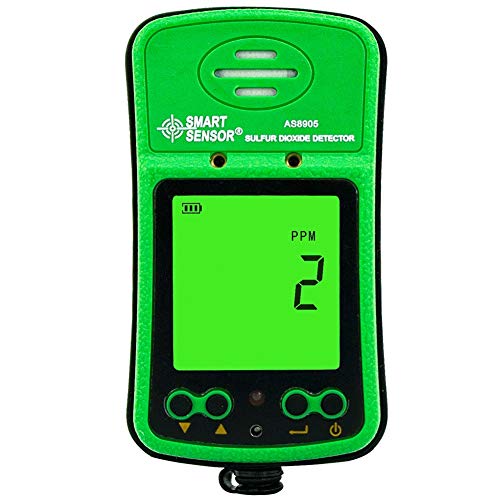
Smart Sensor SO2 Detector Review: 0.1 ppm Steps, No Accuracy Figure
A clip on sulfur dioxide monitor built on an electrochemical sensor, reading 0 to 20 ppm in 0.1 ppm steps, with adjustable high and low alarms signalled by sound, flash and vibration and a rechargeable cell quoted at 8 to 9 hours.
Read More→