As an Amazon Associate, Akermin earns from qualifying purchases. Product links on this page are affiliate links.
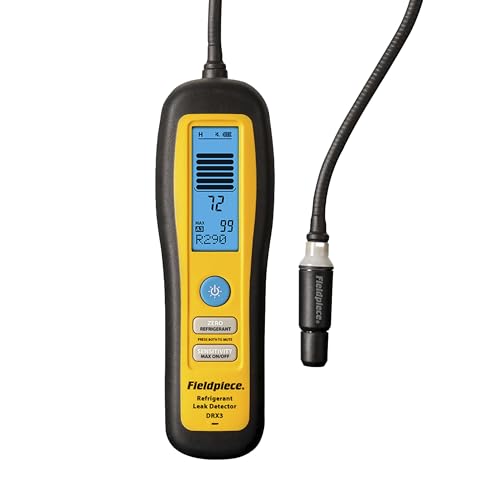
Fieldpiece · Fieldpiece - DRX3 – Refrigerant & Combustible Gas Leak Detector - Detects A3, A2L, A1 Refrigerants and Combustible Gases - Lightweight HVAC Tool
View on AmazonPrice and availability are shown on Amazon and can change at any time.
Verdict
The Fieldpiece DRX3 is the detector to buy when one instrument has to cover a refrigeration case charged with R-290, a heat pump on R-454B, a legacy R-410A split system and the gas valve on the furnace beside it. Its listing states that it detects A3, A2L and A1 refrigerants and combustible gases, that it is for use with HC, HFC, HCFC, CFC, HFO, H2/N2 tracer gas, blends and heating gases, and that its heated-diode sensor and its batteries are field-replaceable. It has high, medium and low sensitivity settings, automatic and manual zero modes, visual and audio indicators that change with leak intensity, and it connects to the Job Link System app. The listing gives no oz/yr, sensor-life, runtime, probe-length or ingress figure. Buy it for breadth and serviceability, not for a specification sheet.
Who It Is For
- Commercial refrigeration technicians who now meet R-290 hydrocarbon systems and need A3 coverage in writing.
- HVAC contractors whose crews handle both refrigerant circuits and gas-fired heating and want one sniffer in the bag.
- Shops that pressure-test with hydrogen-nitrogen tracer gas.
- Fieldpiece users already on the Job Link app.
A technician who wants a stated sensitivity figure or a sensor with nothing to replace is better served by the DR82.
Documented Specifications
| Item | Manufacturer or listing statement |
|---|---|
| Sensor | Heated diode, accurate and field-replaceable |
| Refrigerant classes | A3, A2L, A1 refrigerants and combustible gases |
| Gases | HC, HFC, HCFC, CFC, HFO, H2/N2 tracer gas, blend refrigerants, heating gases |
| Sensitivity settings | High, medium, low |
| Zero modes | Automatic and manual |
| Indicators | Multiple visual and audio feedback indicators that change with leak intensity |
| Power | Long-life, field-replaceable batteries |
| Connectivity | Job Link System app |
| In the box | Heated-diode sensor and blow-molded case |
| Sensitivity (oz/yr) | Not stated |
| Sensor life | Not stated |
| Battery runtime | Not stated |
| Probe length | Not stated |
| Ingress rating | Not stated |
Where other Fieldpiece detectors publish under 0.03 oz/yr, IP54 and a probe length, the DRX3 listing describes capabilities rather than quantities, and this review does not borrow numbers the manufacturer has not put on the listing.
Three Refrigerant Classes and a Fuel Gas
The DRX3 exists because of refrigerant safety classes. A1 refrigerants such as R-410A are non-flammable. A2L refrigerants such as R-32 and R-454B are mildly flammable and are replacing R-410A in new residential equipment. A3 refrigerants such as R-290 are flammable hydrocarbons, propane by another name, spreading through commercial refrigeration, and a detector keyed only to halogens can miss them entirely. The DRX3 listing states all three classes plus combustible and heating gases on one sensor, so it is documented to sweep a propane-charged display case and then a furnace manifold. A2L refrigerant leak detectors explained and refrigerant versus combustible gas detectors cover why that combination is unusual.
The Replaceable Sensor and Batteries
Heated-diode sensors are consumed by use; every large hit shortens the element’s life, and a dead sensor on a sealed instrument means a factory return or a new tool. Fieldpiece’s answer is to make the DRX3 sensor a field-replaceable part and ship one in the box. Batteries follow the same logic: long-life and field-replaceable rather than a sealed pack, so spares in the case cover a long day. Neither rated sensor hours nor battery runtime is on the listing, so judge replacement by behavior: a sensor that takes longer to zero, responds more slowly or fails a reference check is near the end. How to test a refrigerant leak detector before use describes a quick daily check.
Sensitivity, Zeroing and the App
Three sensitivity settings let you start high to find a leak and drop to low to isolate it among nearby fittings. The zero modes are the more interesting control. Automatic zeroing adapts the baseline to surrounding air, convenient in a clean room but able to mask a slow, steady leak where refrigerant already lingers. Manual zeroing holds the reference you set, and owners working in tight equipment rooms favor it for that reason. The Job Link connection puts the leak reading beside readings from other Fieldpiece tools, a convenience for documenting a repair rather than a detection feature.
Strengths
- Documented for A3, A2L and A1 refrigerants and combustible gases on one instrument.
- Field-replaceable sensor and batteries, with a sensor included.
- Three sensitivity levels and both auto and manual zero.
- Tracer gas and heating gas coverage stated on the listing.
Limitations
- No sensitivity figure, sensor-life figure, battery runtime, probe length or ingress rating on the listing.
- Heated-diode element is consumable; replacement is a recurring cost of ownership.
- No stated ppm or percent LEL scale for combustible gas work; a dedicated sniffer offers one.
- App integration adds value only for Fieldpiece users.
How It Compares
The Fieldpiece DR82 is the infrared alternative: under 0.03 oz/yr, a 10-year sensor, IP54, a 17-inch probe and 10 or more hours on USB-C, but its listing covers CFC, HCFC, HFC, HFO and blends with no mention of A3 or combustible gases. The Fieldpiece DR58 is the heated-diode sibling with the numbers the DRX3 lacks, again without A3. The Inficon D-TEK 3 offers Low, Medium, High and Super sensitivity, auto and manual zero, and coverage of CFCs, HCFCs, HFCs, HFOs and blends including A2Ls. Head-to-head pages cover DRX3 versus DR82 and DRX3 versus DR58. The DRX3 is the replaceable-sensor pick in the heated-diode refrigerant leak detector guide, appears in the A2L refrigerant leak detector guide, and the whole category is ranked in the refrigerant leak detector roundup.
A Note on Flammable Refrigerants
An A3 or A2L leak is a flammable gas leak. Ventilate the space and keep ignition sources clear of the work area. The DRX3 finds the leak; it does not make the space safe, and a machinery room with a large hydrocarbon charge needs its own fixed detection.
How We Research
This review is based on the Fieldpiece listing and patterns in owner and technician reports. We did not run laboratory tests. Where the listing omits a figure, the table says so rather than borrowing one from a sibling model.
Recommended Tools


Products shown because their documented specifications fit this guide. Price and availability are on Amazon and can change.
Frequently Asked Questions
What does the DRX3 come with?
The listing states that it includes the heated-diode sensor and a blow-molded case. It does not itemize a charger, spare sensors or spare filter tips, so check the current listing before assuming any of those are in the box.
Does the DRX3 need to be zeroed before use?
It offers both automatic and manual zero modes. Automatic zeroing treats the surrounding air as the baseline and suits a clean room; manual zeroing is for a space that already contains refrigerant, where you want to hold a reference rather than let the instrument adapt to background.
Can the DRX3 sweep a furnace gas valve?
The listing states heating gases and combustible gases among what it detects. That makes it documented for the job, although a dedicated combustible sniffer with a stated ppm range gives you a scale the DRX3 listing does not describe.
How sensitive is the DRX3 in oz/yr?
The listing does not state a figure. Fieldpiece states under 0.03 oz/yr for its DR58 and DR82, but that number belongs to those models and should not be assumed for the DRX3.
Affiliate disclosure: Akermin earns a commission from qualifying Amazon purchases made through links on this page. Our editorial picks are based on documented specifications and owner feedback, not commissions.
Related Guides

WiFi Natural Gas Alarm Review: One Unit Reveals the Whole Design
A WiFi natural gas alarm with an LCD showing gas concentration status and temperature, a stated response within 30 seconds, an alarm of at least 85 decibels and notifications to a phone app.
Read More→
Forensics Detectors Cl2 Review: 5 Percent of Full Scale Is 2.5 ppm
A rechargeable chlorine detector with an electrochemical sensor reading 0 to 50 ppm at 0.1 ppm resolution, a response time under 30 seconds, adjustable audible, visual and vibrating alarms and a supplied calibration certificate.
Read More→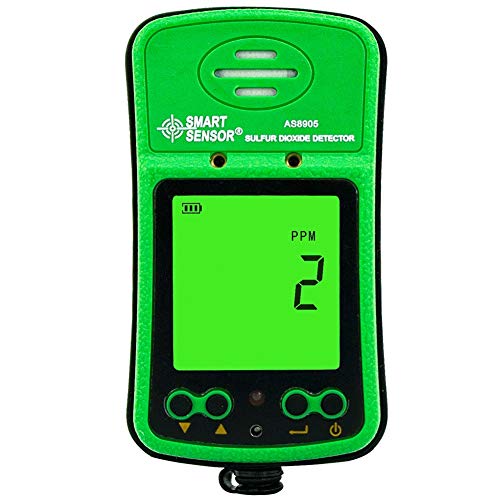
Smart Sensor SO2 Detector Review: 0.1 ppm Steps, No Accuracy Figure
A clip on sulfur dioxide monitor built on an electrochemical sensor, reading 0 to 20 ppm in 0.1 ppm steps, with adjustable high and low alarms signalled by sound, flash and vibration and a rechargeable cell quoted at 8 to 9 hours.
Read More→