As an Amazon Associate, Akermin earns from qualifying purchases. Product links on this page are affiliate links.
Choose the Fieldpiece DR58 if you service halogenated refrigerants only and want the numbers: its listing states sensitivity under 0.03 oz/yr, a 300 hour sensor life, an IP54 rating, a 17-inch probe and an 18 hour rechargeable battery. Choose the DRX3 if your work has expanded into A3 hydrocarbon refrigerants, combustible gases or gas heating, or if you want a sensor and batteries you can swap in the field: its listing states A3, A2L and A1 coverage, combustible gases, HC through HFO families, H2/N2 tracer gas, high/medium/low sensitivity, auto and manual zero, and Job Link app support, but no sensitivity or sensor-life figure. Both are heated-diode instruments, so both sensors are consumed by use; only the DRX3 documents what happens when that day comes.
Shared Technology, Different Emphasis
A heated-diode sensor breaks down halogenated refrigerant molecules on a hot element and detects the resulting ions, which makes it sensitive to small leaks and, in the DRX3’s case, extendable to hydrocarbon and combustible gases. The cost is a finite element life and a need to zero in clean air. Both listings reflect that: the DR58 quotes an hour figure, the DRX3 makes the element replaceable. For the mechanism and its limits, see how gas leak detectors work. The infrared alternative that avoids the consumable element is the DR82, compared in DRX3 versus DR82.
Side by Side
| Item | Fieldpiece DR58 | Fieldpiece DRX3 |
|---|---|---|
| Sensor | Heated diode | Heated diode, field-replaceable |
| Sensor life | 300 hours | Not stated |
| Sensitivity | Under 0.03 oz/yr; 20 times more sensitive than bubbles | Not stated |
| Refrigerant classes | Not stated by class | A3, A2L, A1 and combustible gases |
| Gases listed | HFC, CFC, HCFC, HFO, H2N2 tracer gas, blends | HC, HFC, HCFC, CFC, HFO, H2/N2 tracer gas, blends, heating gases |
| Sensitivity settings | Not stated | High, medium, low |
| Zeroing | Not stated | Auto and manual modes |
| Indicators | Backlit LCD for size and intensity; LED tip and beep | Multiple visual and audio indicators that change with intensity |
| Probe | 17-inch flexible; replaceable filter tips | Not stated |
| Ingress rating | IP54, resists moisture and oil | Not stated |
| Power | 18 hour USB rechargeable battery | Long-life, field-replaceable batteries |
| Extras | Replaceable filter tips | Job Link app; blow-molded case; sensor included |
Where the DR58 Wins
A specification you can hold it to. Under 0.03 oz/yr, 300 hours, IP54, 18 hours: four numbers the DRX3 listing does not match with numbers of its own. Oz/yr figures are defined by each manufacturer’s own test method, so they are for comparing within a brand more than across brands, but within Fieldpiece’s own range the DR58 is the one that states its sensitivity.
Runtime. Eighteen hours on a charge covers two long days. The DRX3 offers replaceable batteries instead, which is a different answer to the same problem: you carry spares rather than a cable.
Moisture and oil. The IP54 rating and the explicit statement that the sensor resists moisture and oil matter on a wet evaporator coil or an oily compressor fitting. The DRX3 listing calls the tool rugged but gives no ingress rating.
Simplicity. One refrigerant job, one set of indicators, no app. For a technician who does not want another device on the phone, that is a feature.
Where the DRX3 Wins
A3 and combustible gases. R-290 propane charges are spreading through commercial refrigeration, and A3 means flammable. The DR58 listing does not mention hydrocarbon refrigerants or combustible gases; the DRX3 lists both, plus heating gases, so it can also sweep a gas valve on a furnace call. The refrigerant versus combustible gas detector explainer covers why most refrigerant sniffers cannot do that.
Explicit A2L. The DRX3 says A2L. The DR58 lists families that include the A2L refrigerants chemically but never uses the term. Where documentation matters, that difference is real.
Field-replaceable everything. The consumable heated-diode element is the technology’s weak point, and the DRX3 makes it a spare part rather than a return to the factory. Batteries follow the same logic.
Controls. Three sensitivity settings and a choice of auto or manual zero give a technician more to work with on a contaminated job site than the DR58’s listing describes. How to test a refrigerant leak detector before use explains why zeroing mode matters in a space that already has refrigerant in the air.
Who Should Buy Which
- Residential and light commercial AC on R-410A, R-32 and R-454B: DR58. It is the documented choice in the heated-diode refrigerant leak detector roundup.
- Supermarket, cold-room and R-290 equipment: DRX3, without hesitation; the DR58 is not documented for A3.
- Shops using hydrogen-nitrogen tracer gas: either; both list it. The tracer gas leak detector roundup covers the dedicated instruments as well.
- Anyone who has retired a heated-diode unit because its sensor died: DRX3, or consider infrared.
What Applies to Both
Each is a heated-diode instrument that needs a clean-air zero before a sweep and slow probe movement along fittings. Neither is a safety monitor for occupied spaces, and neither replaces a fixed alarm in a machinery room. Sensor life on both is finite and, on the DRX3, undocumented; plan for replacement rather than being surprised by it. The complete documentation for each is in the DR58 review and the DRX3 review.
Recommended Tools
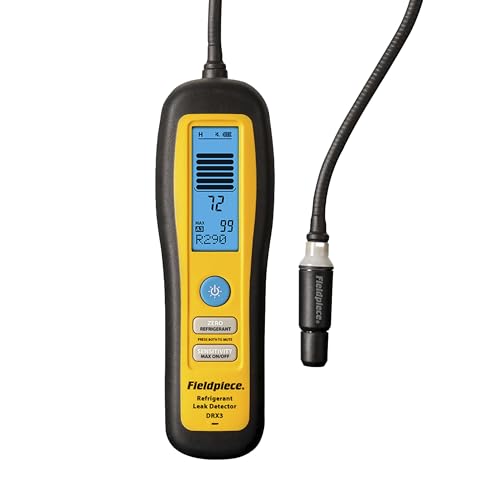


Products shown because their documented specifications fit this guide. Price and availability are on Amazon and can change.
Frequently Asked Questions
Is the DRX3 a replacement for the DR58?
Fieldpiece sells both. The DRX3 broadens coverage to A3 refrigerants and combustible gases and makes the sensor and batteries field-replaceable; the DR58 remains the refrigerant-only heated-diode unit with a documented sensitivity figure and sensor life. Treat them as siblings with different briefs rather than old and new.
How long does a heated-diode sensor last?
It depends on exposure, because the element is consumed by use. Fieldpiece states 300 hours for the DR58 sensor and gives no figure for the DRX3, saying only that it is field-replaceable. Inficon states 100 hours for its TEK-Mate, so 300 hours is on the long side for the technology.
Do both detect tracer gas?
Yes. The DR58 listing includes H2N2 tracer gas and the DRX3 listing includes H2/N2 tracer gas. The 5 percent hydrogen, 95 percent nitrogen mix is safe to pressurize a system with and both heated-diode units are documented to respond to it.
Is the DR58 rated for A2L refrigerants?
The listing states HFC, CFC, HCFC, HFO, H2N2 and blends, which chemically includes R-32 and R-454B, but it does not use the A2L term. The DRX3 listing states A2L explicitly. If you need the classification in writing, the DRX3 is the one that provides it.
Affiliate disclosure: Akermin earns a commission from qualifying Amazon purchases made through links on this page. Our editorial picks are based on documented specifications and owner feedback, not commissions.
Related Guides

WiFi Natural Gas Alarm Review: One Unit Reveals the Whole Design
A WiFi natural gas alarm with an LCD showing gas concentration status and temperature, a stated response within 30 seconds, an alarm of at least 85 decibels and notifications to a phone app.
Read More→
Forensics Detectors Cl2 Review: 5 Percent of Full Scale Is 2.5 ppm
A rechargeable chlorine detector with an electrochemical sensor reading 0 to 50 ppm at 0.1 ppm resolution, a response time under 30 seconds, adjustable audible, visual and vibrating alarms and a supplied calibration certificate.
Read More→
Smart Sensor SO2 Detector Review: 0.1 ppm Steps, No Accuracy Figure
A clip on sulfur dioxide monitor built on an electrochemical sensor, reading 0 to 20 ppm in 0.1 ppm steps, with adjustable high and low alarms signalled by sound, flash and vibration and a rechargeable cell quoted at 8 to 9 hours.
Read More→