As an Amazon Associate, Akermin earns from qualifying purchases. Product links on this page are affiliate links.
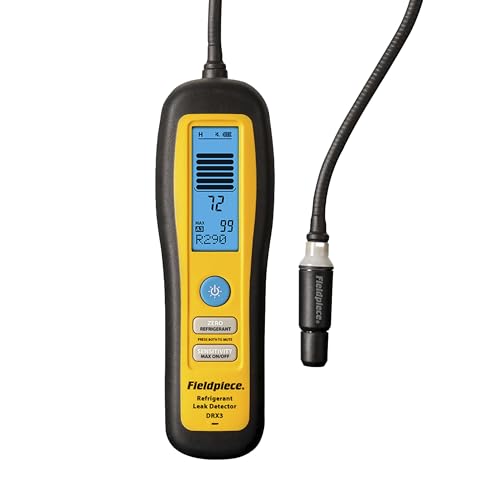
For most heat pump service the strongest pick is the Fieldpiece DRX3. It is the only listing here that states coverage of A3, A2L and A1 refrigerants together with combustible gases, and its heated diode sensor is field replaceable, which matters because heat pump work spans older R410A systems, newer A2L charges such as R32 and R454B, and the hydrocarbon blends appearing in small monobloc units. The Fieldpiece DR82 is the pick when you want the smallest leak found: its listing claims detection below 0.03 oz per year with an infrared sensor rated IP54 and a ten year sensor life. The SENSYX Rechargeable is the budget route into broad halogenated coverage with a rechargeable battery, but its metal-oxide sensor needs a long burn-in and careful sweep speed. The Elitech CLD-100 is a low-cost corona sensor with a long flexible probe, best treated as a first look tool rather than a precision instrument. The GoveeLife 1s is a water leak detector and does not belong on this page at all.
Why a heat pump leaks differently from a split system
A heat pump runs in both directions, which means the refrigerant circuit sees two very different sets of pressures and temperatures across the year. In heating mode the outdoor coil becomes the evaporator and runs cold, often below freezing, while the indoor coil runs hot. Every brazed joint and flare connection expands and contracts through that swing twice a year at least, and a joint that was gas-tight at installation can open a pinhole after a few seasons of thermal cycling.
The practical consequence is that heat pump leaks cluster in places a straight cooling system does not stress as hard. The reversing valve body and its four pipe stubs are a common source. So are the distributor tubes on the outdoor coil, the schrader ports, and any flare connection at the line set. A detector used on heat pumps therefore needs a probe slim enough to reach into the outdoor unit cabinet and a sensor that recovers quickly when you move from a contaminated area to a clean one, because you will be sweeping past the compressor and its oil residue repeatedly.
Refrigerant type matters too. Older heat pumps use R410A, which is an A1 blend. Newer equipment increasingly uses A2L refrigerants such as R32 and R454B, and some small monobloc heat pumps use A3 hydrocarbons like R290. A detector that only covers A1 refrigerants will miss nothing on an old system but may not respond at all to a hydrocarbon charge. That is why the coverage line in a listing is the first thing to read, not the sensitivity figure. For more on the flammable refrigerant classes, see A2L refrigerant leak detectors explained.
What each listing publishes about sensor and sensitivity
The four refrigerant detectors here use three different sensing technologies, and the listings describe them unevenly. The table below collects only what each listing states. Where a listing is silent, the cell says so rather than carrying an estimate.
| Pick | Sensor type as stated | Published sensitivity | Refrigerant coverage as stated | Power | Probe or housing note |
|---|---|---|---|---|---|
| Fieldpiece DRX3 | Heated diode, field replaceable | Not stated in the listing bullets | A3, A2L, A1; HC, HFC, HCFC, CFC, HFO, H2/N2 tracer gas, blends, heating gases | Long-life field-replaceable batteries | Rugged housing, auto and manual zero, three sensitivity settings |
| Fieldpiece DR82 | Infrared | Below 0.03 oz per year, stated as 20x more sensitive than bubbles | CFC, HCFC, HFC, HFO and blends | Not stated in the listing bullets | IP54 rated, 10 year sensor life, backlit LCD, LED tip |
| SENSYX Rechargeable | Metal-oxide semiconductor, Japan-made | Not stated in the listing bullets | Full halogenated family, CFC through HFO; SFD201 also HC and combustible gases | 2500 mAh lithium, up to 24 hours per charge, USB-C | Selectable High and Low sensitivity |
| Elitech CLD-100 | Corona sensor, upgraded analogue circuit | 0.21 oz per year, six adjustable steps | R11, R22, R134A, R404a, R410A and all halogenated refrigerants including HFCs, CFCs, HCFCs and blends | 4 AAA batteries, not included | Flexible probe around 8.26 inches |
Two things stand out. First, the sensitivity figures are not directly comparable. The Fieldpiece DR82 states a threshold below 0.03 oz per year. The Elitech CLD-100 states 0.21 oz per year. Those are both leak rate thresholds, so in principle the lower number finds a smaller leak, but they were not measured on the same rig and the listings do not say at what distance or with what refrigerant. Treat them as an indication of class, not as a ranking. Second, the Fieldpiece DRX3 and the SENSYX Rechargeable do not publish a sensitivity figure at all. That is not a fault in the product; it is a gap in the listing, and you should not fill it with a guess.
The Fieldpiece DRX3 is also the only pick that names tracer gas, H2/N2, in its coverage. Tracer gas is the technique of charging a system with a hydrogen and nitrogen mix and sniffing for hydrogen, which is useful on a heat pump that has already lost its charge and cannot be pressurised with its own refrigerant. That capability is discussed further on the tracer gas leak detector page.
The four refrigerant detectors that fit heat pump work
Fieldpiece DRX3
The only pick whose listing covers A3, A2L and A1 refrigerants alongside combustible gases, with a field-replaceable heated diode sensor.
Fieldpiece DR82
Infrared sensor with the smallest published leak threshold, below 0.03 oz per year, and an IP54 housing rated for moisture and oil.
SENSYX Rechargeable
Rechargeable lithium battery and a metal-oxide sensor covering the full halogenated family, with a stated burn-in procedure.
Elitech CLD-100
Corona sensor with six sensitivity steps, a 0.21 oz per year published threshold and a long flexible probe for tight joints.
Heated diode, infrared and metal-oxide in the field
A heated diode sensor, used in the Fieldpiece DRX3, works by heating a ceramic element and measuring the change in current when halogenated gas molecules touch it. It responds quickly and recovers quickly, which suits the sweep-and-move rhythm of heat pump work. The trade-off is that the diode is consumed over time and eventually needs replacing. The Fieldpiece DRX3’s listing states the sensor is field replaceable, which means the instrument’s life is not tied to the sensor’s life. On a heat pump you may sweep a dozen joints in a minute; a sensor that lingers on the last leak will have you chasing a ghost at the next joint.
An infrared sensor, used in the Fieldpiece DR82, absorbs light at the wavelength where refrigerant molecules absorb and measures the reduction. It does not burn out the way a diode does, and the Fieldpiece DR82’s listing claims a ten year sensor life. That claim is plausible for infrared because there is no consumable element in the same sense, though the optical path can be fouled by oil. The IP54 rating in the listing addresses that, since heat pump cabinets are often oily and wet. Infrared sensors are generally slower to clear than a heated diode, so on a tight sweep you may need to pause between joints.
A metal-oxide sensor, used in the SENSYX Rechargeable, changes resistance when reducing gases contact a heated tin oxide surface. It is cheap to make and broad in coverage, which is why the SENSYX Rechargeable’s listing can name such a long refrigerant list. The cost is warm-up and drift. The SENSYX Rechargeable’s own listing is unusually honest about this: it says the detector reaches full sensitivity after several hours of running and should be left switched on in clean air when new or after storage. It also states a sweep speed of no more than one inch per second and a probe distance of about a quarter inch from the joint. Those are not marketing lines, they are operating instructions, and ignoring them is the most common reason a metal-oxide detector misses a leak that a diode would have found.
A corona sensor, used in the Elitech CLD-100, is the oldest of the four. It relies on a high-voltage discharge whose behaviour changes in the presence of halogen gas. It is inexpensive and it works, but it is more prone to false triggers from humidity and drafts than the other types. The Elitech CLD-100’s listing states six sensitivity steps and a 0.21 oz per year threshold, which is a coarser instrument than the Fieldpiece DR82 but a fair match for confirming a leak you already suspect.
The refrigerant classes a heat pump technician actually meets
Heat pump service today means three refrigerant families, and a detector that covers only one of them will leave you borrowing a tool. A1 refrigerants, chiefly R410A and R134a, are non-flammable and cover the bulk of the installed base. A2L refrigerants, including R32, R454B and R452B, are mildly flammable and are the direction of new equipment. A3 refrigerants, such as R290 propane and R600a isobutane, are highly flammable and appear in small monobloc and domestic heat pump water heaters.
The Fieldpiece DRX3’s listing is the only one here that names all three classes explicitly, and it also names combustible gases and heating gases. That breadth is what makes it the default recommendation for a technician who does not know what the next call will bring. The SENSYX Rechargeable’s listing covers the full halogenated family, which includes A2L refrigerants, and its SFD201 variant additionally covers HC and combustible gases, but the listing as written describes two models and you should check which one you are buying. The Fieldpiece DR82’s listing covers CFC, HCFC, HFC, HFO and blends, which is the halogenated family and therefore includes A2L, but it does not claim hydrocarbon coverage. The Elitech CLD-100’s listing names specific refrigerants including R410A and says all halogenated refrigerants, which again covers A2L but not hydrocarbons.
If your work is exclusively R410A heat pumps, any of the four will do the job and the decision comes down to sensitivity and probe reach. If you touch R290 or R600a equipment, the Fieldpiece DRX3 is the safe choice unless you confirm the SFD201 variant of SENSYX Rechargeable. The distinction matters for safety as well as detection: a detector that responds to hydrocarbons is not a combustible gas safety monitor, and none of these instruments should be used to certify that an atmosphere is safe to work in. For that you need a dedicated gas detector, as covered on the combustible gas detector page.
Maintenance, calibration and the end of the category
Every detector on this page will eventually lie to you, and the mechanism is different in each case. A heated diode loses sensitivity as the element ages, gradually enough that you blame your technique rather than the sensor. The Fieldpiece DRX3’s field-replaceable design is the answer, but the listing does not state a replacement interval, so the practical rule is to replace when you can no longer find a known leak on a test rig. An infrared sensor fouls its optical path with oil and moisture; the Fieldpiece DR82’s IP54 housing resists ingress but does not clean the window for you. A metal-oxide sensor drifts with ambient humidity and needs the burn-in that SENSYX Rechargeable’s listing describes. A corona sensor is sensitive to drafts and to the condition of its high-voltage element.
None of these instruments is a substitute for a pressure test or a vacuum decay test. A leak detector tells you where a leak is, not how big it is, and it cannot tell you whether a system is leak-free. A heat pump that holds pressure for an hour may still lose a few ounces over a season. The detector narrows the search; the pressure test confirms the repair. Nor is any of them an alarm. They are diagnostic tools used with the system running and the technician present, not monitors that will wake you at night.
The category also stops being the right answer when the leak is in a buried line set or a coil that is foamed in place. At that point you are into isolation testing and sectionalising the circuit, and the detector is only useful once you have exposed the suspect section. For a broader view of where these tools sit among other leak detection methods, see refrigerant leak detectors.
Recommended Tools


Products shown because their documented specifications fit this guide. Price and availability are on Amazon and can change.
Frequently Asked Questions
Which detector is best for R32 and R454B heat pumps?
Any of the four listings covers A2L refrigerants, because A2L refrigerants are halogenated. The Fieldpiece DRX3 states A2L coverage explicitly alongside A3 and A1. The Fieldpiece DR82, the SENSYX Rechargeable and the Elitech CLD-100 cover the halogenated family, which includes R32 and R454B. The differentiator is not A2L support but whether you also need hydrocarbon coverage, which only the Fieldpiece DRX3 states in its main listing.
Do I need a heated diode or is infrared good enough?
Both find leaks. A heated diode, as in the Fieldpiece DRX3, responds and clears quickly, which suits sweeping many joints in a heat pump cabinet. Infrared, as in the Fieldpiece DR82, has a longer sensor life and the listing claims detection below 0.03 oz per year, but it generally clears more slowly. If your priority is speed across many joints, diode. If your priority is finding the smallest leak and long sensor life, infrared.
Why does the SENSYX listing mention a several hour burn-in?
Metal-oxide sensors need their heated element to stabilise before they reach full sensitivity. The listing states that the detector should be left switched on in clean air when new or after storage. This is normal for the technology, not a defect. It does mean you cannot take it out of the case and expect full performance on the first joint.
Can any of these detectors be used as a safety monitor for a flammable refrigerant?
No. They are diagnostic sniffers used with the system running and the technician present. They are not alarms, they are not rated for continuous area monitoring, and they do not satisfy confined space entry requirements. If you need to certify that an atmosphere is safe before working, you need a dedicated gas detector with the appropriate sensors and certification, not a refrigerant leak detector.
What does the DR82 sensitivity figure of below 0.03 oz per year actually mean?
It is a leak rate threshold. The listing states the infrared sensor finds leaks below 0.03 ounces per year and describes that as twenty times more sensitive than bubbles. It is a class indicator, not a laboratory measurement, and the listing does not state the test conditions. The equivalent figure for the Elitech CLD-100 is 0.21 oz per year, which is a coarser threshold. The Fieldpiece DRX3 and the SENSYX Rechargeable do not publish a sensitivity figure at all.
Why is the GoveeLife water leak detector on this page?
It should not be. The GoveeLife 1s is a water leak detector with a Sub-1G radio and a 105 dB alarm. It detects water on a floor, not refrigerant gas, and it has no place in a heat pump refrigerant leak comparison. It was excluded from the picks above. If you need a water detector for a condensate pan or a basement, it is a different category of product entirely.
Affiliate disclosure: Akermin earns a commission from qualifying Amazon purchases made through links on this page. Our editorial picks are based on documented specifications and owner feedback, not commissions.