Best Propane Gas Detectors for Homes, Cabins and RVs
Propane is heavier than air and pools at floor level, which rules out most of the advice written for natural gas. These detectors were selected from manufacturer specifications for homes on LP supply, cabins, and RVs, with placement that matches how the gas actually moves.
As an Amazon Associate, Akermin earns from qualifying purchases. Product links on this page are affiliate links.
Our Top Picks
Propane and butane sink, so every pick here mounts low or samples at floor level. Comparison used manufacturer documentation (trip point, power, temperature range, listing) and owner feedback; no laboratory testing was carried out.
Best for RVs
Safe-T-Alert 30-442 LP Gas Alarm
Flush-mount 12V propane alarm that trips below 25% LEL.
Alarm activates at under 25% LEL of propane
12V DC, 90 mA draw, operates within 12V ±15%
Self-cleaning long-life sensor, 85 dB alarm
Mute for ventilation with rapid-recovery sensor; -40 to +158 °F
Low. Propane is heavier than air and collects at floor level, so dedicated propane alarms are mounted within roughly 12 inches of the floor in the space with the appliance or tank line. Keep it away from doors, vents, heaters and places where it will be kicked or blocked by furniture. The manufacturer's instructions take precedence.
Will a natural gas detector work for propane?
The sensor usually responds to both, but a natural gas detector is mounted high because methane rises, and propane pools low, so the alarm would be slow. Buy a unit designed and mounted for propane, or a listed plug-in combination alarm at outlet height.
Why does my RV propane alarm go off with no leak?
Sensors of this type respond to aerosols, hairspray, sunscreen, cleaning sprays, off-gassing from new upholstery and even a dog sleeping against the vent. Ventilate, use the mute if the unit has one, and if the alarm re-arms and sounds again with no sprays present, treat it as a leak and check the system with a sniffer outside the vehicle.
How long do propane detectors last?
RV alarms carry an end-of-life date printed on the unit, typically five to seven years from manufacture; the sensor degrades whether or not it ever alarms. Replace on the date, not when it fails.
Reviews
Safe-T-Alert 30-442 LP Gas Alarm Best for RVs
The 30 Series is the flush-mount propane alarm found in most RVs from the factory, and the reason is in the specification: it is designed for a 12V system, it trips below 25 percent of propane's lower explosive limit, and it is rated from -40 to +158 °F, which a household plug-in is not.
MTI states a self-cleaning sensor with a long service life and an 85 dB horn. The mute button is the feature owners use most: it silences the alarm while you ventilate after a false trigger from a hairspray or a new cushion, and the sensor re-arms itself if propane is still present. It is a direct replacement for the older CCI Controls units.
It is 12V only, so it does not suit a house. For a cabin on LP with a 12V solar system it works; for a mains-powered home, see the Kidde below.
Kidde COPDLG Explosive Gas and CO Alarm Best for the Home
For a house or cabin on propane, the Kidde COPDLG has an advantage that it lacks for natural gas: outlets are low on the wall, and low is where propane goes. A plug-in at 12 to 18 inches above the floor is close to the mounting zone a dedicated propane detector uses, so the outlet position that is a compromise for methane is a good fit here.
The unit also covers carbon monoxide from a propane furnace, water heater or range, with a display that says which sensor tripped, and it runs on AA backup through an outage. Kidde lists it under UL 2034 with ETL certification.
Avoid outlets in a bathroom, next to the range, behind furniture that blocks airflow, or in a dead-air corner. One unit per level with a propane appliance is the usual layout.
TopTes PT520A Gas Leak Detector Best for Tank Fittings
Propane systems leak at the same places every time: the tank valve, the pigtail to the regulator, the regulator vent and the hose to the grill or heater. The PT520A's gooseneck gets into the tank compartment of an RV or under a grill without disconnecting anything, and the bar display shows you which of those joints is the source.
TopTes lists propane, LPG and butane alongside methane, with a 0.5-second response and a 30-second warm-up. Because propane sinks, sweep the probe below the fitting as well as around it; the gas collects under the joint rather than above it.
It is a locator, not an alarm, and it is not weather-sealed, so it lives in a drawer between uses rather than in the tank compartment.
Short answer: in an RV or camper fit a Safe-T-Alert 30-442 (or the 25-742 if you want CO in the same unit); it is 12V, rated for cold, and trips below 25 percent LEL. In a house or cabin on propane, a Kidde COPDLG at a low outlet covers propane and carbon monoxide together. Keep a TopTes PT520A for checking tank fittings and grill hoses.
Propane is not natural gas, and the detector knows it
Most detector advice online is written for natural gas, which rises. Propane (and butane, the other LPG component) is heavier than air; a leak from a tank line runs along the floor, into low cabinets and down basement stairs, and it can sit there for hours with the room smelling normal at head height. That is why propane detectors mount low, why RV alarms sit near the floor by the door, and why a ceiling-mounted methane alarm is the wrong tool. Does propane rise or fall and natural gas detector vs propane detector cover the physics and its consequences.
RVs and campers: 12V alarms
RV alarms are a separate product class for good reasons: they run on the coach 12V system rather than an outlet, they are rated for the temperature swings of an unheated vehicle, and they are designed to be mounted low on a wall near the floor, where propane from a stove or furnace line collects. The Safe-T-Alert range from MTI Industries is what most manufacturers install; the 30 Series is the full-size flush mount, the 20 Series the compact surface mount, and the 25 and 35 Series add a CO sensor. Every one lists a mute button with a rapid-recovery sensor, which matters because nuisance alarms from aerosols are the main complaint owners have about any propane detector. The dedicated RV gas detector guide goes through mounting and replacement dates.
Homes and cabins on LP
A house on propane has a furnace, water heater or range fed from an outdoor tank, and the leak points are the same as for natural gas: appliance connectors and valves. The difference is where the gas goes. Here the Kidde plug-in combination alarms work in propane’s favor, because a wall outlet is already in the low zone. Choose an outlet in the room with the appliance, not a bathroom or a corner behind furniture, and avoid the outlet directly beside the range where cooking fumes trigger false alarms. For a full set of rules read where to place a propane detector.
Carbon monoxide comes with propane appliances
Propane burns clean when the burner is right and produces carbon monoxide when it is not. In an enclosed RV or a small cabin with a propane heater, CO is the more likely killer. The dual LP/CO units and the Kidde combination alarms exist for that reason. Gas leak detector vs carbon monoxide detector explains why the two sensors are different and why one unit needs both.
Finding the leak
Propane leaks show up at the tank valve, the pigtail, the regulator and the appliance connector. A gooseneck sniffer such as the PT520A, swept slowly around and below each joint, finds them; so does soapy water, more slowly. Do the check outdoors at the tank first, then inside, and only after any alarm has been dealt with by leaving and calling for help. The handheld detector guide compares the sniffers, and the main gas leak detector guide covers the natural gas side of the house.
How We Research
Products were compared on manufacturer documentation: stated trip point, supply voltage and current, operating temperature, gases covered, listing standards and mounting. Owner feedback was reviewed for nuisance alarms from aerosols and for sensor end-of-life behavior. We did not run laboratory tests. Amazon data supplies images, availability and links only.
A WiFi natural gas alarm with an LCD showing gas concentration status and temperature, a stated response within 30 seconds, an alarm of at least 85 decibels and notifications to a phone app.
A rechargeable chlorine detector with an electrochemical sensor reading 0 to 50 ppm at 0.1 ppm resolution, a response time under 30 seconds, adjustable audible, visual and vibrating alarms and a supplied calibration certificate.
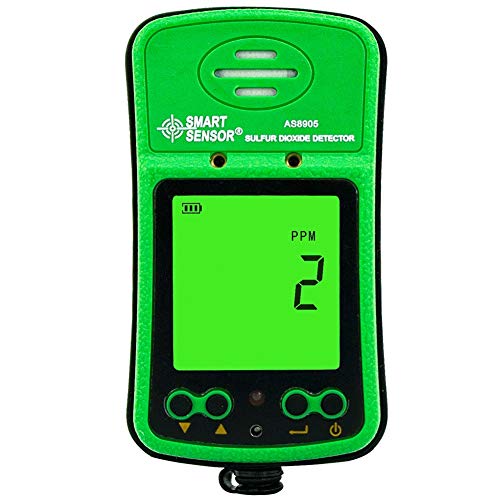
A clip on sulfur dioxide monitor built on an electrochemical sensor, reading 0 to 20 ppm in 0.1 ppm steps, with adjustable high and low alarms signalled by sound, flash and vibration and a rechargeable cell quoted at 8 to 9 hours.