As an Amazon Associate, Akermin earns from qualifying purchases. Product links on this page are affiliate links.
The Placement Rule
Mount a propane detector low, within roughly 12 inches of the floor, in the room with the propane appliance or at the low point where a leak would collect. Keep it clear of floor vents, exterior doors, furniture that blocks airflow, and anything that splashes it. In an RV, it goes near the floor in the living area, close to the galley and the sleeping area. This is the opposite of the natural gas rule, and the reason is physics rather than preference.
Why Low
Propane and butane are heavier than air. A leak does not spread through the room; it sinks and pools at the floor, then deepens like water filling a tub. It flows down stairs, into sumps and crawl spaces and under doors, and it can sit in a low spot for a long time. A detector at the floor meets the gas first. A detector at outlet height sees it only once the pool is already deep, and a detector near the ceiling may never see it. The behavior is explained in does propane rise or fall, and the contrast with methane is the subject of natural gas detector vs propane detector.
In a House
| Space | Propane source | Where to mount | Note |
|---|---|---|---|
| Kitchen | Propane range or cooktop | Low on a wall a few feet from the range | Not behind the range, where the sensor is blocked and heated |
| Utility room | Furnace, boiler, water heater | Low on a wall in the appliance room | Away from the burner opening and from combustion-air inlets |
| Basement | Any propane appliance, or none | Low, near the bottom of the stairs | The basement collects leaks from the floors above |
| Garage or workshop | Propane heater, stored cylinders | Low, near the heater | Gasoline vapor from vehicles triggers combustible sensors; see below |
| Bedroom or living room | Propane fireplace or space heater | Low on a wall in the room | Off to the side of the appliance, not in front of the radiant face |
Many plug-in gas detectors are used for propane, and here the outlet height works in your favor: a standard outlet sits low enough to be within or close to the floor zone. The Orabal plug-in, which lists propane and LPG among its target gases, is the kind of unit that suits a low outlet in a propane kitchen. The manufacturer placement sheet still governs.
In an RV
RVs are the most common propane-detector installation in the country, and they have their own rules. The alarm is hardwired to 12V DC, mounted low on a wall or cabinet face in the main living area, and positioned so that it is not blocked by stored items, bedding or a slide-out. Safe T Alert, the brand most RV manufacturers install, sells surface-mount and flush-mount replacements: the 20 series mini lists a compact surface-mount case and 75 mA draw at 12V, and the 30 series classic is a flush-mount direct replacement for most factory units. Both list alarm activation below 25 percent LEL of propane. Dual propane and CO units such as the 25 series mini combine both sensors in one low-mounted housing. Model choices for RVs are compared in the best gas leak detectors for RV roundup.
Two RV-specific cautions. First, a low-mounted alarm in an RV is close to shoes, pets and cleaning, so check that its vents are clear whenever you set up camp. Second, RV propane alarms have a stated service life and a chirp or indicator at end of life; a unit that came with a used RV may already be past it.
Where a Propane Detector Fails
- Behind furniture or appliances. Gas has to reach the sensor. A detector behind a sofa or a refrigerator is in still air.
- Next to floor registers or return grilles. Forced air disturbs the pool the detector is meant to sense.
- Next to exterior doors. Drafts carry gas away, and cold air entering in winter can push the pool elsewhere.
- Where it gets wet. Mop water, pet bowls and cleaning sprays reach a floor-level unit. Moisture and chemicals cause false alarms and shorten sensor life; the causes are listed in what can cause false gas detector readings.
- Garages with running vehicles. Gasoline vapor and exhaust set off combustible sensors. If a propane heater lives in a garage, expect nuisance alarms unless the detector is well away from the vehicle.
Choosing the Unit for the Spot
For a house, the choice is between a dedicated plug-in gas detector at a low outlet and a combination CO and explosive gas alarm, and the models are compared in the best propane gas detectors roundup and the broader best gas leak detectors guide. For an RV, the choice is a 12V replacement that matches the existing cutout. Our earlier post on choosing a combustible gas leak detector covers response time and sensor features that apply to either.
A detector at the right height gives you minutes of extra warning. What you do with them is fixed: on a propane smell or alarm, get out, do not flip a switch or start the vehicle, and call the propane supplier, the utility emergency number or 911 from a safe distance.
Recommended Tools


Products shown because their documented specifications fit this guide. Price and availability are on Amazon and can change.
Frequently Asked Questions
Where does the propane detector go in an RV?
Near the floor in the main living area, usually close to the galley and sleeping area, where the factory alarm was installed. Replacement units from Safe T Alert are sold as flush or surface mount and list 12V DC power; the 25 series listing cites UL 1484 RV and RVIA/NFPA conformance.
My propane furnace is in the basement. Where does the detector go?
Low on a wall in the furnace room, clear of the burner and flue. Because propane flows downhill, the basement is the natural collection point for a leak anywhere in the house, so a detector at the bottom of the stairs is also worthwhile.
Should I put a detector outside near the propane tank?
No. Consumer detectors are indoor devices and a leak at an outdoor tank disperses in open air. Check tank fittings with soapy water or a handheld sniffer and rely on your nose for the odorant.
Can a floor-level detector get damaged by mopping?
Yes. Water and cleaning chemicals affect the sensor and can trigger alarms. Mount it out of the splash path and never spray cleaner near it.
Affiliate disclosure: Akermin earns a commission from qualifying Amazon purchases made through links on this page. Our editorial picks are based on documented specifications and owner feedback, not commissions.
Related Guides

WiFi Natural Gas Alarm Review: One Unit Reveals the Whole Design
A WiFi natural gas alarm with an LCD showing gas concentration status and temperature, a stated response within 30 seconds, an alarm of at least 85 decibels and notifications to a phone app.
Read More→
Forensics Detectors Cl2 Review: 5 Percent of Full Scale Is 2.5 ppm
A rechargeable chlorine detector with an electrochemical sensor reading 0 to 50 ppm at 0.1 ppm resolution, a response time under 30 seconds, adjustable audible, visual and vibrating alarms and a supplied calibration certificate.
Read More→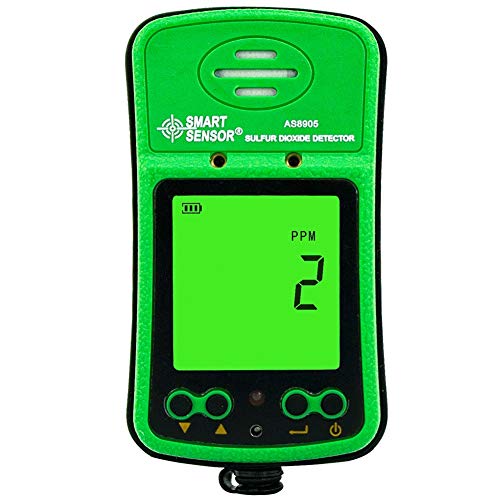
Smart Sensor SO2 Detector Review: 0.1 ppm Steps, No Accuracy Figure
A clip on sulfur dioxide monitor built on an electrochemical sensor, reading 0 to 20 ppm in 0.1 ppm steps, with adjustable high and low alarms signalled by sound, flash and vibration and a rechargeable cell quoted at 8 to 9 hours.
Read More→