As an Amazon Associate, Akermin earns from qualifying purchases. Product links on this page are affiliate links.
The Difference Is Height, Not Sensor
Most consumer gas leak detectors respond to both natural gas and propane. The Kidde combination alarms list natural gas and propane in the name, the Adorelf plug-in lists natural gas, methane, propane and LPG, and even the Safe T Alert RV alarms sold as propane detectors list activation for propane or methane. So a “natural gas detector” and a “propane detector” are, at the sensor, often the same thing. What makes one right for your home and the other wrong is where it is mounted. Natural gas rises and collects under the ceiling; propane sinks and pools on the floor. A detector at the wrong height will still sense the gas eventually, but it will be late, and late is the whole difference.
The Two Fuels Compared
| Item | Natural gas | Propane (LPG) |
|---|---|---|
| Main component | Methane | Propane, often with some butane |
| Relative to air | Lighter; rises | Heavier; sinks and pools |
| Where a leak collects | Under the ceiling first | At the floor, in basements, sumps and stairwells |
| Lower explosive limit | About 5 percent by volume (50,000 ppm) | About 2.1 percent by volume (21,000 ppm) |
| Odorant | Mercaptan, rotten-egg smell | Mercaptan, rotten-egg smell |
| Detector mounting | High, within roughly 12 inches of the ceiling | Low, within roughly 12 inches of the floor |
| Typical supply | Utility pipeline and meter | Tank or cylinders, delivered or exchanged |
| Where it dominates | Urban and suburban homes | Rural homes, RVs, boats, grills, cabins |
| Typical detector | Plug-in or hardwired home alarm at a high position | Low-mounted home alarm, or 12V RV alarm |
Why Placement Decides
Picture a slow leak from a fitting behind a range. If the fuel is natural gas, the first place it accumulates is a thin layer across the ceiling. A detector mounted high meets that layer within minutes; a detector at outlet height meets it only when the layer has grown thick enough to reach down the wall. If the fuel is propane, the leak runs down the back of the range and spreads across the floor, and a high-mounted detector may not see it until the room is well on its way to a hazardous concentration. Same sensor, same sensitivity, radically different warning time. The two placement pages, where to place a natural gas detector and where to place a propane detector, go room by room; the physics is in does propane rise or fall.
Alarm thresholds add a second, smaller difference. Both alarms trip at a fraction of the explosive limit, commonly in the 10 to 25 percent LEL region, but propane’s limit is lower in absolute terms, so a propane alarm is reacting to fewer molecules. A listing that calibrates to methane, as most sniffers do, gives an approximate figure for propane. For an alarm that only has to sound, that approximation is fine; for a meter that has to read a number, it is not.
Which Fuel Do You Have
If a utility bills you for gas and there is a meter on the outside wall, you have natural gas. If there is a tank in the yard, cylinders on a rack or a bottle under the grill, you have propane. RVs, boats and most cabins are propane. Some homes have both: a natural gas furnace and range indoors, a propane grill or patio heater outdoors, a propane space heater in a workshop. Those homes need a high-mounted detector for the natural gas rooms and, if propane is used indoors anywhere, a low-mounted detector there. Propane used only outdoors does not need an indoor detector; open air disperses it.
Choosing the Detector
- Natural gas home: a plug-in or hardwired alarm at a high position in the kitchen and the appliance room. The best natural gas detectors roundup compares units by how well they suit a high mount, and the earlier post on choosing a natural gas detector covers features.
- Propane home: a low-mounted alarm in the appliance room and at the bottom of any stairs. The best propane gas detectors roundup covers those.
- RV or boat: a 12V DC propane alarm that matches the existing cutout. The Safe T Alert 20 series mini is surface mount; the 30 series classic is a flush-mount direct replacement for most factory units.
- Both fuels indoors: two units at two heights. Do not split the difference with one unit at mid-height; it is late for both.
The overall best gas leak detectors guide includes all three categories, and what a combustible gas detector is explains the sensor class they share.
One thing does not differ between the fuels. Both are odorized, and the correct response to either smell is the same: leave the building or vehicle, do not operate switches, ignition or phones until you are clear, and call the utility, the propane supplier or 911 from outside. The detector, at the right height, buys you time to do exactly that.
Recommended Tools


Natural-Gas-Detector with Plug-in Design, Gas-Leak-Detector with High Accuracy Sensor, Portable
View on Amazon
Products shown because their documented specifications fit this guide. Price and availability are on Amazon and can change.
Frequently Asked Questions
Can one detector cover natural gas and propane in the same room?
The sensor can, but the placement cannot. A unit mounted high for methane will be late to a propane pool at the floor, and one mounted low will be late to methane under the ceiling. A room with both fuels needs two units at two heights.
Is the alarm threshold different for propane?
Both are set as a fraction of the explosive limit, but the limit differs. Methane reaches its LEL at about 5 percent by volume and propane at about 2.1 percent, so a propane alarm trips at a lower absolute concentration.
I have natural gas at home and a propane RV. Can I move one detector between them?
No. The RV alarm is hardwired to 12V and mounted low; the home unit is plug-in and, for natural gas, mounted high. They are different products for different fuels and power systems.
What about butane?
Butane behaves like propane: heavier than air, pools at the floor. Use propane placement for any LPG appliance, including butane camp stoves used indoors.
Affiliate disclosure: Akermin earns a commission from qualifying Amazon purchases made through links on this page. Our editorial picks are based on documented specifications and owner feedback, not commissions.
Related Guides

WiFi Natural Gas Alarm Review: One Unit Reveals the Whole Design
A WiFi natural gas alarm with an LCD showing gas concentration status and temperature, a stated response within 30 seconds, an alarm of at least 85 decibels and notifications to a phone app.
Read More→
Forensics Detectors Cl2 Review: 5 Percent of Full Scale Is 2.5 ppm
A rechargeable chlorine detector with an electrochemical sensor reading 0 to 50 ppm at 0.1 ppm resolution, a response time under 30 seconds, adjustable audible, visual and vibrating alarms and a supplied calibration certificate.
Read More→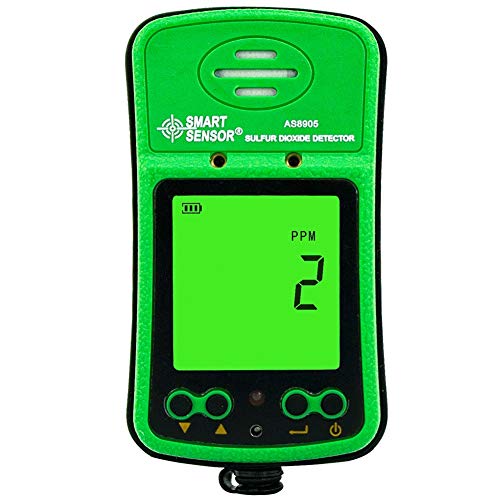
Smart Sensor SO2 Detector Review: 0.1 ppm Steps, No Accuracy Figure
A clip on sulfur dioxide monitor built on an electrochemical sensor, reading 0 to 20 ppm in 0.1 ppm steps, with adjustable high and low alarms signalled by sound, flash and vibration and a rechargeable cell quoted at 8 to 9 hours.
Read More→