As an Amazon Associate, Akermin earns from qualifying purchases. Product links on this page are affiliate links.
Propane falls. It is heavier than air, so gas escaping from a cylinder valve, a grill regulator or an RV appliance connection sinks to the floor, spreads out sideways like spilled water and collects in whatever low space it reaches: a basement, a crawlspace, the floor of a camper, the bilge of a boat, a window well outside. Butane does the same. This is why a propane alarm is mounted low, why RV propane detectors sit inches off the floor, and why clearing a propane leak means opening low doors rather than high windows.
Why Propane Sinks
Propane vapor is denser than air, so gravity wins over mixing whenever the air is still. Picture a heavier-than-air gas as a very thin liquid: it runs downhill, fills the lowest container it can find, and rises inside that container only as more gas is added. The mercaptan odorant added to LP gas rides along with it, so a rotten-egg smell that is stronger when you crouch than when you stand is a classic propane sign.
Two properties of LP gas make the pooling more dangerous than it sounds. First, the amount needed to burn is small; propane reaches its lower explosive limit at roughly 2.1 percent by volume, less than half the figure for methane, so a modest volume of vapor in a small low space can already be within the ignitable range. Second, once pooled it does not leave. There is no buoyancy pushing it out of a basement the way there is pushing natural gas out of an attic vent.
Where a Propane Leak Collects
- Basements and cellars below a ground-floor appliance, including the sump pit and floor drain area.
- Crawlspaces, especially where a supply line passes through the floor.
- The floor of an RV or camper, under dinette benches and inside low cabinets near the range, fridge and furnace.
- Boat bilges and engine compartments on vessels with LP galley stoves.
- Garages with a propane water heater, a stored cylinder or a forklift.
- Outdoors: the ground under a tank regulator, a grill cabinet, a fire pit enclosure, a window well or a ditch downhill from the tank.
Closed doors and cabinet fronts do not stop it. A gas that behaves like a fluid finds the gap under a door and keeps going.
What This Means for Detector Placement
A propane alarm goes low on the wall, and manufacturers typically specify mounting within roughly 12 inches of the floor. It should not sit where it will get kicked, mopped or blocked by furniture, and it should be away from the stove, vents, doorways and dead-air corners. The propane detector placement guide walks through each room type, and the propane detector roundup lists alarms built for that job. RV models such as the 12-volt Safe T Alert series are the clearest example of the principle: they are designed to mount at floor level near the LP appliances and are wired so that they do not depend on a battery you might forget.
A fixed alarm reports that vapor has reached it; it does not say from which fitting. Locating the source is a job for a handheld sniffer swept slowly along the low fittings, valves and hose ends. The gas leak detector guide covers both fixed alarms and sniffers, and using a combustible gas detector safely explains how to sweep without becoming the ignition source.
Clearing a Propane Leak
Because the vapor is at floor level, high windows do very little. The openings that help are low: an exterior door, a garage door, a basement bulkhead, a crawlspace vent. Even then, still air lets propane linger, and a fan is not the answer because a switch or a motor can be an ignition source. If you smell propane, the safe sequence is to leave the space, close the cylinder valve only if it is outside and on your way out, avoid operating any electrical device, and call your propane supplier or 911 from a safe distance. A detector adds a warning to that routine; it does not change it.
A Note on Odor Fade
Propane can lose part of its odorant in certain conditions, a phenomenon suppliers call odor fade. New or rusted steel cylinders can absorb the odorant, and vapor that has passed through soil can arrive with less smell than it started with. It is one of the practical reasons a floor-level alarm is worth having in a propane home even for people with a sharp sense of smell. False alarms have their own causes, covered in what can cause false gas detector readings.
Propane Is the Opposite of Natural Gas
Natural gas is mostly methane, which is lighter than air and collects under the ceiling, so its alarm mounts high. A home that switches from one fuel to the other needs its detector moved, and a house with a natural gas furnace and a propane grill cylinder stored in the garage technically has both problems. The companion article on whether natural gas rises or falls covers the high side.
Recommended Tools


Products shown because their documented specifications fit this guide. Price and availability are on Amazon and can change.
Frequently Asked Questions
How long does propane stay in a low spot after a leak?
Without airflow, a long time. Propane does not evaporate away like a liquid spill; it is already a gas and simply sits in the lowest space it found until moving air dilutes it. Sealed basements, crawlspaces and bilges can hold it for hours.
Does propane sink outdoors too?
Yes. A leak from an outdoor tank or grill regulator flows downhill along the ground and can collect in a window well, a ditch, a swimming pool skimmer area or an open cellar door. Outdoors it disperses faster than indoors, but low spots near the tank deserve attention.
Is butane the same as propane for detector placement?
For placement purposes, yes. Butane is also heavier than air and pools low. Both are sold as LPG, and consumer propane alarms are typically listed for both. Mount low either way.
Can a natural gas alarm mounted high detect propane?
Its sensor usually responds to propane, but its location is wrong. Propane collects at the floor and may never reach a ceiling-mounted sensor until the room is badly contaminated. Use an alarm rated and mounted for propane.
Affiliate disclosure: Akermin earns a commission from qualifying Amazon purchases made through links on this page. Our editorial picks are based on documented specifications and owner feedback, not commissions.
Related Guides

WiFi Natural Gas Alarm Review: One Unit Reveals the Whole Design
A WiFi natural gas alarm with an LCD showing gas concentration status and temperature, a stated response within 30 seconds, an alarm of at least 85 decibels and notifications to a phone app.
Read More→
Forensics Detectors Cl2 Review: 5 Percent of Full Scale Is 2.5 ppm
A rechargeable chlorine detector with an electrochemical sensor reading 0 to 50 ppm at 0.1 ppm resolution, a response time under 30 seconds, adjustable audible, visual and vibrating alarms and a supplied calibration certificate.
Read More→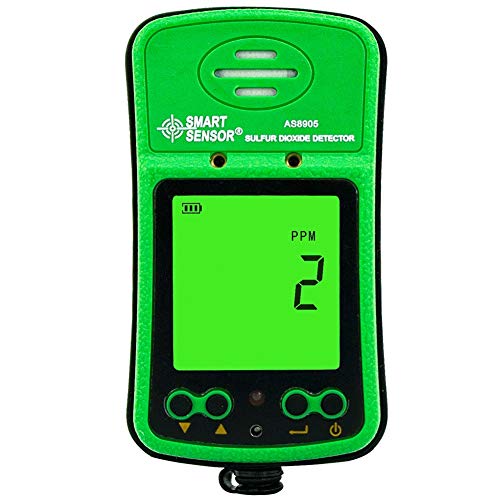
Smart Sensor SO2 Detector Review: 0.1 ppm Steps, No Accuracy Figure
A clip on sulfur dioxide monitor built on an electrochemical sensor, reading 0 to 20 ppm in 0.1 ppm steps, with adjustable high and low alarms signalled by sound, flash and vibration and a rechargeable cell quoted at 8 to 9 hours.
Read More→