As an Amazon Associate, Akermin earns from qualifying purchases. Product links on this page are affiliate links.

TOPTES · PT520A Natural Gas Detector, Gas Leak Detector with 17-Inch Gooseneck, Locating The Source Like Propane, Methane, and Butane for Home and RV (Includes Battery x3) - Orange
View on AmazonPrice and availability are shown on Amazon and can change at any time.
Verdict
The TopTes PT520A is a competent gooseneck gas sniffer for homeowners and RV owners who want to trace a leak to a fitting. The 17-inch flexible probe reaches behind ranges and into water heater closets, the seven-bar display and 75 dB tone escalate as you approach the source, and the listing specifies a 0.5 second response and a 50 to 10,000 ppm methane range. It adds two conveniences the plainer competition lacks: a mute button and a switchable 10 minute auto power-off. What it does not do is put a number on the screen, so treat it as a locator, not a measuring instrument.
Who It Is For
- Homeowners with a gas range, dryer or water heater who want to check the connections after installation or service.
- RV owners tracing the source when a floor-mounted propane alarm sounds.
- Anyone who found the beeping of other sniffers intrusive and wants a mute.
Someone who needs a percent LEL reading, or a pocket-sized unit, should look at the PT210S instead; the comparison section covers that.
Documented Specifications
| Item | Listing statement |
|---|---|
| Gases | Methane, natural gas, propane, LPG, butane and other combustible gases |
| Detection range | 50 to 10,000 ppm, based on methane |
| Response time | 0.5 seconds |
| Probe | 17-inch flexible gooseneck |
| Indication | Seven colored bars plus a 75 dB alarm, both increasing with concentration |
| Controls | Mute button; APO button to enable or disable 10 minute auto power-off |
| Warm-up | 30 seconds in clean air before use |
| Recommended probe distance | About 1 to 5 cm from the suspected source |
| Power | Three AAA batteries, included |
| In the box | Detector, three AAA batteries, protective case, user manual |
The listing does not name the sensor technology; the warm-up requirement and clean-air baseline are typical of heated semiconductor sensors, but that is an inference.
Using It to Find a Leak
The method is the same as for any sniffer, and the PT520A’s manual describes it plainly: warm up in clean air, then bring the probe tip to within a few centimeters of each fitting and move slowly. The seven bars rise and the tone quickens as the tip enters the gas plume, and both drop as you move past it, so the fitting with the peak reading is the leak. Natural gas rises and propane sinks, so approach fittings from the side the gas would drift to; the articles on natural gas and propane behavior explain which. The 17-inch gooseneck matters here because it lets you keep the body and your hand out of a cramped cabinet while the tip does the work.
Two practical notes from owner reports. First, the sensor takes a moment to recover after a strong hit, so after a big response, back the probe into clean air and wait for the bars to fall before checking the next fitting. Second, solvents, flux, some cleaners and fresh paint can produce a response; what can cause false gas detector readings lists the common ones, and a leak that repeats at the same fitting after airing the space out is the one to trust.
Mute and Auto Power-Off
The mute button silences the tone while the bars keep working. That is useful when checking fittings near a sleeping household or when the escalating beep becomes tiring during a long sweep. The auto power-off, switchable from the APO button, shuts the unit down after 10 minutes of inactivity to save the AAA cells, and can be disabled for a longer inspection. Neither feature turns the PT520A into a monitor; the handheld versus fixed detector comparison explains why a hand-held probe cannot do that job.
Strengths
- Long gooseneck reaches fittings that pocket units cannot.
- Seven-bar display gives finer gradation than five-LED designs.
- Mute and switchable auto power-off are genuinely useful in a home.
- Case and batteries included; ready to use.
Limitations
- No numeric or percent LEL readout.
- 75 dB alarm is quieter than the 85 dB of some competitors; fine up close, easy to miss across a garage.
- Range tops out at 10,000 ppm, far below the explosive limit; it cannot assess whether a space is safe.
- AAA power; the PT520A+ exists for those who prefer recharging.
How It Compares
The TopTes PT520A+ is the same tool with a rechargeable cell and Type-C charging; the manufacturer quotes over 3,000 recharge cycles, and the sensing specifications are the same. The Klein Tools ET120 has an 18-inch gooseneck, an 85 dB tone and a two-range sensitivity switch instead of a mute, with five LEDs rather than seven bars. The TopTes PT210S gives up the gooseneck for a 4-inch probe and pen form but shows a two-digit percent LEL reading, which is the feature to want if you care about numbers. All three are ranked in the handheld gas leak detector roundup; fixed alarms to pair with any of them are in the combustible gas detector roundup, and the gas leak detector guide covers the whole category.
What a Sniffer Does Not Replace
The PT520A is for checking fittings when the air smells clean. A strong gas smell is not a cue to fetch the sniffer; it is a cue to leave the building without touching switches and to call the gas utility or 911 from outside.
How We Research
This review is based on the manufacturer’s listing and user manual and on patterns in owner reports. We did not run laboratory tests. Where a figure is quoted, it is the manufacturer’s.
Recommended Tools


Products shown because their documented specifications fit this guide. Price and availability are on Amazon and can change.
Frequently Asked Questions
How close does the PT520A probe need to be to a leak?
The manufacturer recommends pointing the probe at the suspected source and moving it to within about 1 to 5 cm. Sniffers of this type respond to the gas that reaches the sensor tip, so a slow pass close to each fitting is the method.
Is the PT520A rechargeable?
No. This model runs on three AAA batteries, which are included. The PT520A+ is the rechargeable version with a Type-C port and otherwise similar specifications.
Can I leave the PT520A on as a room alarm?
No. It auto powers off after 10 minutes of inactivity unless you disable that, and it is designed to be held at a fitting, not mounted. For continuous protection you need a fixed alarm.
What does the 30 second warm-up do?
It heats the sensor and establishes a clean-air baseline. Switch it on in fresh air, away from the suspected leak, and wait for the countdown before sweeping; starting it in contaminated air makes it read low.
Affiliate disclosure: Akermin earns a commission from qualifying Amazon purchases made through links on this page. Our editorial picks are based on documented specifications and owner feedback, not commissions.
Related Guides

WiFi Natural Gas Alarm Review: One Unit Reveals the Whole Design
A WiFi natural gas alarm with an LCD showing gas concentration status and temperature, a stated response within 30 seconds, an alarm of at least 85 decibels and notifications to a phone app.
Read More→
Forensics Detectors Cl2 Review: 5 Percent of Full Scale Is 2.5 ppm
A rechargeable chlorine detector with an electrochemical sensor reading 0 to 50 ppm at 0.1 ppm resolution, a response time under 30 seconds, adjustable audible, visual and vibrating alarms and a supplied calibration certificate.
Read More→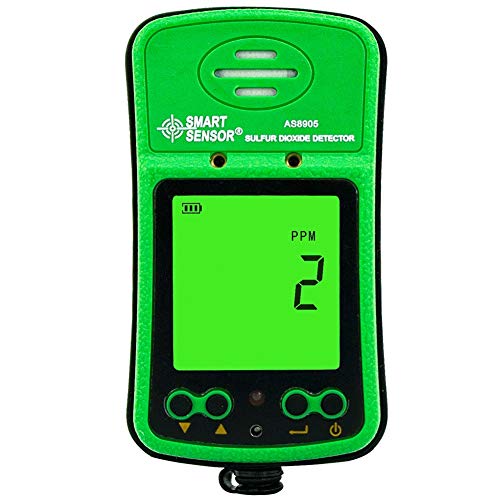
Smart Sensor SO2 Detector Review: 0.1 ppm Steps, No Accuracy Figure
A clip on sulfur dioxide monitor built on an electrochemical sensor, reading 0 to 20 ppm in 0.1 ppm steps, with adjustable high and low alarms signalled by sound, flash and vibration and a rechargeable cell quoted at 8 to 9 hours.
Read More→