As an Amazon Associate, Akermin earns from qualifying purchases. Product links on this page are affiliate links.

TOPTES · TopTes PT210S Gas Leak Detector, Natural Gas Detector with 4-inch Probe, Propane Leak Detector Locating Combustible Gases Like Natural Gas, Methane for Home, Measures%LEL (Incl. Batteries) - Orange
View on AmazonPrice and availability are shown on Amazon and can change at any time.
Verdict
The TopTes PT210S is the pocket sniffer to buy if you want a number rather than a row of lights. It displays a two-digit percent LEL reading across a range of 1 to 10 percent LEL, which the manufacturer equates to 100 to 5,000 ppm of methane, alongside a rising bar graph, a screen that turns red and a 75 dB buzzer. It responds in 0.5 seconds, offers high and low sensitivity modes, powers off after 5 minutes idle and runs on two AAA cells. The trade-off for the pen form is a short 4-inch probe. As a leak locator with a readable scale, it is a strong choice; as a safety monitor it is not, and it does not claim to be.
Who It Is For
- Homeowners who want to know roughly how large a leak is, not only where it is.
- People who keep a sniffer in a kitchen drawer or RV glovebox and want it pocket-sized.
- Anyone learning to read percent LEL who wants an inexpensive way to see the scale in use.
If your fittings are deep behind appliances, a longer probe is a better fit; see the comparison below.
Documented Specifications
| Item | Listing statement |
|---|---|
| Gases | Propane, natural gas, methane, butane and other combustible gases |
| Display | Two-digit percent LEL reading plus bar graph; screen turns red on alarm |
| Range | 1 to 10 percent LEL (100 to 5,000 ppm, based on methane) |
| Response | 0.5 seconds |
| Audible alarm | 75 dB buzzer, escalates with concentration |
| Sensitivity | High and low modes |
| Probe | 4-inch fixed probe, pen-style body with anti-slip grip |
| Power | Two AAA batteries, included; low battery light below 2.5 V |
| Auto power-off | After 5 minutes of inactivity |
| In the box | Detector, storage bag, multi-language manual, two AAA batteries |
Reading the Number
Percent LEL expresses concentration as a fraction of the amount needed for the gas to ignite. For methane that limit is about 5 percent by volume, or 50,000 ppm, so the PT210S’s full scale of 10 percent LEL corresponds to about 5,000 ppm and its first digit, 1 percent LEL, to about 100 ppm. Two things follow. The instrument cannot see leaks below roughly 100 ppm, which some 50 ppm class sniffers can, so it is less sensitive to the faintest leaks than its siblings. And its scale ends far below the alarm setpoints of fixed alarms and the concentrations that make a room dangerous; a reading pegged at the top tells you to stop and get out, not to keep measuring. Because the scale is referenced to methane, readings for propane or butane are indicative rather than exact. What LEL means on a gas detector covers how to interpret the display and ppm versus LEL compares the units.
In Use
Warm it up in clean air, then bring the probe tip close to each fitting and move slowly. In high sensitivity mode it flags small leaks quickly; in low mode the number stays useful when you are already at a large leak and want to find the exact joint. The red screen and rising bar graph work as a glanceable indicator while the number gives you something to compare between fittings or between before and after tightening. Owners report that the pen form makes it easy to keep at hand, and that the short probe is the main thing they notice when checking a range connector without pulling the range out. Keep solvents and aerosols away during the check; they can move the reading. For the safe procedure, including which ignition sources to switch off first, see using a combustible gas detector safely.
Strengths
- Actual two-digit percent LEL number, unusual at this size.
- Red-screen alarm is visible from across a room.
- Dual sensitivity modes and a clear low battery warning.
- Pocket-sized with a storage bag and batteries included.
Limitations
- 4-inch probe; no gooseneck or extension.
- Range starts at 100 ppm, so it is less sensitive to tiny leaks than 50 ppm class units.
- Scale tops out at 10 percent LEL; a hand-held locator, not a safety monitor.
- 75 dB buzzer is moderate; the red screen does most of the alerting.
How It Compares
Within the TopTes range, the PT205 offers the same 1 to 10 percent LEL scale in a pocket body with a pen hook and a warm-up countdown; the choice between them is mostly about the probe. The PT760 extends the scale to 1 to 20 percent LEL, adds a 12-inch telescoping stainless probe, a built-in flashlight and Type-C charging, which makes it the pick for anyone who wants both the number and the reach. The PT199 drops the LEL display for a plain 50 to 1,000 ppm alarm and is the most sensitive to faint leaks of the three. Gooseneck alternatives are covered in the PT520A review and Klein ET120 review. The whole field is ranked in the handheld gas leak detector roundup, fixed alarms in the combustible gas detector roundup, and both together in the gas leak detector guide.
The Number Is Not a Permission Slip
A readout is easy to over-trust. If your home smells of gas, the PT210S stays in the drawer: leave, keep your hands off switches and appliances, and call the utility or 911 from outside. The sniffer is for confirming fittings afterward, in a ventilated space.
How We Research
This review draws on the manufacturer’s listing and manual and on patterns in owner reports. We did not run laboratory tests. Every figure quoted is the manufacturer’s, and the ppm equivalents are its methane-based conversions.
Recommended Tools


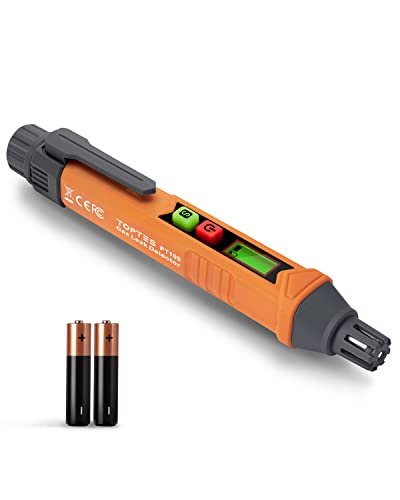
Products shown because their documented specifications fit this guide. Price and availability are on Amazon and can change.
Frequently Asked Questions
What does a reading of 10 on the PT210S mean?
It means the sensor is seeing about 10 percent of the lower explosive limit of methane, roughly 5,000 ppm, which is the top of its display range. It does not mean the room is at 10 percent gas by volume. Anything at or near the top of the scale is a significant leak.
Can the PT210S tell me a room is safe to enter?
No. Its scale stops at 10 percent LEL, and it is a hand-held locator with no certification as a safety monitor. A reading at the top of its range means leave and call the utility, not measure further.
Is the 4-inch probe long enough?
For range connectors, dryer hookups, grill regulators and most water heater unions, yes. For fittings deep behind an appliance or inside an RV cabinet, a gooseneck model such as the PT520A or a telescoping probe such as the PT760 reaches further.
How do I know when to change the batteries?
The manufacturer states that a low battery light flashes when cell voltage drops below 2.5 volts. Replace both AAA cells then; sensor warm-up and response degrade on weak batteries.
Affiliate disclosure: Akermin earns a commission from qualifying Amazon purchases made through links on this page. Our editorial picks are based on documented specifications and owner feedback, not commissions.
Related Guides

WiFi Natural Gas Alarm Review: One Unit Reveals the Whole Design
A WiFi natural gas alarm with an LCD showing gas concentration status and temperature, a stated response within 30 seconds, an alarm of at least 85 decibels and notifications to a phone app.
Read More→
Forensics Detectors Cl2 Review: 5 Percent of Full Scale Is 2.5 ppm
A rechargeable chlorine detector with an electrochemical sensor reading 0 to 50 ppm at 0.1 ppm resolution, a response time under 30 seconds, adjustable audible, visual and vibrating alarms and a supplied calibration certificate.
Read More→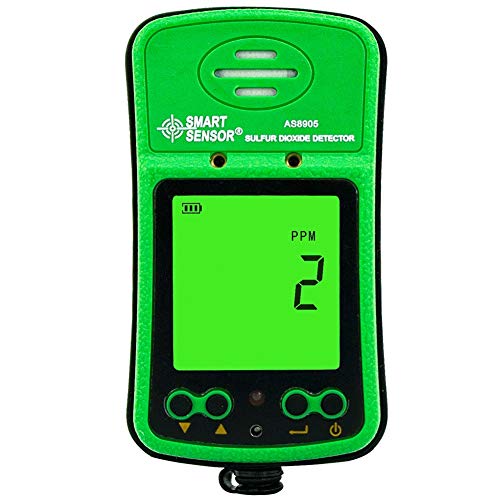
Smart Sensor SO2 Detector Review: 0.1 ppm Steps, No Accuracy Figure
A clip on sulfur dioxide monitor built on an electrochemical sensor, reading 0 to 20 ppm in 0.1 ppm steps, with adjustable high and low alarms signalled by sound, flash and vibration and a rechargeable cell quoted at 8 to 9 hours.
Read More→