Best Gas Sniffers: 9 Sensitive Picks for Pinpoint Leak Detection
A gas sniffer is a portable instrument you carry to the suspected leak, not a box bolted to a wall. This page compares nine handheld and wearable detectors on the single thing that decides whether one is any use to you, which is the gas it is built to sense, and it says plainly where a listing publishes no range, no resolution and no calibration reference.
As an Amazon Associate, Akermin earns from qualifying purchases. Product links on this page are affiliate links.
Our Top Picks
Every product here is portable and sensor-specific, and each was sorted by the gas its own manufacturer listing names. Ranges, resolutions and calibration statements are quoted from those listings. Where a listing publishes no figure the cell reads Not stated rather than an estimate. We ran no laboratory tests and publish no gas measurements of our own.
Best Overall
NOYAFA JMS19 4 in 1 Gas Detector
Four sensors in one body, so one sweep answers four questions.
Listing states detection of H2S, CO, LEL and O2 in one instrument
Described as rapid detection for workplace hazard prevention
One instrument replaces four single-gas sniffers
No range, resolution or response time published on the listing
Every figure is the manufacturer's own, taken from the product listing at the time of research. Four of the nine publish a range and three publish a resolution; the rest name a gas and nothing more, and those cells read Not stated. Nothing here is a measurement of ours.
How to Choose a Gas Sniffer
Four questions decide this purchase:
Which Gas, Exactly
An electrochemical cell is built for one gas. A chlorine detector is blind to methane and a hydrogen sulfide unit is blind to carbon monoxide. Name the hazard before you look at any other specification.
Range and Resolution
Chlorine matters at tenths of a ppm and hydrogen at hundreds. A detector whose resolution is coarser than the level you care about will read zero right up until it reads danger.
Calibration Trail
Three listings here state NIST traceable calibration. The rest state nothing. A sensor with no reference and no date behind it produces a number you cannot defend.
One Gas or Four
Single-gas units are cheaper and usually better documented. A four-in-one covers the standard workplace set in one sweep. Which is right depends on whether you know the hazard in advance.
What makes a detector a sniffer rather than a monitor?
Portability and intent. A sniffer is carried to the suspected leak and moved along a pipe, a joint or a vessel seam until the reading rises, which is how you locate a source. A fixed monitor is mounted in one place and watches that place continuously. Both are gas detectors, but a wall-mounted unit cannot be walked along a flange and a handheld unit left on a shelf is not protecting anybody.
Why do so many of these listings publish no range?
Because the marketplace listing is a sales document, not a datasheet. The three Forensics Detectors units and the two Smart Sensor units publish ranges because those brands sell on specification. The rest name a gas and describe an alarm. The figures usually exist in the manual, so the absence of a number on the listing is a gap in disclosure rather than proof that the instrument has no specification.
Does a bump test replace calibration?
No. A bump test applies a known gas briefly and confirms that the sensor responds and the alarm sounds. It is a go or no-go check before use. Calibration adjusts the instrument against a reference concentration so the number it displays is correct. You bump test often, ideally before every use where the reading matters, and calibrate on the schedule the manufacturer sets.
How long should a sniffer warm up?
Electrochemical cells need time to stabilise after power on, and a reading taken during that window can be badly wrong in either direction. None of these listings publishes a warm-up figure, which is why it is worth reading the manual before the first use rather than during an incident.
Can one instrument cover every gas I might meet?
No. The NOYAFA four-in-one covers the standard workplace hazard set of hydrogen sulfide, carbon monoxide, combustibles and oxygen, which is the widest coverage on this page. Chlorine, chlorine dioxide, sulfur dioxide, hydrogen and alcohol vapour each need their own sensor, and every one of those is a separate instrument here.
Reviews
NOYAFA JMS19 4 in 1 Gas Detector Best Overall
The problem with single-gas sniffers is arithmetic. A sewer vault can be oxygen deficient, carry hydrogen sulfide from decomposition and hold methane from a cracked line, and a detector for one of those tells you nothing about the other two. The NOYAFA JMS19 listing states four sensors in one body covering hydrogen sulfide, carbon monoxide, lower explosive limit combustibles and oxygen, which is the standard four-gas set used for workplace hazard screening.
The practical advantage is that you sweep once. Moving a single-gas unit along a pipe run three times, changing instruments between passes, is how a hazard gets missed. It is also how batteries get flat, because each instrument has its own warm-up and its own charge state to remember.
What this listing does not do is publish numbers. There is no stated range for any of the four channels, no resolution, no response time, no alarm threshold and no calibration reference, so everything beyond the gas list is unverified from the listing alone. For a detector that people rely on before entering a space, that gap matters, and the manual should be read before the instrument is trusted.
Strengths
Four gases covered by one sweep
The standard workplace hazard set of H2S, CO, LEL and O2
Forensics Detectors Chlorine Gas Detector Best Documented
Most sniffer listings name a gas and stop. This one gives you the three figures that let you judge whether the instrument suits the job: a range of 0 to 50 ppm, a resolution of 0.1 ppm and a statement that the unit ships factory calibrated against a NIST traceable source. Chlorine matters at low concentrations, and a detector with 1 ppm resolution would round away the readings that decide whether a room is safe to occupy.
The calibration statement is the part that separates this from the unbranded field. A gas sensor is only as good as the reference it was set against, and an electrochemical cell drifts whether or not it is used. A traceable factory calibration gives you a defensible starting point and a date to count drift from.
The limitation is inherent to the design. This detector responds to chlorine and to nothing else, so it belongs on a pool plant, a water treatment site or a chemical store, not in a general service bag. It is also the most expensive way to answer one question, and the listing does not state battery life, response time or ingress rating.
Strengths
Range, resolution and calibration all published
0.1 ppm resolution suits a gas that matters at low levels
NIST traceable calibration stated
USB recharge and adjustable alarm thresholds stated
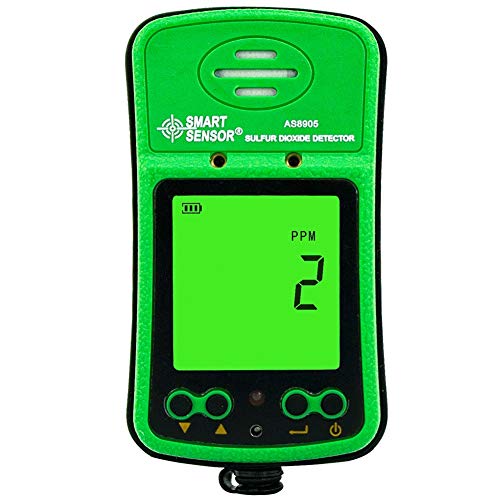
Sulfur dioxide turns up around combustion plant, refrigeration systems using it as a legacy refrigerant, metal processing and fumigation work, and it is irritating well below the concentration at which most people would think to check. The Smart Sensor unit publishes a 0 to 20 ppm range, which covers the occupational band that matters, and puts it behind a rechargeable battery and an LCD rather than a coin cell and a buzzer.
At this price the value is in having any sulfur dioxide capability at all. The alternative is a four-gas instrument with an SO2 channel added, which costs several times more and is not something a small operation buys for an occasional check.
The listing is thin beyond the range. It states an electrochemical sensor and high sensitivity without a resolution figure that survives intact, no response time, no alarm threshold, no calibration reference and no ingress rating. Treat it as a screening instrument, bump test it against a known source before you rely on a reading, and do not use it as the basis for an entry decision.
Strengths
Published 0 to 20 ppm range for a gas few cheap meters cover
Short answer: the NOYAFA JMS19 is the sniffer to buy when you do not know in advance which hazard you are walking into, because its listing states hydrogen sulfide, carbon monoxide, LEL combustibles and oxygen in one body; the Forensics Detectors chlorine unit is the best documented single-gas instrument here, stating 0 to 50 ppm at 0.1 ppm resolution with NIST traceable factory calibration; and the Smart Sensor SO2 monitor is the value pick, a rechargeable sulfur dioxide instrument with a published 0 to 20 ppm range.
Why this page lists nine and not twelve
Twelve listings were supplied for this topic and three are not gas sniffers. The ACEIRMC MQ-3 pack is five bare sensor modules sold for Arduino projects, with no display, no alarm, no enclosure and no calibration; it is a component, not an instrument. The IOKGVEDD unit and the Forensics EX LEL detector are both fixed installations, described on their own listings as fixed and wall mount for continuous monitoring, which is the opposite of a tool you carry along a pipe run. Padding the table with those three would have made the number in the heading true and the page useless, so the count is nine and every row is something you can pick up and walk with.
What a sniffer actually does
A sniffer answers a location question, not a compliance question. You already suspect a leak, and the instrument tells you where it is by reading higher as you get closer. That is why response time matters more here than absolute accuracy: an instrument that takes thirty seconds to settle cannot be swept along a flange, because by the time it reacts you have moved two metres past the source. None of these nine listings publishes a response time, which is the single biggest documentation gap in this group and is covered in why gas sensor response time matters.
The sensor decides everything
Eight of the nine use an electrochemical cell, which is a small wet cell whose chemistry is chosen for one target gas. That is why there is no general purpose sniffer on this page and no way to buy one. The Forensics chlorine and chlorine dioxide units, the Smart Sensor SO2 and H2 units, the TEKCOPLUS and MSA hydrogen sulfide instruments and the Forensics alcohol detector are each tuned to their own molecule and effectively blind to the others. The VGVGV unit is the exception, using an infrared sensor and describing combustible gas detection with temperature and humidity alongside it. Cross sensitivity is real in both directions, so a cell tuned for one gas can respond weakly to a chemically similar one, which produces a reading that is neither zero nor trustworthy.
Which listings publish numbers
Four of the nine state a measuring range: chlorine at 0 to 50 ppm, chlorine dioxide at 0 to 20 ppm, sulfur dioxide at 0 to 20 ppm and hydrogen at 0 to 1000 ppm. Three state a resolution, all of them at the fine end, 0.1 ppm on the two Forensics units and 1 ppm on the Smart Sensor hydrogen detector. Three state a calibration reference, all of them Forensics Detectors, which publishes NIST traceable calibration performed in Los Angeles. Everything else on this page names a gas and describes an alarm. That is not the same as the instruments being unspecified, but it does mean the specification lives in a manual you cannot read before buying. Understanding ppm, LEL and volume explains why the units on those ranges are not interchangeable.
The MSA ALTAIR 2X is specified differently
MSA publishes nothing about range or resolution on this listing and instead sells on ownership cost: fastest sensor response times, the lowest calibration gas flow rate, a four-year expected sensor life and a three-year instrument warranty. That is a rational way to describe a personal monitor that gets clipped to a jacket every shift for years, because the cost of a wearable is dominated by calibration gas and sensor replacement rather than by the purchase. The low concentration hydrogen sulfide variant is built for workplaces where the exposure limit is low enough that a standard cell would round it away. For a compliance-driven site this is a different kind of purchase from the rest of the page.
Before you trust any reading
Three habits, in order. Bump test before use, which means applying a known gas briefly and confirming that the reading rises and the alarm sounds; a silent instrument in a hazardous atmosphere is worse than no instrument, because it produces confidence. Let the sensor warm up and stabilise, because a reading taken in the first seconds after power on can be wrong in either direction. And calibrate on the manufacturer schedule, since electrochemical cells drift whether or not they are used. Why gas detectors need bump tests and calibration covers the distinction, and how to calibrate a gas detector covers the procedure. None of these instruments is a substitute for ventilation, for a permit system or for staying out of a space you have not proved safe.
Guides in This Category
Gas sniffer warm-up time for anyone who has taken a reading in the first thirty seconds after switching on and wondered whether to believe it.
Products were sorted by the gas each manufacturer listing names, then compared on stated measuring range, stated resolution, stated calibration reference, power source and form factor. Listings that publish no figure were recorded as Not stated rather than estimated from comparable models. Three products supplied with this group were excluded as off-category and the reasons are given on the page. We ran no laboratory tests and publish no gas measurements of our own. Amazon data supplies images, availability and links only.
A WiFi natural gas alarm with an LCD showing gas concentration status and temperature, a stated response within 30 seconds, an alarm of at least 85 decibels and notifications to a phone app.
A rechargeable chlorine detector with an electrochemical sensor reading 0 to 50 ppm at 0.1 ppm resolution, a response time under 30 seconds, adjustable audible, visual and vibrating alarms and a supplied calibration certificate.
A clip on sulfur dioxide monitor built on an electrochemical sensor, reading 0 to 20 ppm in 0.1 ppm steps, with adjustable high and low alarms signalled by sound, flash and vibration and a rechargeable cell quoted at 8 to 9 hours.