As an Amazon Associate, Akermin earns from qualifying purchases. Product links on this page are affiliate links.
Buy the MSA ALTAIR 4XR Multigas Detector if you need a personal four-gas safety monitor that survives drops and water, because it is the only product here that states a drop rating, an IP rating and a man-down alarm. Buy the Fieldpiece DRX3 Refrigerant and Combustible Gas if your field work is locating refrigerant or combustible gas leaks on HVAC equipment, because it is a leak detector with a replaceable heated diode sensor and adjustable sensitivity, not an area monitor. The Leakbee RV Propane Gas Detector R501 is a fixed 12 volt RV propane alarm, useful in a vehicle but not a field instrument. The Generic Home Natural and the Leakbee 2-in-1 are excluded from the picks: the Generic Home Natural is a plug-in household alarm with no published sensor specification, and the Leakbee 2-in-1 is a 12 volt RV combination alarm. None of the five is a substitute for the other; a leak detector does not prove an atmosphere is safe, and a four-gas monitor does not find a pinhole leak.
Drop ratings, IP codes and the two numbers that decide whether a field detector survives
Two specifications separate a field instrument from a bench instrument: the drop rating and the ingress protection code. The MSA ALTAIR 4XR Multigas Detector is the only product in this set that publishes both. The listing states it survives multiple 25-ft drops onto concrete and carries MIL-STD-810G drop protection, and it is certified IP68, which means dust-tight and protected against continuous immersion. In practice, a 25-ft drop onto concrete is the height of a ladder fall, which is exactly how a personal monitor gets destroyed on a site. The IP68 rating matters because a four-gas monitor worn on a belt gets rained on, hosed down, and occasionally dropped in a puddle.
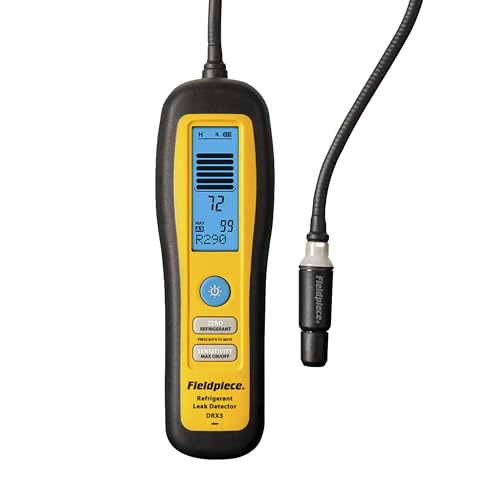
The Fieldpiece DRX3 Refrigerant and Combustible Gas publishes no drop rating and no IP code. The listing calls it rugged and lightweight, and it has a field-replaceable sensor and field-replaceable batteries, which are the two serviceable parts that most often end a tool’s life. That is a different kind of ruggedness: not rated against a fall, but repairable when something wears out. For a hand-held leak sniffer used on HVAC equipment, a replaceable sensor is often more valuable than a drop rating, because the sensor is what fails first.
The Leakbee RV Propane Gas Detector R501 publishes neither a drop rating nor an IP code. It is a fixed alarm, so that is not a criticism of its design; it is a statement about what it is for. A wall-mounted propane alarm in an RV does not get dropped.
What each listing actually publishes about sensing, power and alarms
The table below uses only figures and claims that appear in the supplied listing bullets. Where a listing is silent, the cell says Not stated. This is the honest picture: the three products are not variations on one instrument, they are three different jobs.
| Product | What it senses | Sensor detail published | Power | Alarm or output | Ruggedness stated |
|---|---|---|---|---|---|
| MSA ALTAIR 4XR Multigas Detector | LEL, O2, H2S, CO | Four channels, designed for virtually no cross-channel interference; end-of-sensor-life warning | Rechargeable Li-polymer, 24-hour runtime | LED bump pass/fail, on-screen cues, MotionAlert man-down, InstantAlert manual alarm | Over-molded rubber armor, multiple 25-ft drops onto concrete, MIL-STD-810G, IP68 |
| Fieldpiece DRX3 Refrigerant and Combustible Gas | A3, A2L, A1 refrigerants and combustible gases; HC, HFC, HCFC, CFC, HFO, H2/N2 tracer gas and blends; heating gases | Heated diode, field-replaceable; auto and manual zero; high, medium and low sensitivity | Long-life field-replaceable batteries; voltage Not stated | Visual and audio indicators that change with leak intensity | Described as durable and lightweight; no drop rating or IP code stated |
| Leakbee RV Propane Gas Detector R501 | Propane gas | Not stated | 12V DC hardwired | Not stated | Not stated |
Two things stand out. First, the MSA ALTAIR 4XR Multigas Detector is the only product with a published runtime: 24 hours on a charge, plus 500+ alarm events and 50+ hours of data recorded, including bump and calibration records. For a monitor worn all shift, runtime is not a convenience feature, it is the difference between a working detector and a dead one at hour 20. Second, the Fieldpiece DRX3 Refrigerant and Combustible Gas is the only product with a replaceable sensor and adjustable sensitivity, which is what a leak detector needs, because leak intensity changes as you move the probe.
The two excluded products are worth naming so you do not mistake them for field instruments. The Generic Home Natural is a plug-in household natural gas and CO alarm with a stated 10-year sealed battery life and no published sensor specification or detection threshold. The Leakbee 2-in-1 is a 12 volt RV combination CO and gas alarm with a digital display and lever-nut connectors. Both are fixed alarms for a building or a vehicle. Neither is carried onto a site.
The three field instruments worth carrying
MSA ALTAIR 4XR Multigas Detector
The only product in this set with a stated drop rating (multiple 25-ft drops onto concrete, MIL-STD-810G) and an IP68 rating, plus a 24-hour runtime on a rechargeable battery and a man-down alarm.
Fieldpiece DRX3 Refrigerant and Combustible Gas Leak Detector
A leak locator with a field-replaceable heated diode sensor, auto and manual zero, and three sensitivity settings, which is the right tool for tracing a refrigerant or combustible gas leak rather than monitoring an area.
Leakbee RV Propane Gas Detector R501
A hardwired 12 volt propane alarm with three mounting brackets and a stated 5-year life, included because it is the only fixed alarm in the set with a published operating voltage and life, but it is a vehicle alarm, not a field instrument.
Why a leak detector and an area monitor are not interchangeable
A four-gas monitor like the MSA ALTAIR 4XR Multigas Detector answers one question: is the air around me safe to breathe and free of explosive concentration right now? It samples the atmosphere and alarms when a threshold is crossed. It is a safety device. It does not tell you where the gas is coming from. If you walk into a room with a slow refrigerant leak, the MSA ALTAIR 4XR Multigas Detector will not point at the fitting; it will only tell you the general area has a problem, and only if the gas is one of the four it senses.
A leak detector like the Fieldpiece DRX3 Refrigerant and Combustible Gas answers a different question: where is the leak? It uses a heated diode sensor and a probe, and the audio and visual feedback change with leak intensity, so you sweep the probe along a joint and follow the signal to its strongest point. It is a locating tool. It is not a safety device. You should not use it to decide whether a space is safe to enter, because it is not calibrated to give you a concentration you can compare against an exposure limit.
This is the most common field mistake: treating a leak detector as a safety monitor, or treating a four-gas monitor as a leak finder. The instrument you carry depends on whether you are proving an atmosphere or finding a source. If you do both, you carry both. The gas detection toolkit page covers how those two roles fit together on a service van.
Sensor life, replaceability and the maintenance that decides whether the alarm means anything
Every one of these instruments is only as good as its sensor, and sensors age. The MSA ALTAIR 4XR Multigas Detector publishes an end-of-sensor-life warning, which is the monitor telling you that a channel is approaching the end of its useful life and the reading can no longer be trusted. The Fieldpiece DRX3 Refrigerant and Combustible Gas publishes a field-replaceable heated diode sensor, which means the sensing element can be swapped without sending the tool away. The Leakbee RV Propane Gas Detector R501 publishes a 5-year life, which is a statement about the alarm, not a sensor specification.
The maintenance that matters in the field is bump testing and calibration. The MSA ALTAIR 4XR Multigas Detector records 500+ alarm events and 50+ hours of data including bump and calibration records, and its LED indicates bump pass or fail with large on-screen cues. That record is what turns a green light into evidence. If you are asked to show that a monitor was tested before entry, the instrument that stores the bump record is the one that can answer. The Fieldpiece DRX3 Refrigerant and Combustible Gas publishes auto and manual zero modes, which is the leak detector equivalent of a self-check: zero it in clean air before you start, and the reading is relative to that baseline.
What none of the listings publish is a calibration interval. That is not an omission you can work around by guessing; it is a manufacturer and jurisdiction decision. The rechargeable monitoring page goes into how power and calibration interact over a shift.
Where these three stop being the right answer
The MSA ALTAIR 4XR Multigas Detector is a personal four-gas monitor. It does not satisfy confined space entry on its own, because entry typically requires pre-entry testing with a pump or a separate instrument, and a personal monitor worn on the body is not a pre-entry sampler. It also does not detect gases outside its four channels. If your hazard is ammonia, chlorine or a volatile organic compound, the MSA ALTAIR 4XR Multigas Detector is the wrong instrument.
The Fieldpiece DRX3 Refrigerant and Combustible Gas is a leak detector. It does not measure concentration, it does not alarm at a exposure threshold, and it does not tell you whether a space is safe. It is also not a combustible gas indicator in the regulatory sense; it finds leaks, it does not classify an area. If you need to know whether a room is below ten percent of the lower explosive limit before you strike an arc, you need a calibrated combustible gas meter, not a sniffer.
The Leakbee RV Propane Gas Detector R501 is a fixed 12 volt RV propane alarm. It is not portable, it does not detect CO, and it is not for field work. If your question is about a vehicle cabin rather than a site, the boat cabin alarm selection page covers the fixed-alarm logic that applies here. If you need a portable instrument for a site, none of Leakbee RV Propane Gas Detector R501, the Generic Home Natural or the Leakbee 2-in-1 belongs in your bag.
Recommended Tools


Products shown because their documented specifications fit this guide. Price and availability are on Amazon and can change.
Frequently Asked Questions
Can the MSA ALTAIR 4XR Multigas Detector replace a dedicated leak detector?
No. The MSA ALTAIR 4XR Multigas Detector is a four-gas area monitor. It alarms when the atmosphere around it crosses a threshold, but it does not have a probe or a directional signal to trace a leak to its source. If you need to find where gas is escaping, you need a leak detector like the Fieldpiece DRX3 Refrigerant and Combustible Gas. If you need to know whether the air is safe, you need a monitor like the MSA ALTAIR 4XR Multigas Detector.
Does the Fieldpiece DRX3 Refrigerant and Combustible Gas tell me the gas concentration in ppm or percent LEL?
The listing does not publish a concentration display. The Fieldpiece DRX3 Refrigerant and Combustible Gas is described as a leak detector with visual and audio feedback that changes with leak intensity, which is a relative indication, not a calibrated measurement. Do not use it to decide whether a space is below an exposure limit.
Is the MSA ALTAIR 4XR Multigas Detector suitable for confined space entry?
The listing does not state that it is a confined space entry instrument. It is a personal four-gas monitor with a man-down alarm and a 24-hour runtime. Confined space entry generally requires pre-entry testing, often with a pump or a separate sampling instrument, and a personal monitor worn on the body does not perform that function.
How long does the MSA ALTAIR 4XR Multigas Detector battery last, and can I replace it?
The listing states a rechargeable Li-polymer battery with a 24-hour run-time. It does not state that the battery is field-replaceable. Treat the runtime as the working figure and plan charging around it.
Why are the Generic Home Natural and the Leakbee 2-in-1 not in the picks?
the Generic Home Natural is a plug-in household natural gas and CO alarm with no published sensor specification, and the Leakbee 2-in-1 is a fixed 12 volt RV combination CO and gas alarm. Neither is a portable field instrument. They are fixed alarms for a building or a vehicle, and including them in a field-work comparison would misrepresent what they are for.
What is the single most important specification for field work?
The one that decides whether the instrument is still working when you need it. For the MSA ALTAIR 4XR Multigas Detector that is the stated 25-ft drop rating and IP68 sealing. For the Fieldpiece DRX3 Refrigerant and Combustible Gas it is the field-replaceable heated diode sensor and the ability to zero the instrument in clean air. A detector that has been dropped or has a dead sensor reads nothing useful, regardless of how many gases it claims to sense.
Affiliate disclosure: Akermin earns a commission from qualifying Amazon purchases made through links on this page. Our editorial picks are based on documented specifications and owner feedback, not commissions.