As an Amazon Associate, Akermin earns from qualifying purchases. Product links on this page are affiliate links.
For a four-gas personal monitor where the vibration alert is part of a complete alarm package, the MSA ALTAIR 4XR Multigas Detector is the strongest pick: its listing states LEL, O2, H2S and CO detection, MotionAlert man-down and InstantAlert manual alarm, a 24-hour rechargeable battery and IP68 with MIL-STD-810G drop protection. The TopTes Guard-863Pro 4 Gas Monitor is the value alternative if you want a colour screen, USB data export and a stated 18-hour runtime. The FORENSICS DETECTORS FD 4 Gas Monitor covers the same four gases with adjustable vibration alarms and a factory calibration but publishes almost no numbers. The BW Technologies GasAlertMicroClip XL is a four-gas detector with a green compliance flash, but its listing does not publish a vibration alarm at all, so read that one as a hearing-and-sight instrument unless the manufacturer confirms otherwise.
Why vibration is the alarm channel that survives a noisy site
Every gas monitor in this group has to get your attention through at least one of three channels: sound, light and vibration. Sound fails first. A personal monitor worn at chest height inside a hood, beside a running compressor, or next to a jackhammer is competing with a noise floor that can sit well above the alarm’s output. Light fails next, because the display is often under a jacket, behind a welding shield, or simply out of your line of sight while you look at the work. Vibration is the only channel that does not depend on line of sight or a quiet room. It is also the channel that works when your hands are gloved and your ears are covered.
What vibration cannot do is tell you which gas. A vibration motor is a single bit of information: something crossed a threshold. The screen and the audible pattern carry the identity of the hazard. That matters because the correct response to an oxygen deficiency is to leave, while the correct response to a trace of H2S at the low alarm may be to ventilate and re-test. Treat the buzz as a command to stop and look, never as the whole message.
One more limit applies to all four monitors here. They are personal safety devices. None of them locates a leak, and none of them replaces a fixed alarm system. If you are chasing a smell rather than protecting a person, the right tool is a leak detector, which is a different purchase. Our guide to gas leak detectors covers that side of the market.
What each listing states about alarms, sensors and runtime
The table below uses only what the listings publish. Where a listing is silent, the cell says so. That silence is itself information: a monitor that does not name a vibration alarm may still have one, but you cannot buy on an unpublished feature.
| Pick | Gases stated | Alarm channels stated | Battery / runtime | Durability stated |
|---|---|---|---|---|
| MSA ALTAIR 4XR | LEL, O2, H2S, CO | MotionAlert man-down, InstantAlert manual alarm, LED bump pass/fail, on-screen cues; vibration not named | Rechargeable Li-polymer, 24-hour runtime | IP68, MIL-STD-810G, 25-ft drop onto concrete |
| Testo Gas Leak Detector | Not stated in the listing bullets | Not stated in the listing bullets | Not stated in the listing bullets | Not stated in the listing bullets |
| BW GasAlertMicroClip XL | H2S, O2, CO, combustibles | Flashing green IntelliFlash visual compliance; vibration not stated | Not stated in the listing bullets | Thin and lightweight; no rating published |
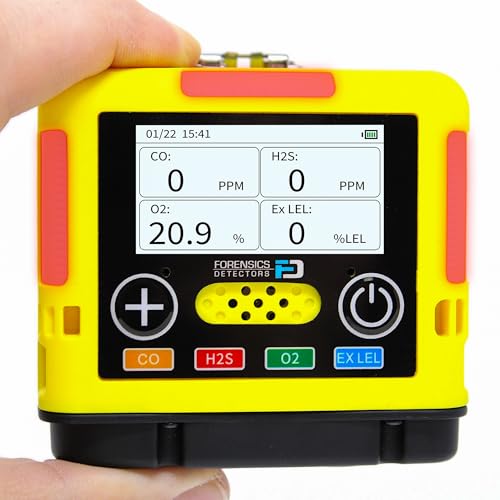
| FORENSICS DETECTORS FD | O2, CO, H2S, LEL | Adjustable audio, visual and vibration alarms | USB recharge; runtime not stated | Water-resistant, dust-proof, explosion-proof |
| TopTes Guard-863Pro | H2S, CO, LEL, O2 | Continuous triple alarm: sound, light, vibration | 2.5-hour charge, over 18 hours operation | Back clip; no IP rating published |
Read the MSA ALTAIR 4XR Multigas Detector row carefully. The MSA listing describes a man-down alarm and a manual alarm but does not use the word vibration. That is a gap in the bullet text, not a claim that the feature is absent. If tactile alerting is the reason you are buying, confirm it with the manufacturer before committing. The FORENSICS DETECTORS FD 4 Gas Monitor and the TopTes Guard-863Pro 4 Gas Monitor are the two listings that state vibration outright, and they are therefore the two safest picks on the specific question this page asks.
The four monitors, and what each listing actually promises about vibration
MSA ALTAIR 4XR Multigas Detector
The only pick whose listing names both a vibration-adjacent feature set and a full alarm package: MotionAlert man-down, InstantAlert manual alarm, four-gas detection with low cross-channel interference, 24-hour runtime and IP68.
Testo Gas Leak Detector
Included because it is sold as a gas leak detector, but the listing supplies no bullets, so nothing about vibration, detection range or alarms can be stated. It is a different category of tool from the four-gas monitors and is treated as such below.
BW Technologies GasAlertMicroClip XL
A thin, lightweight four-gas detector with one-button operation and a flashing green IntelliFlash compliance cue. The listing does not publish a vibration alarm, so buy it for the form factor and the compliance flash, not for tactile alerting.
FORENSICS DETECTORS FD 4 Gas Monitor
The listing explicitly states adjustable audio, visual and vibration alarms, factory calibration and zero and span calibration options, with an explosion-proof, water-resistant housing. It is the clearest vibration claim of the four, but the thinnest on published numbers.
TopTes Guard-863Pro 4 Gas Monitor
States a continuous triple alarm of sound, light and vibration, a 0.5-second response time, a TFT colour screen, USB data export and over 18 hours of runtime from a 2.5-hour charge.
The four-gas monitor is a safety device, and it does not find leaks
All four working monitors here detect the same four-gas set: combustibles by LEL, oxygen, hydrogen sulfide and carbon monoxide. That combination exists because those four hazards travel together in confined spaces, in sewers, in tanks and around combustion. A four-gas monitor answers one question: is the air around me safe to breathe right now. It does not answer where a leak is, how big it is, or whether a joint will pass a pressure test.
This is the most common expensive mistake in the category. A technician buys a four-gas monitor to find a domestic gas leak, walks the kitchen with it, and gets nothing, because the instrument alarms in percent LEL and a pinhole leak in a pipe run rarely builds a flammable concentration in open air. Finding the leak needs a different sensor principle, usually a heated diode or an infrared point sensor that responds to parts per million. If that is your job, start with our combustible detectors with ppm displays instead.
The second mistake is treating the monitor as an alarm system for a room. A personal monitor protects the person wearing it. A fixed alarm protects a space. If you are safeguarding a plant room, a battery store or a boat cabin, a wearable monitor left on a shelf is the wrong architecture. See our boat cabin alarm selection page for how that decision looks when the space, not the person, is the thing being protected.
Sensor life, calibration and the maintenance that decides whether the buzz means anything
A vibration alarm is only as good as the sensor behind it. Every electrochemical cell in these monitors consumes itself while it works, whether or not it ever sees the target gas. Oxygen sensors age fastest and are the usual reason a monitor that passed last quarter now reads 20.9 percent in dead air and drifts low in a real deficiency. The TopTes Guard-863Pro 4 Gas Monitor’s listing claims an upgraded oxygen sensor with a service life of up to five years; that is a stated life, not a guarantee, and it still needs calibration checks.
Calibration is the part nobody schedules. A bump test exposes the sensor to a known gas and confirms it responds and alarms. A full calibration adjusts the reading to that gas. The MSA ALTAIR 4XR Multigas Detector’s listing states that it records bump and calibration records and shows a bump pass or fail with LED and on-screen cues, which is exactly the traceability an employer needs when the monitor’s data is later reviewed. The FORENSICS DETECTORS FD 4 Gas Monitor states factory calibration plus zero and span calibration options, which tells you the instrument is adjustable but does not tell you how often it needs adjusting. The TopTes Guard-863Pro 4 Gas Monitor states that alarm records, fault logs, calibration records and operation history can be exported over USB, which turns the monitor into a record-keeping device as well as an alarm.
What no listing here publishes is a calibration interval. That is normal: the interval depends on your exposure, your procedures and your sensor type, and it is set by your site rules rather than by the box. Budget for a bump test before each use and a calibration on a fixed schedule, and treat the alarm as unverified until the bump test passes.
Choosing between the four, and where this category stops being right
If you need the most complete published safety package, the MSA ALTAIR 4XR Multigas Detector leads. It is the only pick that names a man-down alarm, which matters for lone workers: if you stop moving, the monitor escalates on its own. It also publishes the toughest environmental case here, IP68 with MIL-STD-810G and 25-foot drops. Its weakness on this page is that the word vibration does not appear in its bullets.
If a stated vibration alarm is non-negotiable, the TopTes Guard-863Pro 4 Gas Monitor is the strongest documented choice: sound, light and vibration are named, the response time is stated at 0.5 seconds, the runtime is over 18 hours and the data export is described. The FORENSICS DETECTORS FD 4 Gas Monitor also names adjustable vibration alarms and adds an explosion-proof housing, but it publishes no runtime, no response time and no IP number, so it is harder to plan around. The BW Technologies GasAlertMicroClip XL is the lightest and simplest to train on, with a one-button interface and a green compliance flash, but its listing does not publish a vibration alarm, so it should not be bought for that feature alone.
Where the category stops being right: any job that needs a number rather than an alarm. A confined space entry with a permit needs a monitor, but it also needs a pre-entry test with a calibrated instrument and often a second person. A leak survey needs a ppm instrument. A home with a suspected gas smell needs the gas utility, not a wearable monitor. And a monitor is not a substitute for ventilation, isolation or a rescue plan. The buzz tells you to leave; it does not make the space safe.
For the broader field, our four-gas detector comparison covers the same instruments without the vibration focus, and the multi-gas detector guide widens the set beyond four channels.
Recommended Tools



Products shown because their documented specifications fit this guide. Price and availability are on Amazon and can change.
Frequently Asked Questions
Do all four monitors here have a vibrating alert?
Only the FORENSICS DETECTORS FD 4 Gas Monitor and the TopTes Guard-863Pro 4 Gas Monitor state vibration in their listing bullets. The MSA ALTAIR 4XR Multigas Detector describes MotionAlert and InstantAlert but does not use the word vibration. The BW Technologies GasAlertMicroClip XL describes a flashing green IntelliFlash and does not mention vibration. The Testo Gas Leak Detector publishes no bullets at all, so nothing can be stated. If tactile alerting is the deciding feature, buy on a published claim or confirm with the manufacturer.
Can I rely on the vibration alarm instead of the sound?
No. Use vibration as a backup channel, not the primary one. A vibration motor gives you a single on or off signal and cannot tell you which gas crossed which threshold. The screen and the audible pattern carry that information, and you need both to decide whether to ventilate, isolate or evacuate.
Will a four-gas monitor find a small gas leak in a pipe?
Usually not. These monitors alarm in percent LEL for combustibles, which is far above the concentration a pinhole leak produces in open air. Finding the leak needs a ppm-resolution instrument, such as the detectors in our guide to combustible gas detectors with ppm displays.
How often do the sensors need replacing?
The listings do not publish replacement intervals except for the TopTes Guard-863Pro 4 Gas Monitor, which states an oxygen sensor life of up to five years. Electrochemical cells consume themselves with use and age, and oxygen cells typically go first. Follow your site's calibration and replacement schedule rather than the box.
Is a personal monitor a substitute for a fixed gas alarm?
No. A personal monitor protects the person wearing it. A fixed alarm protects a space and everyone in it, including people who are asleep or not wearing a monitor. For a plant room, battery store or boat cabin, you need a fixed system as well, or instead.
What does the man-down feature on the MSA ALTAIR 4XR Multigas Detector actually do?
MotionAlert is stated as a man-down alarm: if the monitor detects that the wearer has stopped moving, it raises its own alarm. That is valuable for lone workers, but it still depends on the monitor being worn, charged and bump-tested, and it does not summon help by itself.
Affiliate disclosure: Akermin earns a commission from qualifying Amazon purchases made through links on this page. Our editorial picks are based on documented specifications and owner feedback, not commissions.