As an Amazon Associate, Akermin earns from qualifying purchases. Product links on this page are affiliate links.
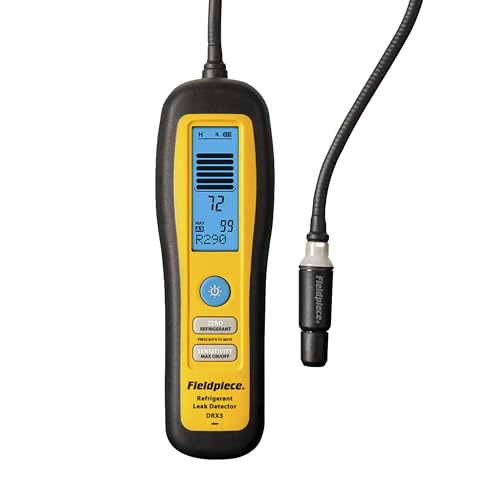
For finding a combustible gas leak, the Fieldpiece DRX3 Refrigerant and Combustible Gas is the pick: its listing states a heated diode sensor, auto and manual zero, three sensitivity settings and audio and visual feedback that changes with leak intensity, which is what a service technician actually uses. For a genuine ppm number on ammonia, the BTMETER BT-5800G Ammonia Gas Detector is the pick because the listing publishes a 0 to 100 PPM range, 0.1 PPM resolution and stated accuracy, and it also logs temperature and humidity. The Testo 0632 0336 Gas Leak Detector is the compact alternative for sniffing, and the TOPTES AT-505 Rechargeable Ammonia Gas Detector is the ammonia monitor for someone who wants alarms and stored records rather than a bare reading. The Inficon 718-202-G1 Combustible Gas Detector is listed but its bullets describe packaging, not detection, so it cannot be compared on performance.
A ppm display is not the same thing as a ppm measurement
The phrase ppm display gets used loosely. On a leak sniffer, the screen often shows a bar graph or a rising number that tracks how close you are to the source. That number is leak intensity, not concentration. It tells you the leak is getting bigger as you move the probe, which is exactly what you want when hunting a joint behind a boiler. It does not tell you whether the air in the room is at 5 percent of the lower explosive limit or 40 percent.
On a true ppm instrument, the sensor produces a current or voltage proportional to the gas concentration, and the display converts that into a number you could write on a certificate. The difference matters because the two tools answer different questions. One asks where. The other asks how much.
Of the four listings on this page, only the TOPTES AT-505 Rechargeable Ammonia Gas Detector and the BTMETER BT-5800G Ammonia Gas Detector publish a ppm range, and both of those are ammonia monitors, not combustible gas detectors in the piped-gas sense. The Testo 0632 0336 Gas Leak Detector, the Fieldpiece DRX3 Refrigerant and Combustible Gas and the Inficon 718-202-G1 Combustible Gas Detector are sold as combustible gas detectors, and only the Fieldpiece DRX3 Refrigerant and Combustible Gas describes the sensing mechanism at all. If you need a number to compare against a threshold, the combustible listings here largely cannot give you one. That is not a flaw in the products; it is a mismatch between the marketing phrase and the instrument.
What the listings publish, side by side
The table below uses only figures and features that appear in the supplied listing text. Where a listing is silent, the cell says so rather than guessing.
| Pick | Sensor type | Stated range | Alarms | Power | Intended gas |
|---|---|---|---|---|---|
| Testo 0632 0336 Gas Leak Detector | Not stated in the listing bullets | Not stated in the listing bullets | Not stated in the listing bullets | Not stated in the listing bullets | Combustible gas leak detection |
| Fieldpiece DRX3 Refrigerant and Combustible Gas | Heated diode, field replaceable | Not stated in the listing bullets | Visual and audio feedback that changes with leak intensity | Long-life field-replaceable batteries | A3, A2L, A1 refrigerants and combustible gases |
| Inficon 718-202-G1 Combustible Gas Detector | Not stated in the listing bullets | Not stated in the listing bullets | Not stated in the listing bullets | Not stated in the listing bullets | Combustible gas, per the title only |
| TOPTES AT-505 Rechargeable Ammonia Gas Detector | UK sensor, type not stated | 0.0 to 100.0 PPM NH3 | Sound, light and vibration, adjustable high and low limits | 4000 mAh rechargeable, over 60 hours | Ammonia |
| BTMETER BT-5800G Ammonia Gas Detector | Electrochemical cell | 0 to 100 PPM NH3 | Not stated in the listing bullets | Rechargeable via USB | Ammonia, plus temperature and humidity |
Two things stand out. First, the Fieldpiece DRX3 Refrigerant and Combustible Gas is the only combustible listing that names a sensor technology, and a heated diode is a well-established way to detect halogenated refrigerants and combustible vapours, so it is plausible for the stated job. Second, the BTMETER BT-5800G Ammonia Gas Detector publishes an accuracy figure of plus or minus 2 percent, which is unusually specific for this price class of ammonia monitor. Treat it as the listing states it, and verify against a known reference if you are using it for compliance.
the Fieldpiece DRX3 Refrigerant and Combustible Gas versus the Testo 0632 0336 Gas Leak Detector: the two service sniffers
The Fieldpiece DRX3 Refrigerant and Combustible Gas and the Testo 0632 0336 Gas Leak Detector are both handheld leak hunters, but the listings describe them at very different levels of detail. The Fieldpiece DRX3 Refrigerant and Combustible Gas states a heated diode sensor that can be replaced in the field, which matters because sensor elements degrade with exposure and a technician who cannot swap one is sending the whole tool away. It also states auto and manual zero modes. Auto zero lets the instrument re-baseline in a clean area so that background contamination does not follow you around; manual zero gives you control when you know the background is not clean. Three sensitivity settings let you start coarse to find the general area and then switch fine to pin the joint.
The Testo 0632 0336 Gas Leak Detector’s listing, as supplied, gives a brand and a model and nothing else. There is no sensor type, no sensitivity control, no battery detail. That does not mean the instrument lacks them. It means a buyer working from this listing alone cannot compare it on performance. If you are choosing between the two, the honest position is that Fieldpiece DRX3 Refrigerant and Combustible Gas publishes its mechanism and the Testo 0632 0336 Gas Leak Detector does not.
Neither listing states a ppm range for combustible gas, and neither describes an alarm threshold in percent LEL. That is normal for this class. These are locating tools. If you need a numeric reading against a safety threshold, see our guide to ppm, LEL and volume in gas detection before you buy.
The four listings, and what each one really measures
Testo 0632 0336 Gas Leak Detector
A leak detector from a brand with a long instrument pedigree, but the supplied listing gives no sensor type, no range and no ppm figure, so it can only be assessed as a sniffing tool, not a measuring instrument.
Fieldpiece DRX3 Refrigerant and Combustible Gas Leak Detector
The only pick here whose listing describes how it finds a leak: a field-replaceable heated diode sensor, auto and manual zero modes, and three sensitivity settings with feedback that changes with leak intensity.
Inficon 718-202-G1 Combustible Gas Detector
Listed as a combustible gas detector, but the bullets describe test instruments and gauges, country of manufacture and package dimensions. No sensor, range or alarm detail is published, so nothing about its detection performance can be compared.
TOPTES AT-505 Rechargeable Ammonia Gas Detector
A true ppm instrument for ammonia, with a stated 0.0 to 100.0 PPM range, a UK sensor, triple alarms and 1200 stored alarm records, aimed at livestock and poultry buildings rather than gas piping.
BTMETER BT-5800G Ammonia Gas Detector
The most fully specified measuring instrument here: 0 to 100 PPM, 0.1 PPM resolution, stated accuracy, an electrochemical cell sensor and a tripod mount for continuous spot measurement.
The ammonia pair: where a real ppm number lives
The TOPTES AT-505 Rechargeable Ammonia Gas Detector and the BTMETER BT-5800G Ammonia Gas Detector are the only instruments here that put a concentration number on the screen. Both cover 0 to 100 PPM of ammonia, which is the range that matters in poultry houses, pig buildings and stables, where chronic exposure damages bird and animal health long before it becomes dangerous to a person. The BTMETER BT-5800G Ammonia Gas Detector states 0.1 PPM resolution and plus or minus 2 percent accuracy; the TOPTES AT-505 Rechargeable Ammonia Gas Detector states a 0.0 to 100.0 PPM range and a UK sensor but no accuracy figure.
The two listings emphasise different things. The TOPTES AT-505 Rechargeable Ammonia Gas Detector is built around alarms: sound, light and vibration, adjustable high and low limits, and 1200 stored alarm records. That is a monitor you leave running, and the record history is what lets you show that a ventilation change worked. The BTMETER BT-5800G Ammonia Gas Detector is built around measurement: an electrochemical cell, a tripod mount so it can sit in one spot and track the gas, and simultaneous temperature and humidity readings. The listing makes a fair point that warm, humid conditions accelerate ammonia production, so tracking all three together is more informative than ammonia alone.
One caution applies to both. Electrochemical ammonia sensors are cross-sensitive to other amines and can drift with temperature and humidity. Neither listing describes a calibration schedule or a replaceable sensor, so factor in how you will verify the reading over time. For a broader view of this class, see our ammonia gas detector comparison.
the Inficon 718-202-G1 Combustible Gas Detector, and why its listing cannot be used
The Inficon 718-202-G1 Combustible Gas Detector is titled as a combustible gas detector, but the bullet text supplied describes test instruments and gauges, country of manufacture, the manufacturer name and package dimensions. None of that is detection information. There is no sensor type, no range, no alarm description and no response time.
When a listing’s bullets clearly belong to a different product or to a logistics record rather than the instrument, the only honest thing to do is say so and use the title alone. On that basis, the Inficon 718-202-G1 Combustible Gas Detector is a combustible gas detector by name and nothing more can be said about its performance. It is not ranked here because ranking requires comparable facts. If you are considering it, ask the seller for the sensor type and range before committing.
This is also a reminder about listings generally. A page can be long and still tell you nothing about the sensing element. The sensor is the instrument. Everything else is housing.
Where a ppm display stops being the right tool
A ppm instrument is the wrong purchase in two common situations. The first is finding a leak in a gas pipe. A ppm monitor responds slowly and averages over its sample volume, so walking a joint with one is frustrating; you want a sniffer with fast response and rising intensity feedback, which is what the Fieldpiece DRX3 Refrigerant and Combustible Gas describes. The second is protecting people while they sleep. None of the handheld instruments here is an alarm you mount on a wall and trust overnight. For that you need a fixed detector with its own power and its own alarm, and our combustible gas detector guide covers that class.
There is also a legal point. A handheld meter reading does not satisfy confined space entry requirements, which typically call for a multi-gas instrument with oxygen, combustible gas, hydrogen sulphide and carbon monoxide channels, bump tested before use. A single ppm monitor, however accurate, is one channel of a four-channel job.
Finally, remember what a combustible gas sniffer does not do. It does not detect carbon monoxide, which is a product of incomplete combustion rather than a fuel gas, and it does not measure oxygen. If your concern is a boiler or a flue, you need different instruments, not a more sensitive version of this one.
Recommended Tools



Products shown because their documented specifications fit this guide. Price and availability are on Amazon and can change.
Frequently Asked Questions
Which of these actually shows a ppm number for combustible gas?
None of the combustible gas listings here publishes a ppm range. The Testo 0632 0336 Gas Leak Detector, the Fieldpiece DRX3 Refrigerant and Combustible Gas and the Inficon 718-202-G1 Combustible Gas Detector are leak detectors, and only the Fieldpiece DRX3 Refrigerant and Combustible Gas describes how it senses. The two instruments with a stated ppm range, the TOPTES AT-505 Rechargeable Ammonia Gas Detector and the BTMETER BT-5800G Ammonia Gas Detector, measure ammonia, not fuel gas.
Can I use an ammonia monitor to find a propane leak?
No. An electrochemical ammonia sensor responds to ammonia and is not selective for propane or methane. Using one on a fuel gas line will not give you a meaningful reading, and the absence of a response does not mean the joint is sound.
Why does the Fieldpiece DRX3 Refrigerant and Combustible Gas listing mention refrigerants as well as combustible gases?
A heated diode sensor responds to halogenated compounds, which is why the listing covers A3, A2L, A1 refrigerants and blends, and it also responds to combustible vapours. That dual use is why it is sold as an HVAC tool rather than a dedicated gas detector.
How often do these sensors need replacing or calibrating?
None of the four listings publishes a calibration interval or a sensor life figure. The Fieldpiece DRX3 Refrigerant and Combustible Gas states that its sensor and batteries are field replaceable, which is the only maintenance detail given. For any instrument used for safety decisions, check the manufacturer's calibration guidance separately.
Is a ppm display better than a bar graph for finding leaks?
For locating a leak, no. A bar graph or intensity indicator that rises as you approach the source is faster to interpret than a settling number. A ppm readout is better when you need to record a concentration or compare against a threshold.
Do any of these work as a permanent room alarm?
No. All four are handheld or portable instruments. A permanent installation needs a fixed detector with continuous power and its own alarm output, which is a different product category.
Affiliate disclosure: Akermin earns a commission from qualifying Amazon purchases made through links on this page. Our editorial picks are based on documented specifications and owner feedback, not commissions.