As an Amazon Associate, Akermin earns from qualifying purchases. Product links on this page are affiliate links.

Amprobe · Amprobe GSD600 Gas Leak Detector
View on AmazonPrice and availability are shown on Amazon and can change at any time.
Verdict
The Amprobe GSD600 is a handheld leak detector for methane and propane that does one thing few consumer sniffers do: it tells you which concentration step it is seeing. The manufacturer specifies a five-level LED alarm at greater than 40, 80, 160, 320 and 640 ppm, a buzzer whose beep frequency rises with gas concentration, a flexible probe for awkward fittings and a built-in earphone jack that also works as a mute. There is no numeric display, and the listing does not state the probe length, the battery, the warm-up time, the alarm volume or the sensor type. As a locator with a labeled scale, it suits homeowners and technicians who want to describe a leak as “second light” or “fifth light” rather than “some lights.” It is not a safety monitor and does not claim to be.
Who It Is For
- Homeowners who want to know whether a leak is getting worse between checks, in steps they can note down.
- Technicians who need silent operation in occupied buildings and will use an earphone.
It is not for anyone who needs a unit that reads to the alarm setpoints of a fixed detector, since its top LED sits at 640 ppm, or who needs a reach specification before buying. The handheld versus fixed detector comparison covers the wider question of what a sniffer can and cannot replace.
Documented Specifications
| Item | Manufacturer or listing statement |
|---|---|
| Gases | Methane and propane |
| Visual alert | Five-level LED alarm at greater than 40, 80, 160, 320 and 640 ppm |
| Audible alert | Buzzer; beep frequency coincides with concentration |
| Mute | Built-in earphone jack with mute function; earphone not included |
| Probe | Flexible, for difficult measurement areas; length not stated |
| Battery, warm-up, response time, alarm volume, sensor type | Not stated on the listing |
What the Five Thresholds Mean
The GSD600 scale is the most useful thing about it and it deserves a plain reading. Methane ignites in air at about 5 percent by volume, which is 50,000 ppm; propane reaches its lower explosive limit at about 2.1 percent, or 21,000 ppm. The fifth LED at 640 ppm is therefore roughly 1.3 percent of the methane LEL and about 3 percent of the propane LEL. Every light on this tool sits far below the 10 to 25 percent LEL range at which residential fixed alarms commonly trip, which is what a leak locator is for. The first LED at 40 ppm is a lower floor than the 50 ppm most consumer sniffers publish. What the tool cannot do is judge whether a room is safe, and a fifth light on every fitting is a signal to leave rather than to keep counting. The units are explained in this guide to ppm, LEL and volume, and gas detector sensitivity covers why a 40 ppm floor matters.
Beep Rate and the Earphone Jack
The buzzer speeds up as the concentration rises, which is the same tic-rate idea technicians like on the UEi CD100A: you can follow a leak by ear while your eyes stay on the probe tip. The earphone jack is the unusual feature. Plug in an earphone and the buzzer is silenced, so a technician can check a range in a house where a baby is asleep, or work in a noisy plant room without losing the signal. The listing does not include an earphone or state the jack size. Owners who use it describe it as the reason they keep this unit over louder rivals.
The Flexible Probe
Amprobe describes a flexible probe for difficult measurement areas without giving a length. Owner reports describe it as long enough to reach behind a range and around a water heater union, but we cannot confirm a figure. As with any sniffer, sweep slowly, within a few centimeters of each joint; why gas sensor response time matters explains why a fast pass misses leaks.
Strengths
- Five stated LED thresholds, giving a repeatable scale without a display.
- 40 ppm first-level threshold, lower than most consumer sniffers.
- Earphone jack with mute for silent operation.
- Beep rate that follows concentration for hands-free locating.
Limitations
- No numeric or percent LEL readout; top step is 640 ppm.
- Probe length, battery, warm-up and alarm volume are not published.
- Manufacturer names only methane and propane; broader response is unstated.
- Earphone not included.
How It Compares
The Klein ET120 covers a wider 50 to 10,000 ppm span with two sensitivity ranges, an 18-inch gooseneck and an 85 dB alarm, but its five LEDs are not tied to stated ppm steps. The UEi CD100A shares the rising-tic approach, adds a tip light and a 10-second warm-up, and publishes no range at all. The TopTes PT199 is the pocket option with a 50 to 1,000 ppm range and no probe. If the GSD600 scale appeals but you want a real number, the TopTes PT210S shows percent LEL from 1 to 10 percent. The handheld gas leak detector roundup ranks them all; fixed alarms are in the combustible gas detector roundup, and the gas leak detector guide covers both.
Five Lights Is Not a Measurement of Safety
Whatever the LEDs show, a strong smell of gas or a sounding fixed alarm means the same thing: leave, keep your hands off switches and phones until you are outside, and call the gas utility or 911. The GSD600 helps you find a small leak in a safe room. It does not qualify you to stay in an unsafe one.
How We Research
This review is based on the Amprobe listing and product information and on patterns in owner reports. We did not run laboratory tests. The LEL percentages are simple arithmetic from the stated thresholds and the published LEL of methane and propane; where the listing gives no figure, such as probe length and battery, we say so.
Recommended Tools


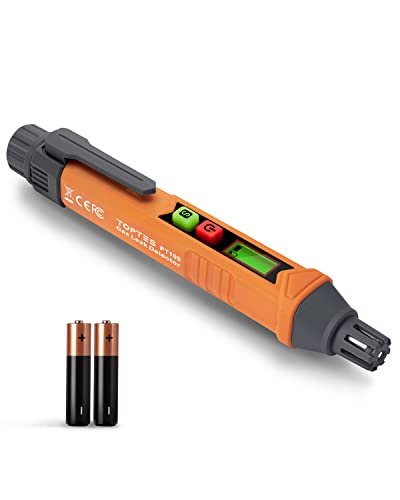
Products shown because their documented specifications fit this guide. Price and availability are on Amazon and can change.
Frequently Asked Questions
How much gas is 640 ppm on the GSD600?
A small amount in explosive terms. Methane reaches its lower explosive limit at about 50,000 ppm, so 640 ppm is a little over 1 percent of the LEL. The fifth LED means a definite leak worth fixing, not an ignitable room. The GSD600 is a locator for small leaks, and its scale reflects that.
Why do the GSD600 thresholds double at each step?
Each stated level, 40, 80, 160, 320 and 640 ppm, is twice the one before. A doubling scale spreads the LEDs across the low end where connector leaks live, so a change from 50 to 100 ppm moves a light, while still leaving room for a larger leak to show as more lights. It is a sensible design for a leak locator.
Can I use headphones with the GSD600?
The listing states a built-in earphone jack with a mute function and that no earphone is included. It does not give the jack size, so check the manual or the socket before buying an earphone. Plugging one in is how you get silent operation in an occupied home.
Does the GSD600 detect anything other than methane and propane?
The manufacturer names methane and propane only, and states the thresholds without naming a reference gas. Sensors in this class typically respond to butane and some solvents as well, but that is general background on the product type rather than an Amprobe statement.
Affiliate disclosure: Akermin earns a commission from qualifying Amazon purchases made through links on this page. Our editorial picks are based on documented specifications and owner feedback, not commissions.