As an Amazon Associate, Akermin earns from qualifying purchases. Product links on this page are affiliate links.
Buy the TopTes PT520A if any of your gas fittings sit behind an appliance, above a water heater or inside an RV cabinet: its 17-inch gooseneck reaches them, its range runs to 10,000 ppm so the display keeps working at a large leak, and it adds a mute button and a protective case. Buy the PT199 if your fittings are in plain reach and you want a sniffer that lives in a pocket or a glovebox; it shares the PT520A’s 50 ppm methane floor and 0.5 second response but stops at 1,000 ppm. Both are locators without a numeric readout. The sections below cover where each pulls ahead and which buyer belongs with which.
What They Share
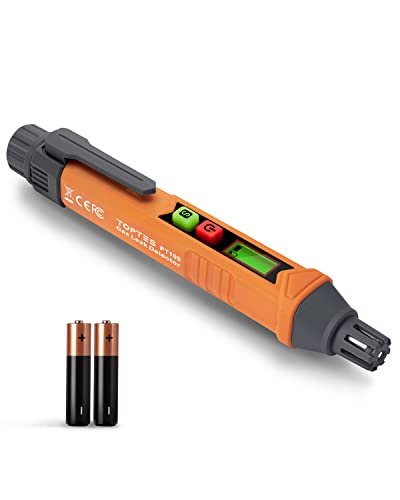
Both are TopTes combustible gas sniffers that list natural gas, methane, propane, butane and LPG among the gases they respond to. Both state a 0.5 second response, a 30 second warm-up in clean air, and a recommended probe distance of 1 to 5 cm from the suspected source. Both run on AAA batteries, included in the box, and both auto power off to save them. Neither displays a ppm or percent LEL number; each uses an escalating visual and audible alarm instead. If you have never used a sniffer, how gas leak detectors work explains what that escalating alarm is telling you.
Side by Side
| Item | TopTes PT520A | TopTes PT199 |
|---|---|---|
| Form | Handheld body with 17-inch flexible gooseneck | Pocket-sized body, no gooseneck |
| Documented range | 50 to 10,000 ppm (methane) | 50 to 1,000 ppm (methane) |
| Response time | 0.5 seconds | Within 0.5 seconds |
| Visual indication | Seven colored bars, rising with concentration | LCD turns red when gas levels are high |
| Audible alert | 75 dB, increases with concentration; mute button | Intensifies with concentration; no mute stated |
| Warm-up | 30 seconds in clean air | 30 seconds |
| Auto power-off | 10 minutes, switchable via APO button | 5 minutes without operation or gas detection |
| Low battery warning | Not stated | Indicator activates below 2.4 V |
| Power | Three AAA, included | Two AAA, included |
| In the box | Detector, three AAA, protective case, manual | Detector, storage bag, two AAA, manual |
Where the PT520A Wins
Reach. This is the whole argument. A range connector behind a slide-in stove, the union on top of a water heater in a closet, the regulator under an RV: a 17-inch gooseneck gets the tip there while your hand and eyes stay outside. A pocket unit either fits or it does not, and when it does not you end up pulling the appliance out to check a fitting.
Headroom. Ten times the ceiling means the seven bars keep telling you something as you close in on a strong leak. The PT199 saturates at 1,000 ppm, after which every fitting in the area reads the same and the tool stops helping you pick the culprit.
Mute and a longer auto-off. The mute lets you sweep quietly; the 10 minute auto power-off, which you can disable, gives a longer working window than the PT199’s fixed 5 minutes before you have to wake the tool again.
The case. A protective case beats a storage bag for a tool with a bendable probe.
Where the PT199 Wins
Size. A pocket sniffer gets used, because it is on you. Owners of gooseneck units report leaving them in the garage; owners of pocket units report checking a grill regulator on a whim. For a homeowner who wants a quick check at the stove connector after a delivery, that habit matters more than the ceiling.
Fewer cells and a stated low battery threshold. Two AAA cells rather than three, and the listing tells you the low battery indicator comes on below 2.4 V, so you know what the warning means. The PT520A listing does not state a low battery threshold.
The red screen. A whole LCD turning red is visible from across the room, which some people prefer to a bar graph they have to look at closely.
Who Should Buy Which
- Homes with a gas range, dryer and water heater in closets: PT520A, for the gooseneck alone. The kitchen gas detector roundup covers the fixed alarms to pair it with.
- RV owners: PT520A. Propane fittings under a camper are exactly where reach and a mute earn their place; the RV gas leak detector roundup covers the floor-mounted alarm that does the continuous watching.
- Apartments and homes with only a range: PT199. The fittings are in reach and the pocket format wins.
- Anyone who wants a number rather than bars: neither; the pen-style PT210S shows a two-digit percent LEL reading and is reviewed in the PT210S review.
What Both Leave Out
Neither instrument approaches the lower explosive limit of methane, so neither can judge whether a space is safe; they find leaks in air that already smells clean. A strong gas odor means the sniffer stays in the drawer while you leave the building without touching switches and call the gas utility or 911 from outside. Both units also react to solvents and aerosol propellants, so confirm a response by airing out the space and sweeping again. The individual reviews of the PT520A and PT199 cover each tool’s quirks, and the handheld gas leak detector roundup ranks both against the Klein and UEi alternatives.
Recommended Tools

Products shown because their documented specifications fit this guide. Price and availability are on Amazon and can change.
Frequently Asked Questions
Is the PT199 less sensitive than the PT520A?
Not at the low end. Both listings state a 50 ppm floor based on methane. The PT199 range ends at 1,000 ppm while the PT520A continues to 10,000 ppm, so the difference shows up at large leaks, where the PT199 display saturates early.
Do both TopTes sniffers need a warm-up?
Yes. Both listings specify a 30 second warm-up in clean air before detection. Starting either one next to the suspected leak makes it treat contaminated air as its baseline and under-report.
What happens to the PT199 screen during a leak?
The manufacturer states that the LCD turns red when gas levels are high and that the audible and visual alarm intensifies with concentration. There is no ppm or percent LEL figure on either the PT199 or the PT520A.
Affiliate disclosure: Akermin earns a commission from qualifying Amazon purchases made through links on this page. Our editorial picks are based on documented specifications and owner feedback, not commissions.
Related Guides

What Does PPM Mean on a Gas Detector? Reading Parts per Million Without Guesswork
PPM is parts per million: gas molecules per million molecules of air. 10,000 ppm is 1 percent by volume, and 50,000 ppm of methane is its explosive limit.
Read More→
Fieldpiece DR58 Review: Why Heated-Diode Leak Detection Still Has a Place
A heated-diode refrigerant detector with stated sensitivity under 0.03 oz/yr, a 300 hour sensor, IP54, 17-inch probe, tracer gas coverage and 18 hour battery.
Read More→
Fieldpiece DR82 Review: Is Infrared Refrigerant Detection Really Worth the Extra Money?
An infrared refrigerant detector with a stated 10-year sensor, under 0.03 oz/yr, IP54, 17-inch probe and 10-plus hours on USB-C. Halogenated refrigerants only.
Read More→