As an Amazon Associate, Akermin earns from qualifying purchases. Product links on this page are affiliate links.
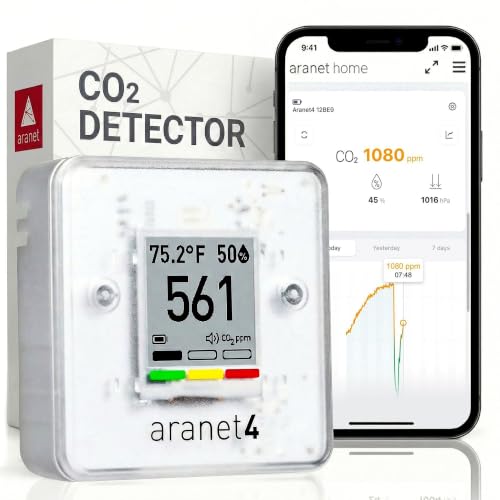
For a nursery, the pick is the Aranet4 because it is the only monitor here whose listing publishes a CO2 sensor technology, an e-ink display readable in a dim room without a phone, and a battery life stated in years rather than hours. CO2 is the number that tells you whether the door and window routine is working while a baby sleeps, and the Aranet4 is built around that single number. The Airthings View Plus is the better choice if radon is your concern, because it is the only listing here that measures radon at all. The Lwyinp 10-in-1 and the AcuRite 17012M both measure CO2 but their listings do not publish the sensor type or accuracy, and the Keenso Wall Mount publishes a CO2 range and response time but no sensor technology, so all three are weaker evidence for the one job a nursery monitor actually has.
Why CO2, not particles, is the nursery number
A nursery is usually a small room with the door shut and the window closed for warmth. A baby exhales CO2 at a rate that is small in absolute terms but large relative to the volume of the room. Over a night, the concentration climbs. The climb is the single best proxy you have for whether fresh air is reaching the cot, because CO2 is exhaled by the occupant and diluted only by ventilation. Particles and VOCs matter too, but they come from furnishings, paint and cleaning products, and they do not tell you whether the window has been open.
This is why the listings that publish a CO2 sensor technology are more useful here than the ones that publish a long list of gases. The Aranet4 is the clearest example: the listing describes the product as a CO2 meter first and lists temperature, humidity and pressure as secondary. The Airthings View Plus names its sensor type as electrochemical, which is a meaningful disclosure. The Lwyinp 10-in-1, the AcuRite 17012M and the Keenso Wall Mount all claim CO2 measurement but do not publish the sensor type, so you cannot tell whether the CO2 channel is a dedicated non-dispersive infrared cell or a derived estimate from a mixed sensor array. For a nursery, that distinction decides whether the number is worth acting on.
If you are new to the category, the broader guide to CO2 monitors explains the sensor types in more depth. The point for this page is narrower: in a nursery, you want the CO2 channel to be the product’s main job, not one line in a ten-in-one feature list.
The comparison table, using only what the listings publish
The table below contains only figures and claims that appear in the supplied listing text. Where a listing is silent, the cell says so. No accuracy figure has been inferred from a display resolution, and no sensor type has been assumed from a product category.
| Pick | CO2 | Particles | VOCs / formaldehyde | Radon | Display | Battery / power |
|---|---|---|---|---|---|---|
| Airthings View Plus | Stated | PM2.5 | VOCs stated | Stated | Not stated | Battery powered, WiFi connected |
| Aranet4 | Stated, with colour coding and optional buzzer | Not stated | Not stated | Not stated | E-ink, colour coded | Up to 4 years, cable free |
| Lwyinp 10-in-1 | Stated, smart calibration claimed | PM1.0, PM2.5, PM10 | HCHO and TVOC stated | Not stated | HD colour screen | Not stated |
| AcuRite 17012M | Stated | PM1.0, PM2.5, PM10 | Formaldehyde and TVOCs stated | Not stated | Green, orange, red IAQ meter | Not stated |
The Keenso Wall Mount is not in the table because its listing publishes only CO2, temperature accuracy and a detection range, with no particle, VOC or radon channel. It is discussed separately below.
What the Aranet4 listing actually commits to, and what it does not
The Aranet4 listing is the shortest in this batch and the most specific about the job. It states that the device measures CO2, temperature, relative humidity and atmospheric pressure in real time. It states an e-ink display, a battery life of up to four years, colour coding, a prominent CO2 number and an optional buzzer. It states a free app with up to 90 days of historical data and graphs.
What it does not state is equally important. There is no CO2 accuracy figure, no measurement range, no sensor technology, and no sampling interval. For a nursery, the missing accuracy figure is the one that matters most, because the difference between a reading of 900 and a reading of 1400 is the difference between leaving the door ajar and opening a window in February. The listing’s claim of being top-rated in its segment is a marketplace position, not a measurement specification, and it is reported here as stated rather than as evidence of accuracy.
The e-ink display is the feature that makes this pick work in a nursery. It is readable in low light without emitting much light of its own, and it does not need a phone. That matters because you will check it while holding a baby, and because a screen that needs an app is a screen you stop checking. The four-year battery claim is also unusual in this batch; only the Airthings View Plus also describes itself as battery powered, and it does not publish a battery life figure.
Four monitors that could sit on a nursery shelf
Aranet4
The only listing here that names its CO2 sensor as the centre of the product, with an e-ink display and a battery life stated in years. For a nursery, that combination means a number you can read at 3am without a phone and without a charger.
Airthings View Plus
The only monitor in this batch that measures radon, alongside PM2.5, CO2, VOCs, humidity, temperature and pressure. It is the pick if the nursery is in a basement or a radon-affected area, and it is the one listing here that names a sensor type, electrochemical.
AcuRite 17012M
Measures CO2, PM1.0, PM2.5, PM10, formaldehyde and TVOCs, and gives an audible alert when the listing’s own thresholds are crossed. Useful if you want the monitor to make a noise rather than just show a colour, but the listing does not publish sensor technology or accuracy.
Lwyinp 10-in-1
The widest measurement list here, including CO2, formaldehyde, TVOCs, PM1.0, PM2.5, PM10, temperature and humidity. The listing claims electrochemical sensors for HCHO and TVOC and smart calibration, but does not publish a CO2 accuracy figure, which is the number a nursery actually needs.
The radon question, and why the Airthings View Plus is the basement nursery pick
Radon is a radioactive gas that comes from soil and rock and accumulates in lower floors and basements. It is the second leading cause of lung cancer in many countries after smoking, and the listing for the Airthings View Plus states that it is the number one cause among non-smokers. That claim is a public health statement, not a measurement claim, and it is reported here as the listing states it. What matters for this page is that Airthings View Plus is the only monitor in the batch that measures radon at all.
If your nursery is on a ground floor or in a basement, and you have not had the home tested for radon, a monitor that includes a radon channel gives you a second reason to own it beyond CO2. The Airthings View Plus also measures PM2.5, CO2, VOCs, humidity, temperature and pressure, and the listing names its sensor type as electrochemical. It requires the Airthings app to function, requires an account with an email and name, and requires internet access for both the monitor and the app. That is a real constraint: if the WiFi drops, the listing implies the cloud tracking stops. For a nursery, that is a reason to check the router before you rely on the overnight graph.
If radon is your main concern rather than a secondary one, the dedicated guide to radon monitors for multi-floor homes covers the category properly. This page treats radon as one channel among several, which is what the Airthings View Plus offers.
The three listings that measure CO2 without publishing how
The Lwyinp 10-in-1, the AcuRite 17012M and the Keenso Wall Mount all claim CO2 measurement. None of them publishes a CO2 sensor technology or an accuracy figure. That does not make them useless, but it changes what you can do with the number.
The Lwyinp 10-in-1 is the widest listing here: CO2, formaldehyde, TVOCs, temperature, humidity, AQI, PM1.0, PM2.5, PM10 and a clock. It claims electrochemical sensors for HCHO and TVOC and a smart chip for CO2, with smart calibration and stable sensitivity. The calibration claim is worth reading carefully. The listing says the device calibrates time automatically over Bluetooth, and that it has smart calibration for the sensors, but it does not say what the CO2 channel is calibrated against or how often. In a nursery, an uncalibrated CO2 channel can drift high or low, and you have no way to tell which. The three-colour screen and the average concentration tracking are genuinely useful for a quick glance.
The AcuRite 17012M measures CO2, PM1.0, PM2.5, PM10, formaldehyde and TVOCs, and provides an audible alert when unhealthy IAQ levels are detected, which can be disabled in the app. The alert is the feature that distinguishes it: it will make a noise rather than waiting for you to look. The listing does not publish the thresholds at which the alert triggers, so you cannot set expectations against a specific CO2 number. It also does not publish a battery or power description beyond the WiFi connection implied by the app name.
The Keenso Wall Mount is the narrowest of the three. It publishes a CO2 range of 400 to 5000ppm, a resolution of 1ppm, a response time of 1.5 seconds, four colour-coded CO2 stages, and a temperature accuracy of plus or minus 1.0 degrees Celsius. A resolution of 1ppm is a display figure, not an accuracy figure, and the listing does not publish a CO2 accuracy claim. The wall-mount format suits a fixed position, but the listing does not state whether it logs, connects to an app, or stores anything. For a nursery, a monitor that only shows a live number and does not record it is a weaker tool, because the overnight peak is the thing you need to see.
Placement, power and the habits that make the number useful
Where you put the monitor decides what it measures. A CO2 sensor measures the air at its own inlet, not the air in the cot. If you place it on a shelf above a radiator, you will read warmer, drier air than the baby breathes. If you place it on the floor, you will read the coldest, most CO2-rich layer in the room, because exhaled air is warm and rises but pools in still conditions. The practical compromise is a shelf or windowsill at roughly the height of the cot, away from the radiator, away from the window draught, and not inside a closed cupboard.
Power is the second habit. The Aranet4 claims up to four years on its battery, which means you can leave it running and forget it. The Airthings View Plus is battery powered but does not publish a battery life, and it needs WiFi and an account, so it has more ways to stop reporting. The Lwyinp 10-in-1, the AcuRite 17012M and the Keenso Wall Mount do not publish battery or power details at all, so you should assume they need a cable until the listing tells you otherwise. A monitor that needs a cable will end up near a socket, and the nearest socket is rarely the right height.
The third habit is checking at the right time. A nursery CO2 reading taken at 7pm while the door is open tells you almost nothing. The number that matters is the peak, usually in the early hours after several hours of closed-door sleep. If your monitor logs, look at the peak, not the average. If it does not log, you are guessing. This is why the logging and history behaviour of the listing matters more than the length of the feature list, and it is the reason a simple CO2 meter with a long battery can beat a ten-in-one tester with no published history.
Recommended Tools


Products shown because their documented specifications fit this guide. Price and availability are on Amazon and can change.
Frequently Asked Questions
Do I need a monitor that measures particles and VOCs in a nursery, or is CO2 enough?
CO2 is the number that tells you whether ventilation is working, because it comes from the occupant and is diluted only by fresh air. Particles and VOCs come from furnishings, paint and cleaning products, and they are worth measuring if you have recently decorated or if the nursery is near a road. The Airthings View Plus and the AcuRite 17012M both measure particles and VOCs alongside CO2; the Aranet4 measures CO2 only. If you have to choose one channel, choose CO2.
The listings do not publish CO2 accuracy. Does that matter?
Yes, and it is the biggest gap in this batch. None of the four picks publishes a CO2 accuracy figure. The Keenso Wall Mount publishes a resolution of 1ppm and a response time of 1.5 seconds, but resolution is not accuracy. Without an accuracy figure you cannot tell whether a reading of 1200 is really 1200 or could be 900 or 1500. For a nursery, treat the number as a trend rather than an absolute, and act on changes rather than on a single threshold.
Can I use a baby monitor or a smart speaker to measure CO2 instead?
Not from the listings here. None of these four products is a baby monitor or a smart speaker, and none of the listings claims compatibility with either. If a device does not publish a CO2 sensor, it does not measure CO2, regardless of what its app displays.
the Aranet4 claims up to four years of battery. Is that realistic?
The listing states it, and the mechanism is plausible because e-ink displays draw power only when the image changes and the CO2 sensor is the main load. The listing does not state the sampling interval or whether the optional buzzer affects battery life. Treat four years as the listing's claim under conditions it does not fully describe, and keep a spare set of cells.
the Airthings View Plus is the only one with radon. Do I need radon in a nursery?
Only if the nursery is at or below ground level and the home has not been tested. Radon comes from soil and accumulates in lower floors. If you are on an upper floor with no known radon issue, the radon channel is a bonus rather than a reason to buy. If you are in a basement, it is the strongest reason in this batch to choose the Airthings View Plus.
What does the Airthings View Plus's requirement for an account and internet mean in practice?
The listing states that the monitor requires the Airthings app to function, that an account is required with an email and name, and that the monitor and app both require internet access, with data saved in the cloud. In practice, if your WiFi drops overnight, the listing implies you lose the live view and the cloud record for that period. For a nursery, that is a reason to check the connection before relying on an overnight graph.
the Keenso Wall Mount publishes a CO2 range of 400 to 5000ppm. Is that wide enough for a nursery?
Yes. A closed nursery will rarely exceed 3000ppm, and 5000ppm is well above the range you need. The limitation is not the range but the absence of a published accuracy figure, logged history, and any stated app or connectivity. A wall-mounted live display is a useful secondary check, not the main record.
Affiliate disclosure: Akermin earns a commission from qualifying Amazon purchases made through links on this page. Our editorial picks are based on documented specifications and owner feedback, not commissions.