As an Amazon Associate, Akermin earns from qualifying purchases. Product links on this page are affiliate links.
For most HVAC technicians, P6 is the practical starting point because it publishes a +/- 60 inH2O range and +/- 1.5 percent full scale accuracy, which covers static pressure, filter drop, and most gas pressure checks in one instrument. P1 is the better choice if you want the meter to talk to a phone app and calculate volume flow from a pitot tube factor. P2 is the specialist pick: two independent wireless probes with a 1000 foot range, which removes the hose problem entirely when you are checking return and supply static at the same time. The rest of the field splits between gas-focused low-range meters like P4 and P5, and P3, which is a pressure switch tester rather than a general purpose manometer.
Range and accuracy decide which jobs a meter can do
Two numbers separate a manometer that works on a residential air handler from one that works on a gas valve. The first is the pressure range. The second is the accuracy expressed as a percentage of full scale.
Full scale accuracy means the error is a fraction of the top of the range, not of the reading. A meter with a +/- 60 inH2O range and +/- 1.5 percent full scale accuracy can be off by roughly 0.9 inH2O anywhere on that scale. That is fine when you are reading a filter drop of 0.5 inH2O, but it is a large error if you are trying to set a gas manifold pressure of 3.5 inH2O. This is why gas work pushes technicians toward a low range meter with a tighter full scale figure.
P6 publishes +/- 60 inH2O and +/- 1.5 percent full scale. P4 publishes +/- 2.999 psi, which converts to roughly 83 inH2O, with +/- 0.3 percent full scale accuracy. P5 publishes +/- 2 psi and a resolution of 0.001 psi, but the listing does not publish a full scale accuracy figure. That omission matters: resolution is not accuracy, and a meter can display a number to three decimal places while being wrong in the first decimal place.
The practical rule is to match the range to the pressure you expect, then check the accuracy figure. A wide range meter is convenient, but it is the wrong tool for setting a low gas pressure precisely.
One port, two ports, or two wireless probes
Differential pressure is the difference between two pressures, so the meter needs two reference points. How those two points reach the meter is the main design split in this category.
The conventional design is two ports on the meter body with hoses running to the test points. P3, P4, P5 and P6 all use this arrangement. The limitation is physical: hoses are a fixed length, they kink, and on a rooftop unit the two test ports may be several feet apart. The listing for P2 addresses this directly with two independent wireless sensors and a stated 1000 foot range, so each probe can sit on its own test port and the readings arrive at the display without a hose between them.
P1 takes a middle path. It is a single wireless probe that pairs with a phone app, and the listing states the app has a measurement menu that includes pressure drop alarms and volume flow calculation when you enter a pitot tube factor and dimensions. That is a different proposition from two independent probes: it is one pressure reference plus software.
If your work is mostly filter drop and supply static on packaged units, a two port hose meter is enough. If you regularly measure return and supply static simultaneously on equipment where the ports are far apart, the wireless probe design removes a real physical problem.
What each listing publishes, side by side
| Pick | Stated range | Stated accuracy | Ports | Units | Notable stated feature |
|---|---|---|---|---|---|
| P1 | Not stated in the listing bullets | Not stated in the listing bullets | Single wireless probe | Not stated in the listing bullets | App volume flow calculation and pressure drop alarms |
| P2 | Not stated in the listing bullets | Not stated in the listing bullets | Two independent wireless probes | Not stated in the listing bullets | 1000 foot wireless range, up to 8 readings at once |
| P3 | Not stated in the listing bullets | Not stated in the listing bullets | Two ports plus pump | Not stated in the listing bullets | Tests and adjusts pressure switches, includes adapters and Y splitter |
| P4 | +/- 2.999 psi | +/- 0.3 percent FSO at 25 C | Dual port | 12 | 24 bit ADC, 0.5 second response time |
| P5 | +/- 2 psi | Not stated in the listing bullets | Dual port | 11 | 0.001 psi resolution, min max average recording |
| P6 | +/- 60 inH2O | +/- 1.5 percent full scale | Dual port | 11 | Strong magnet on back |
The table is the honest picture. Three of the six listings do not publish a range or an accuracy figure at all. That does not mean the instruments are poor; it means the listing does not give you enough to compare them numerically, and you should not assume a figure that is not there.
The six meters, and the job each one is built for
Testo 510i wireless manometer
The only pick here that pairs a magnetic back with an app that calculates volume flow from a pitot factor, so it suits technicians who want the math done for them and a pressure drop alarm to watch while they work.
Fieldpiece Job Link dual port manometer kit
Two independent wireless sensors and a 1000 foot range mean you can leave one probe on the return and one on the supply without running hose across the rooftop, which is the main reason to pay more for this kit.
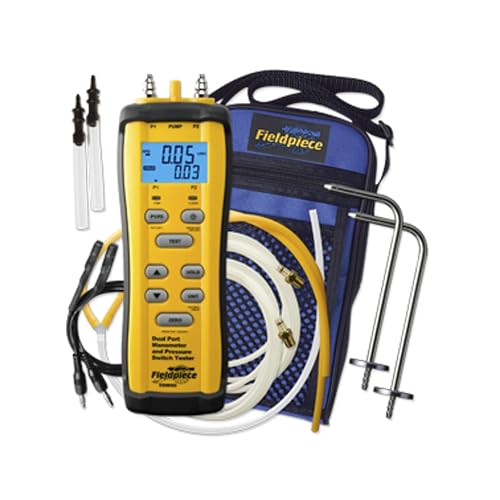
Fieldpiece SDMN6 pressure switch tester
A dedicated switch tester with a built in pump, gas adapters and a Y splitter, so it tests and adjusts pressure switches rather than just reading pressure.
EHDIS dual port digital manometer
A low range gas focused meter with 12 units and a published accuracy of +/- 0.3 percent full scale, aimed at tankless heaters, boilers and calibration work where the pressure being set is small.
ZIBOO ET1013 digital manometer
A compact one handed meter with min, max and average recording and a 0.001 psi resolution, which is useful when you are watching a gas pressure drift rather than taking one reading.
Klein Tools ET180 digital manometer
The widest published range of the handhelds here at +/- 60 inH2O with +/- 1.5 percent full scale accuracy, plus 11 units and a strong magnet, which makes it the general purpose pick for static and differential work.
Gas pressure work needs a different meter from static pressure work
Static pressure and gas manifold pressure are both measured in inches of water column, which makes them look like the same job. They are not. Static pressure in a duct runs from a few tenths of an inch up to a couple of inches on a residential system. Gas manifold pressure on a natural gas appliance is typically in the range of 3 to 4 inH2O, and the tolerance is tight because the appliance is designed around that number.
A meter with a 60 inH2O range and a 1.5 percent full scale accuracy figure can be off by more than the tolerance on a gas setting. That is the mechanism behind the advice to use a low range meter for gas work. P4 and P5 are both built around a low range, and P4 publishes a full scale accuracy of +/- 0.3 percent, which is the tightest figure in this group.
The other gas specific point is the fittings. Gas test ports on many appliances are a specific size, and the listing for P3 states it includes two slide on gas adapters and a Y splitter, which is what you need to connect to a gas valve test port without improvising. P4 and P5 are described as gas pressure testers, but the listings do not state which adapters are included, so check the package before you rely on it for a gas job.
If your work includes combustion analysis or checking a gas appliance, the meter is one part of a set. A differential pressure meter does not detect gas leaks and it does not measure carbon monoxide. Those are separate instruments, and the page on gas detectors for HVAC technicians covers what a sniffer will and will not do.
The accessories and habits that decide whether the reading is usable
A manometer reading is only as good as the connection to the test point. Three things go wrong repeatedly.
- Leaky hoses. A hose that does not seal at the test port reads a pressure that is lower than the true value. On a static pressure reading this shows up as a number that drifts when you wiggle the hose. Zero the meter with the hoses connected and open to atmosphere before you trust a reading.
- Wrong reference. Differential pressure needs one port at the point you care about and the other at the correct reference. For supply static, the reference is usually the space the unit serves, not the return duct. Getting this wrong produces a plausible number that means nothing.
- Zero drift. Low range sensors drift with temperature and orientation. The zero adjust button on P3 and the zero function on P5 exist for this reason. Zero the meter at the start of each job, and re zero if the meter has been in a hot van.
The magnet is a small feature with a large effect on accuracy. P1, P3 and P6 all state a magnetic back or hanger. A meter that hangs on the unit leaves both hands free for the hose and the test port, which is when a good seal is easiest to get. If you are comparing meters, treat the mounting as part of the measurement system, not as a convenience.
For airflow work that goes beyond pressure, a pitot tube and a meter that accepts a pitot factor is the combination that produces velocity. P1 is the only pick here whose listing states a volume flow calculation with a pitot tube factor. The page on airflow meters covers the instruments that measure velocity directly.
Where each of these stops being the right answer
None of these meters is a monitor. A monitor logs continuously and raises an alarm; a meter gives you a reading when you press a button. If you need a record of filter loading over a week, or a pressure trend on a critical space, you need a logger, not a handheld. The page on environmental data loggers for building monitoring covers that class of instrument.
P3 is the clearest example of a tool with a narrow job. It tests and adjusts pressure switches, and its value is the built in pump and the gas adapters. If you do not service pressure switches, the extra parts are weight you carry for nothing, and a general purpose meter like P6 will do more of your work.
P2 is the opposite case. Its two independent wireless probes are the reason to buy it, and if your work is single point static checks, you are paying for a capability you will not use. The listing states the probes are untethered with independent sensors, which is exactly the feature that matters on a large rooftop unit and exactly the feature that is wasted on a residential furnace in a closet.
Finally, remember what a differential pressure meter cannot do. It cannot tell you whether a heat exchanger is cracked, it cannot measure carbon monoxide, and it cannot verify combustion air. It measures pressure, and only pressure. The technician who understands that boundary uses the meter faster and trusts it further.
Recommended Tools




Products shown because their documented specifications fit this guide. Price and availability are on Amazon and can change.
Frequently Asked Questions
What range do I need for HVAC static pressure work?
Residential and light commercial static pressure readings usually fall within a few inches of water column, so a meter with a +/- 60 inH2O range like P6 covers the job with headroom. The range is not the only number that matters; check the accuracy figure as well, because a wide range with a loose full scale accuracy can be less useful than a narrower range with a tighter one.
Can I use one of these meters to set gas pressure?
You can, but the low range meters are the right choice for it. P4 publishes +/- 2.999 psi with +/- 0.3 percent full scale accuracy, and P5 publishes +/- 2 psi with 0.001 psi resolution. A wide range meter like P6 can read gas pressure, but its stated +/- 1.5 percent full scale accuracy on a 60 inH2O range is a larger error than the tolerance on many gas settings.
Do I need two wireless probes or is a hose meter enough?
It depends on how far apart your two test points are. On a packaged rooftop unit, return and supply static ports can be several feet apart, and running two hoses from one meter body is awkward. P2 solves that with two independent wireless probes and a stated 1000 foot range. On a residential furnace, a two port hose meter like P6 is simpler and does the same job.
Is resolution the same as accuracy?
No. Resolution is the smallest change the display can show. Accuracy is how close the displayed number is to the true pressure. P5 publishes a resolution of 0.001 psi but does not publish a full scale accuracy figure in the listing. A display that shows three decimal places is not evidence that the third decimal place is correct.
What is not included with these meters?
The listings are specific about this. P1 states a pitot tube is not included, so volume flow calculation requires you to supply one. P3 lists its included accessories in detail: two static pressure probes, two gas adapters, quick connect leads, three hoses, a Y splitter and a pump bleed accessory. P4, P5 and P6 do not publish an accessory list in their bullets, so confirm what comes in the box before you buy.
Can a differential pressure meter detect a gas leak or carbon monoxide?
No. A differential pressure meter measures pressure only. It does not sense combustible gas and it does not measure carbon monoxide. Gas detection and combustion safety require separate instruments, and a pressure reading that looks normal is not evidence that an appliance is safe.
Affiliate disclosure: Akermin earns a commission from qualifying Amazon purchases made through links on this page. Our editorial picks are based on documented specifications and owner feedback, not commissions.