As an Amazon Associate, Akermin earns from qualifying purchases. Product links on this page are affiliate links.
A calibrated instrument has a documented, traceable link between what it displays and a known reference, usually through a certificate that states the correction applied and the uncertainty that remains. An uncalibrated one may be perfectly repeatable and still be wrong by an unknown amount. For most home air quality checks the difference is small enough to ignore; for anything you will act on, record, or compare over time, it is the difference between data and decoration.
The number on the screen is not the measurement
Every sensor produces a raw signal: a voltage, a resistance, a frequency, a count of infrared absorption events. The display converts that signal into a number using a stored relationship, usually a polynomial or a lookup table. Calibration is the process of checking that relationship against a known reference and, if needed, correcting it.
Two properties get confused here. Repeatability is whether the instrument gives the same answer when the same condition returns. Accuracy is whether that answer is close to the truth. An uncalibrated meter can be highly repeatable and consistently wrong. If it reads 800 ppm every time the room is at 800 ppm, it is repeatable. If it reads 920 ppm when the room is at 800 ppm, it is still repeatable, and it is also inaccurate by 120 ppm.
This matters because most of what people do with environmental instruments is look at change, not absolute value. A CO2 monitor that is 15 percent high will still show you that a room is stuffy. But it will tell you to ventilate earlier than necessary, and it will make two rooms look different when they are not. The error scales with the reading, so the gap widens exactly where the decisions get serious.
Calibration does not make a cheap sensor into a good one. It makes a good sensor trustworthy. A drifting electrochemical cell that has lost sensitivity cannot be calibrated back to life; it can only be replaced. Knowing which situation you are in is the whole skill.
What a calibration certificate actually tells you
A certificate is not a sticker that says the instrument is good. It is a record with four parts, and each one can be weak.
- The reference. What the instrument was compared against, and whether that reference is traceable to a national standard. A certificate that names no reference is a receipt, not a calibration.
- The conditions. Temperature, humidity, gas concentration or flow rate at which the check was made. A CO2 sensor calibrated at 25 degrees Celsius and 50 percent relative humidity may behave differently in a cold, damp cellar.
- The as-found and as-left readings. How far off the instrument was before adjustment, and what correction was applied. This is the most useful part and the one most often omitted from consumer paperwork.
- The uncertainty. The band within which the true value lies. An instrument calibrated to plus or minus 50 ppm has a stated accuracy of plus or minus 50 ppm; a certificate that claims better than the sensor’s own published specification is quoting the calibration rig, not the instrument.
For field instruments, the interval between calibrations is usually set by the manufacturer or by the standard you are working to, not by how often you use the device. A meter that sits in a drawer still drifts. A meter used daily in dirty air drifts faster. Neither the interval nor the drift rate is something the listing bullets usually publish, so treat any specific interval you see quoted without a source as a claim rather than a fact.
Where the difference shows up in real instruments
Take two indoor air monitors. The 8-in-1 CO2 monitor lists a Swiss-made CO2 sensor with a range of 400 to 5000 ppm and an accuracy of plus or minus 50 ppm. The 5-in-1 CO2 monitor lists the same battery capacity and a similar feature set but does not publish a CO2 accuracy figure at all. Both will display a number. Only one gives you a stated bound on how wrong that number might be.
That is the practical shape of the calibrated versus uncalibrated question. It is rarely a binary. It is a question of whether the manufacturer has published an accuracy figure, whether the device offers a calibration routine, and whether you can verify it against something you trust. The wall mount NDIR CO2 monitor is the clearest example in this set: its listing states automatic and manual calibration options, which means the instrument exposes a way to correct it against a known reference. That is not the same as arriving calibrated, and the listing does not publish an accuracy figure or a calibration interval. It is a device that can be calibrated, which is a different and more useful claim than a device that is calibrated.
Now consider a professional air velocity instrument. The Testo 440 lists a vane probe range of 0.3 to 35 metres per second and a hot wire probe range of 0 to 50 metres per second with automatic absolute pressure compensation. Pressure compensation is a form of continuous correction: the instrument adjusts its flow calculation for the ambient barometric pressure, because velocity and volume flow depend on air density. That is not calibration in the certificate sense, but it is the same idea applied continuously, and it is why a duct measurement taken at altitude can be wrong on an uncompensated meter. The listing does not publish an accuracy figure for either probe, so the honest position is that the instrument corrects for pressure but its velocity accuracy is not stated in the listing bullets.
The pattern holds across the category. Consumer monitors tend to publish a headline accuracy for one sensor and stay silent on the rest. Professional instruments tend to publish ranges and compensation features and expect you to consult the datasheet for accuracy. Neither is dishonest, but only one of them lets you decide whether the number is good enough for the job.
A table of what the listings do and do not promise
The table below records only what the supplied bullets state. A blank in the accuracy column is not a criticism of the product; it is a statement about the paperwork.
| Instrument | Sensor type stated | Accuracy stated | Calibration mentioned | What the number is worth |
|---|---|---|---|---|
| Testo 440 | Differential pressure, vane, hot wire | Not stated in the listing bullets | Not stated in the listing bullets | Ranges and pressure compensation stated; accuracy requires the datasheet |
| Dienmern 8-in-1 | CO2, HCHO, TVOC, temperature, humidity | Not stated in the listing bullets | Not stated in the listing bullets | Claims high-precision sensors; no figure to check |
| Dienmern 5-in-1 | Swiss-made CO2 sensor, temperature, humidity | CO2 plus or minus 50 ppm over 400 to 5000 ppm | Not stated in the listing bullets | The only stated CO2 accuracy in this set |
| Aolidsive 3-in-1 | NDIR CO2, temperature, humidity | Not stated in the listing bullets | Automatic and manual calibration options | Can be corrected, but no stated bound on the result |
The lesson from the table is not that one product wins. It is that the information you need to answer the calibrated versus uncalibrated question is often absent from the listing, and the absence itself is the answer. If you cannot find an accuracy figure or a calibration statement, assume the instrument is uncalibrated in any formal sense and treat its readings as indicative.
The mistake: buying calibration you cannot use
The common error is the opposite of what you might expect. People who have just learned about calibration often buy a certificate and then never use it. A certificate is a snapshot of one instrument on one day. It does not travel with the instrument through a year of use, and it does not tell you what the instrument is doing now.
What actually keeps an instrument honest is a routine. For a humidity sensor, that means knowing whether the element can be replaced and how the instrument behaves when it drifts, which is covered in why a replaceable humidity sensor extends instrument life. For a CO2 monitor, it means using the fresh-air baseline routine if the device offers one, and understanding that automatic baseline correction assumes the room reaches outdoor concentration regularly. A basement that never ventilates will calibrate itself to a false zero.
The second mistake is assuming that a calibration sticker makes a consumer-grade sensor into a reference instrument. It does not. Calibration corrects a known offset; it does not reduce the sensor’s noise floor, its cross-sensitivity to other gases, or its response time. A plus or minus 50 ppm CO2 sensor calibrated to plus or minus 50 ppm is still a plus or minus 50 ppm sensor. If your task needs 10 ppm resolution, calibration will not get you there.
There is a useful test for whether you need formal calibration at all. Ask what decision the number will drive. If the answer is open a window, an uncalibrated monitor is fine. If the answer is sign a compliance report, commission a building, or prove a filter is working, you need a traceable chain and you need to know its uncertainty. Anything in between is a judgement call, and the judgement should be made before purchase, not after.
When the calibrated instrument is the wrong answer
There are situations where a calibrated instrument is not just unnecessary but misleading. The clearest is when the thing you are measuring cannot be held still long enough for the calibration to mean anything. Air velocity at a ceiling diffuser swings by metres per second as the damper moves and the room pressure changes. A calibrated hot wire probe gives you a precise number for an instant that has already passed. The useful output is a traverse average, not a spot reading, and the calibration matters less than the method.
The second situation is when the instrument measures a proxy rather than the quantity you care about. A CO2 monitor measures CO2. It does not measure ventilation rate, occupancy, or air quality in any general sense. A calibrated CO2 reading of 1200 ppm tells you that the CO2 concentration is 1200 ppm; it does not tell you whether the room is safe, because safety depends on what else is in the air. The listing for the Dienmern 8-in-1 mentions HCHO and TVOC, but the bullets do not publish accuracy for those channels, and a low-cost semiconductor VOC sensor is not a substitute for a calibrated formaldehyde measurement. Treat the extra channels as trend indicators.
The third situation is when the calibration interval is longer than the period over which the sensor drifts. A sensor that drifts by more than its stated accuracy between calibrations is effectively uncalibrated for most of its life. This is why replaceable sensing elements matter: they reset the drift clock. If your instrument cannot be recalibrated or have its element replaced, its accuracy figure is a statement about the day it left the factory.
Finally, calibration does not transfer between quantities. A certificate for temperature says nothing about humidity. A certificate for CO2 says nothing about the NDIR sensor’s pressure dependence. Each channel needs its own traceability, and a listing that publishes one accuracy figure for a multi-channel instrument is usually publishing the best one. The related question of whether a humidity sensor can be corrected at home is covered in can a hygrometer be calibrated, and the answer is more limited than most people hope.
The short version
Calibration is a chain of evidence, not a feature. If the listing does not publish an accuracy figure, a calibration statement, or a reference method, you are buying an indicator, not a measurement instrument. That is fine for a window-opening decision and not fine for anything you will sign. Decide which one you are doing before you spend, and if you need the chain, ask for the certificate before the invoice.
Frequently Asked Questions
Does an uncalibrated instrument give useless readings?
No. It gives readings whose error is unknown. For detecting change, such as a room getting stuffier, that is often enough. For comparing two rooms or tracking a slow trend over months, the unknown offset becomes the dominant error and the readings mislead.
Can I calibrate a consumer CO2 monitor myself?
Only if the device exposes a routine and you have a known reference gas or a trustworthy fresh-air baseline. The Aolidsive Wall Mount lists automatic and manual calibration options; the Dienmern 8-in-1 and the Dienmern 5-in-1 do not state any calibration method in their bullets. A fresh-air baseline assumes the room reaches outdoor concentration, which many basements and bedrooms do not.
How often should an environmental instrument be calibrated?
The manufacturer or the standard you work to sets the interval, and the listing bullets supplied here do not publish one for any of these products. A common field practice is annual for stable sensors and more often for electrochemical cells, but treat any specific interval without a source as a claim, not a specification.
What does traceable mean on a certificate?
It means the reference used to check the instrument is itself linked, through an unbroken chain of comparisons, to a national metrology standard. Without that chain, a certificate records that someone compared two devices, not that either is right.
Is a more expensive instrument always more accurate?
No. Price buys build quality, serviceability, probe options and documentation as often as it buys sensor accuracy. The only reliable guide is the published accuracy figure and the calibration statement, and if either is missing, the price tells you nothing about the number on the screen.
What if the listing claims high precision but gives no figure?
Treat it as marketing. High precision is a claim about repeatability, not accuracy, and without a number it cannot be checked. The one product in this set that publishes a CO2 accuracy figure is the Dienmern 5-in-1, at plus or minus 50 ppm over 400 to 5000 ppm; the others do not publish one in their bullets.
Related Guides
Handheld Meter vs Fixed Installed Monitor: Which Do You Actually Need?
This page explains the engineering difference between spot measurement and continuous monitoring, and how that difference decides which instrument fits the job.
Read More→Single point reading against a logged average: which number should you trust?
This page explains when a single point reading is the honest answer, when an average is, and how to tell which your instrument is actually giving you.
Read More→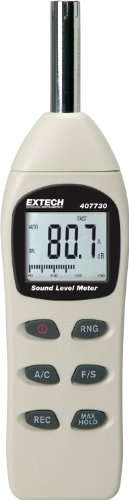
Extech 407730-NIST Sound Level Meter Review: Who It Is For, and Who Should Walk Away
This review explains what the Extech 407730-NIST measures, what its specifications mean in practice, and which buyers should choose a different instrument.
Read More→