As an Amazon Associate, Akermin earns from qualifying purchases. Product links on this page are affiliate links.
For most EV charger installation and fault work, P1 is the pick: the listing states a CAT III 1500 V rating, DC power measurement, a thin jaw for crowded enclosures and an iFlex flexible probe, which together cover the DC side of a charger and the awkward cable runs around it. P3 is the value alternative if your work is mostly high-voltage DC on solar and wind as well as EV chargers, because the listing claims a 2000 V DC and 2000 A AC/DC range, though it publishes no safety category. P5 is a general-purpose budget clamp for AC-side checks and basic diagnostics, but its listing does not state a CAT rating, so treat it as a low-voltage troubleshooting tool rather than a charger commissioning instrument.
Why an EV charger is not a normal clamp meter job
A domestic consumer unit sits at CAT II or CAT III 300 V. A DC fast charger and the battery side of a vehicle sit far above that, and the current is direct rather than alternating. A clamp meter measures current by sensing the magnetic field the conductor produces. On AC, the field reverses every half cycle, and a simple transformer jaw can pick that up. On DC the field is steady, so the meter needs a Hall-effect or fluxgate sensor and a circuit that can zero out the earth’s field and any nearby magnetic interference. That is why a cheap AC-only clamp reads zero on a DC cable no matter how much current is flowing.
The second difference is the safety rating. A charger cabinet can hold 400 V or 800 V DC and large stored energy. If the meter’s jaw or leads break down under a transient, the energy goes through the meter and into the person holding it. The CAT rating tells you what impulse the meter is designed to survive at a given working voltage. For EV charger DC work, a CAT III rating at 1000 V or 1500 V is the sensible floor. The listing for P1 states CAT III 1500 V. The listing for P3 states 2000 V and 2000 A but does not publish a safety category, which is a gap you should resolve with the manufacturer before relying on it.
What the listings actually publish
The table below uses only what each listing states. Where a figure is missing, it says so rather than guessing.
| Feature | P1 | P3 | P5 |
|---|---|---|---|
| Safety category | CAT III 1500 V | Not stated | Not stated |
| DC voltage range | Not stated | Up to 2000 V | Not stated |
| AC/DC current range | Not stated | Up to 2000 A | Not stated |
| True RMS | Not stated | Stated | Stated |
| DC power measurement | Stated | Not stated | Not stated |
| Flexible current probe | iFlex included | Not stated | Not stated |
| Jaw type | Thin jaw | Connected clamp | D-shaped, opens to 1.1 in |
| Ingress protection | IP54 | Not stated | Not stated |
| Wireless logging | Fluke Connect enabled | Not stated | Not stated |
| Non-contact voltage | Not stated | Not stated | Stated |
| Temperature | Not stated | Not stated | Stated, thermocouple included |
The pattern is clear. P1 publishes the safety and DC power data that matter for charger work. P3 publishes the biggest ranges but leaves the safety category blank. P5 publishes the widest feature list but no safety or DC current figures. None of the three listings publishes a DC current accuracy specification, which is the number you would want before trusting a reading for a commissioning report.
Jaw access, flexible probes and the enclosure problem
EV charger cabinets and the cable bundles feeding them are tight. A rigid jaw needs a straight run of conductor to close around, and in a crowded combiner box or a charger with stacked busbars there may be no such run. A thin jaw helps because it slips between cables that a fat jaw cannot reach. P1’s listing states a thin jaw for access to cables in crowded combiner boxes, and P5’s listing states a D-shaped jaw that opens to 1.1 inches. Those are different solutions to the same problem.
The other solution is a flexible current probe, often called a Rogowski coil or by Fluke’s name iFlex. It is a thin, flexible loop you wrap around a conductor, which means you can measure current in a cable that is already bent, bundled or buried behind other wiring. P1’s listing states an iFlex is included. P3’s listing says the clamp is connected, which implies a fixed jaw, and P5’s listing does not mention a flexible probe at all. If your charger work involves reading current on cables you cannot easily separate, the flexible probe is the feature that decides the purchase. There is a dedicated comparison of flexible probes on this site if you want to go deeper.
The three clamp meters worth considering for EV charger work
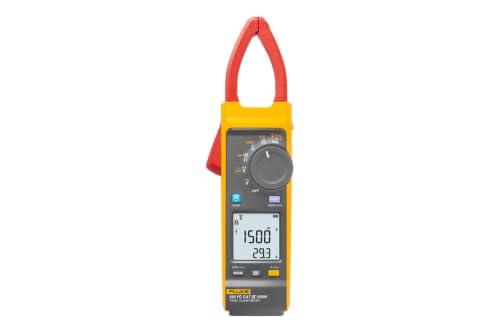
Fluke 393 FC Solar Clamp Meter
The only pick whose listing states a CAT III 1500 V rating alongside DC power measurement, a thin jaw and an iFlex probe, which is the combination EV charger DC-side work demands.
Klein Tools CL910
The listing claims the highest voltage and current ranges here, 2000 V DC and 2000 A AC/DC, with True RMS and a worklight, but it publishes no safety category, so verify that before trusting it near a live charger.
KAIWEETS Digital Clamp Meter
A compact True RMS clamp with a D-shaped jaw, NCV and temperature, useful for AC-side checks and general electrical troubleshooting, but the listing states no CAT rating or DC current accuracy.
The DC power feature and why it matters on a charger
Voltage and current tell you two separate things. Power tells you what the charger is actually delivering. On the DC side of an EV charger, power is the product of voltage and current, and if you measure the two separately you have to do the multiplication yourself and accept the timing error between the two readings. A meter with a DC power function does the multiplication internally and displays watts or kilowatts directly. P1’s listing states DC power measurement. P3 and P5 do not. For commissioning a charger, or for proving that a unit is derating under load, a direct power reading removes a step and a source of error.
The related feature is the audio polarity indicator and visual continuity, both stated for P1. On a DC installation, getting polarity wrong can damage equipment or, at worst, create a fault. An audible indication that you are on the correct polarity, without having to look away from the terminals, is a small thing that matters when you are working in a tight cabinet. Visual continuity is useful for checking protective bonding and earth paths, which is part of any charger installation sign-off.
Where a clamp meter stops being the right instrument
A clamp meter measures current. It does not test insulation resistance, it does not perform a formal earth loop impedance test, and it does not replace the dedicated tester your commissioning procedure may require. If your sign-off paperwork calls for insulation resistance at 500 V or 1000 V DC, or for a residual current device trip test, you need the instrument that does those tests, not a clamp. A clamp meter is a diagnostic and monitoring tool, not a compliance tester.
It is also not an alarm. None of the three picks will warn you that a charger is overheating or that a cable is drawing more than it should. For that you need either a logging meter left in place or a thermal camera to find the hot joint. P1’s listing states Fluke Connect software is enabled, which allows measurements to be logged and trended, and that is the closest any of these comes to continuous monitoring. If you are doing fault-finding on a fleet of chargers, a clamp meter plus a thermal camera is a more useful pair than a clamp meter alone. There is a separate guide to thermal cameras for electrical work on this site.
Practical notes before you buy
Check three things against your own procedure. First, the safety category and working voltage. If the listing does not publish a CAT rating, as with P3 and P5, ask the manufacturer for it in writing before you take the meter anywhere near a live DC bus. Second, the DC current range and accuracy. None of these three listings publishes a DC current accuracy figure, which is unusual for instruments aimed at this work, so treat the claimed ranges as maximums rather than as precision specifications. Third, the accessories. P1 includes an iFlex probe. P3 and P5 do not list one. If you need to measure current on bundled cables, that inclusion is the difference between a meter that works in the cabinet and one that does not.
For a broader view of DC-capable clamps, including models not listed here, see the comparison of clamp meters with DC power measurement. For solar and battery work that often sits alongside EV charging, the solar clamp meter guide covers the irradiance and temperature functions that P1’s sibling kit adds.
Recommended Tools


Products shown because their documented specifications fit this guide. Price and availability are on Amazon and can change.
Frequently Asked Questions
Can I use my existing AC clamp meter on an EV charger?
Only on the AC input side, and only if its safety category suits the voltage. An AC-only clamp will read zero on the DC output of a charger because it has no Hall-effect sensor for steady magnetic fields. For the DC side you need a meter that explicitly states DC current measurement.
What safety category do I need for EV charger work?
For the DC side of a charger, CAT III at 1000 V or 1500 V is the sensible minimum. P1's listing states CAT III 1500 V. P3 and P5 do not publish a category, so you should confirm it with the manufacturer before using either near a live DC bus.
Is a flexible current probe necessary?
Not always, but it helps when cables are bundled or hard to separate. P1's listing includes an iFlex probe. P3 and P5 do not list one. If you regularly measure current in crowded charger cabinets, the flexible probe is the feature that decides the purchase.
Can these meters log data for a commissioning report?
P1's listing states Fluke Connect software is enabled, which allows measurements to be logged and trended. P3 and P5 do not publish logging or wireless connectivity. None of the three listings states a memory capacity or a download format.
Do I need a separate insulation tester as well?
If your commissioning procedure calls for insulation resistance testing, yes. A clamp meter measures current and voltage; it does not perform insulation resistance or earth loop impedance tests. Those require a dedicated tester.
Which pick is best for a solar installer who also does EV chargers?
P3's listing claims the highest voltage and current ranges, 2000 V DC and 2000 A AC/DC, which suits large solar strings as well as charger DC work, but its safety category is not stated. P1 is the safer documented choice for charger cabinets, and its sibling kit adds irradiance and temperature functions for solar.
Affiliate disclosure: Akermin earns a commission from qualifying Amazon purchases made through links on this page. Our editorial picks are based on documented specifications and owner feedback, not commissions.