As an Amazon Associate, Akermin earns from qualifying purchases. Product links on this page are affiliate links.

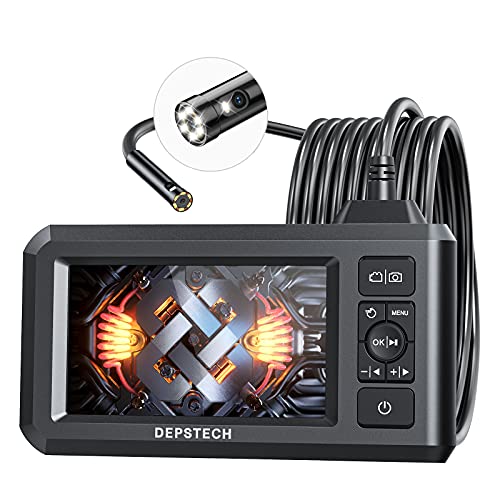
DEPSTECH · DEPSTECH 2K Endoscope Camera with Light, Dual Lens 2560P Phone Borescope | Inspection Scope for iPhone Android, Semi-Rigid Snake Cable, 9LEDs, IP67 Waterproof, for Automotive, HVAC, Plumbing, Mechanic
View on AmazonPrice and availability are shown on Amazon and can change at any time.
A phone powered dual lens borescope on a 7.9 mm head: front and side cameras capturing 2560 by 1440, an 80 degree field of view, a 16.5 ft semi rigid cable, IP67, eight plus one adjustable LEDs, Type-C and Lightning connectors for iOS 11 and Android 9 upward, and the DEPSTECHCAM app with 2 times zoom and 90 degree rotation. The resolution advantage over the 1080P standard in this category is genuine. The phrase 80 percent sharper is a pixel count restated, and worth understanding before it influences a purchase.
The resolution claim is real, and it matters here
Almost everything in this category captures 1920 by 1080. This listing states 2560 by 1440 as the lens resolution, with 3.69 million pixels, and nothing in the text suggests upscaling. On the face of it that is a genuine step up rather than a software one, which is a welcome change from the thermal camera category where super resolution usually means interpolation.
Extra pixels do real work on a borescope, more than on a thermal camera. What you are usually trying to judge is fine: whether a crack is a crack or a casting mark, whether a thread is damaged or dirty, whether corrosion has pitted a surface or stained it. All of that is detail at the limit of what the optics can resolve, and more sampling helps.
Set against that is the honest caveat about every borescope: the lens, the illumination and the focus window limit what reaches the sensor. A higher pixel count on a small cheap lens looking at a surface outside its focus window produces a very detailed photograph of a blurry image. Resolution is necessary and not sufficient.
The arithmetic behind 80 percent sharper
The first bullet states that the 2560 by 1440 lens is 80 percent sharper than standard 1920 by 1080, and gives 3.69 million pixels in the same sentence.
Those two figures explain each other. 1920 by 1080 is 2.07 million pixels. 2560 by 1440 is 3.69 million. The ratio is about 1.78, so there are roughly 78 percent more pixels, which rounds to the 80 percent in the copy.
The problem is the word sharper. Sharpness relates to how finely detail is resolved across the frame, which follows the linear dimension, not the pixel area. From 1920 to 2560 is a 33 percent increase in linear resolution. A feature that was four pixels wide is now about five, not seven.
So the correct statement is 80 percent more pixels, or about a third more linear resolution. Both are improvements and neither is 80 percent sharper. We are spelling this out not to be pedantic but because pixel area comparisons are the most common way resolution claims get inflated across this whole category, and once you see the pattern you can read every listing more accurately.
The same bullet calls this the first 2K resolution endoscope on the market. There is nothing in the listing to support that, and it is not a claim we can check. The resolution figure does not need it.
Two fixed views, called 360 degrees
The second bullet describes front and side cameras that eliminate blind spots, switched instantly in the app, for complete 360 degree inspection.
Two cameras at fixed angles are a substantial improvement on one, and switching in software is instant and reliable. But two directions are not 360 degrees of coverage. Between the forward cone and the sideways cone there are angles neither lens sees, and aiming the side camera at a chosen spot means rotating a 16.5 ft semi rigid cable, where a twist at the handle does not reliably become a twist at the tip.
What two lenses genuinely buy you is the pipe wall without a mirror and without a mechanism. That is worth having. It is not the same as a steerable head, which is the only way to choose your viewing direction after insertion, and the articulating units are a different purchase for a different job.
The 80 degree field of view is narrower than the 170 degree figures quoted elsewhere in this category. Narrower means less of the surroundings per frame and more pixels on whatever is in the middle, which is consistent with a unit whose argument is detail.
Phone powered, with the usual consequences
| Specification | Published in the listing |
|---|---|
| Capture | 2560 by 1440, 3.69 million pixels |
| Lenses | Front and side, both on a 7.9 mm head |
| Field of view | 80 degrees |
| Cable | 16.5 ft, 5 m, semi rigid |
| Protection | IP67 |
| Lighting | Eight plus one adjustable LEDs |
| Platform | Type-C and Lightning, iOS 11.0 plus, Android 9.0 plus |
| App features | Photo and video capture, 2 times zoom, 90 degree rotation |
| Accessories | Hook, magnet, threaded protective cap |
| Focus range | Not stated in the listing bullets |
| Screen | None, uses the phone |
| Battery | None, drawn from the phone |
Supplying both Type-C and a Lightning adapter in the box is the right decision and worth noting, since several phone attachments in this category sell the adapter separately and mention it quietly.
The missing focus range is a specific disappointment because the same brand publishes both focus windows on its DS300 handset. The information clearly exists. For a camera whose entire argument is detail, the distance at which that detail resolves is the second most important number on the page, and it is absent.
The eight plus one LED layout implies eight on the front lens and one on the side. That is a reasonable inference and it means the side view is considerably more dimly lit than the front, which the listing does not say and which affects how usable the side camera is in a dark pipe.
The recommendation
Buy this if image detail is the point and you are content to use your phone as the screen. For examining a surface closely, judging a crack, documenting corrosion for someone else to look at, the higher capture resolution plus a narrower lens plus dual views is a coherent and well chosen set of trades.
Do not buy it expecting 80 percent better pictures, because that is a pixel count restated. Do not buy it if you need the tool to work without a phone, or if your access needs something slimmer than 7.9 mm. And if the side view is important to your work, factor in that it is lit by a fraction of the LEDs the front view gets.
Recommended Tools

Products shown because their documented specifications fit this guide. Price and availability are on Amazon and can change.
Frequently Asked Questions
Is 2560 by 1440 genuinely better than 1080P here?
Yes, and it is a real difference rather than an interpolated one, since the listing presents it as the lens resolution rather than an upscaled figure. 2560 by 1440 is 3.69 million pixels against 2.07 million for 1920 by 1080. On a borescope that extra detail shows up on fine features: hairline cracks, thread damage, the texture of corrosion. It is the clearest technical advantage in this listing.
What does 80 percent sharper mean?
It is a pixel count comparison dressed as a sharpness claim. 3.69 million against 2.07 million is about 78 percent more pixels, which is almost certainly where the figure comes from. Sharpness is not defined that way: linear resolution rises by about a third, from 1920 to 2560 across the frame, not by 80 percent. The image is better. It is not 80 percent better by any measure anyone uses.
Is the first 2K endoscope claim verifiable?
No. The listing states it is the first 2K resolution endoscope on the market, and nothing in the listing supports or dates that. Treat it as marketing. The resolution figure stands on its own without the claim.
What do the dual lenses give you?
Front and side cameras on the same 7.9 mm head, switched in the app, which the listing describes as eliminating blind spots for 360 degree inspection. The 360 degree framing is loose, since two fixed directions are not full coverage, but two views beat one and a mirror. The side camera handles pipe walls without any mechanism to jam.
What is missing?
The focus range for either lens, which is notable because the sibling DS300 from the same brand publishes both. Also no battery, because it draws from the phone, and no screen, so a charged phone with the DEPSTECHCAM app is part of the tool.
Affiliate disclosure: Akermin earns a commission from qualifying Amazon purchases made through links on this page. Our editorial picks are based on documented specifications and owner feedback, not commissions.