As an Amazon Associate, Akermin earns from qualifying purchases. Product links on this page are affiliate links.
Short answer: the EN300 suits a survey where you need several numbers from each room and none of them need to be exceptional. The 605i suits humidity and temperature work specifically, and the bendable probe plus automatic dew point make it the better instrument for anything to do with ducts and condensation.
What Each Listing States
| Item | Extech EN300 | Testo 605i |
|---|---|---|
| Parameters | Air velocity, light, humidity, temperature, sound level | Relative humidity, temperature |
| Derived values | Not stated in the bullets | Dew point and wet bulb, calculated automatically |
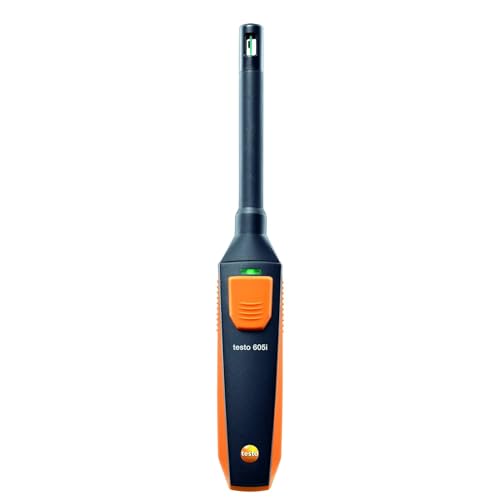
| Probe | Built into the handheld body | Compact head bendable to 90 degrees |
| Connectivity | Not stated in the bullets | Bluetooth to iOS and Android, live data feed |
| Display | Large LCD with multiple parameters, data hold | Readings on the phone or tablet |
| Stated uses | Labs, HVAC adjustment, noise and light audits in classrooms and offices | Rooms, ducts, crawl spaces, registers, environmental chambers |
The Honest Case For and Against a Combination Meter
A five in one meter is an excellent buy for someone who needs occasional numbers across several parameters and does not want five instruments in a bag. Walking a building and recording temperature, humidity, light level, noise and airflow in each room is a real job, and a single tool with one battery and one case makes it practical.
The cost is that each individual measurement is usually less capable than a dedicated instrument, and the sensors are all in one body, which means all of them have to be where the meter is. That is the limitation the Testo design attacks directly.
Probe Shape Decides What You Can Measure
Humidity and temperature in a duct are among the most useful numbers in HVAC, and they are impossible to take with a sensor buried in a handheld body. The 605i bends to 90 degrees so the head goes through a test port while the instrument stays out of the airstream. That single mechanical decision is why a dedicated probe beats a combination meter for duct work, regardless of what the specification sheets say.
Automatic Dew Point Prevents Mistakes
Dew point is the number that tells you whether condensation will form on a surface, and it is what actually matters for mould, corrosion and comfort complaints. Calculating it from temperature and humidity by hand or from a chart is error prone on a ladder. The 605i doing it automatically, and adding wet bulb, removes a step that people get wrong. Our humidity checker shows the same relationship if you want to explore it.
The Bluetooth Question
The 605i has no display of its own; readings appear on a phone or tablet. That is a genuine advantage when the probe is somewhere you cannot see, and a genuine annoyance when your phone is in another pocket, the battery is low or the app has updated itself. Decide which of those you will encounter more often. A meter with its own screen, like the EN300, never has that problem.
Who Buys Which
- Building surveys, classrooms, offices: EN300, for five numbers per room.
- HVAC duct and register work: 605i, for the probe and dew point.
- Damp and condensation investigation: 605i.
- Simple room monitoring: neither; a fixed hygrometer such as the TempPro TP50 is enough.
How We Research
All figures come from the manufacturer listings. We did not run laboratory tests and publish no measurements of our own. Ranking in the environmental monitoring device roundup.
Recommended Tools

Products shown because their documented specifications fit this guide. Price and availability are on Amazon and can change.
Frequently Asked Questions
What does the EN300 measure?
The listing states five parameters in one device: air velocity, light intensity, relative humidity, temperature and sound level, with a large LCD and data hold.
What is the 90 degree bendable probe for?
Reaching into ducts, registers, crawl spaces and chambers. The listing states the compact probe head bends to 90 degrees, which lets the instrument sit outside while the sensor measures inside a duct.
Does the 605i calculate dew point?
Yes. The listing states it measures relative humidity and temperature and calculates dew point and wet bulb temperature automatically, which saves the psychrometric arithmetic on site.
Which is better for an HVAC technician?
The 605i for duct and register work, because of the probe shape and the automatic calculations. The EN300 if you also need airflow, light and noise on the same visit, such as a building survey.
Affiliate disclosure: Akermin earns a commission from qualifying Amazon purchases made through links on this page. Our editorial picks are based on documented specifications and owner feedback, not commissions.
Related Guides

TempPro TP50 vs Testo 605i: Room Hygrometer or Professional Probe?
The TP50 states 2 to 3 percent relative humidity and 1 F accuracy with a comfort icon and high and low records. The 605i is a Bluetooth probe with a bendable head and automatic dew point.
Read More→
Best Environmental Monitoring Devices: 12 Powerful Picks for Complete Indoor Testing
Twelve devices sorted by what each listing states: WiFi and USB temperature loggers, single-use shipment recorders, an NDIR CO2 meter and a particle counter.
Read More→
Best Airflow Meters: 9 Professional Picks for Accurate HVAC Testing
Nine airflow instruments sorted by what each listing states: a balancing flow hood, hot wire probes for in-duct velocity, and vane anemometers with CFM.
Read More→